Out of Hand’s Equitable Dinners are back to start the conversation about race
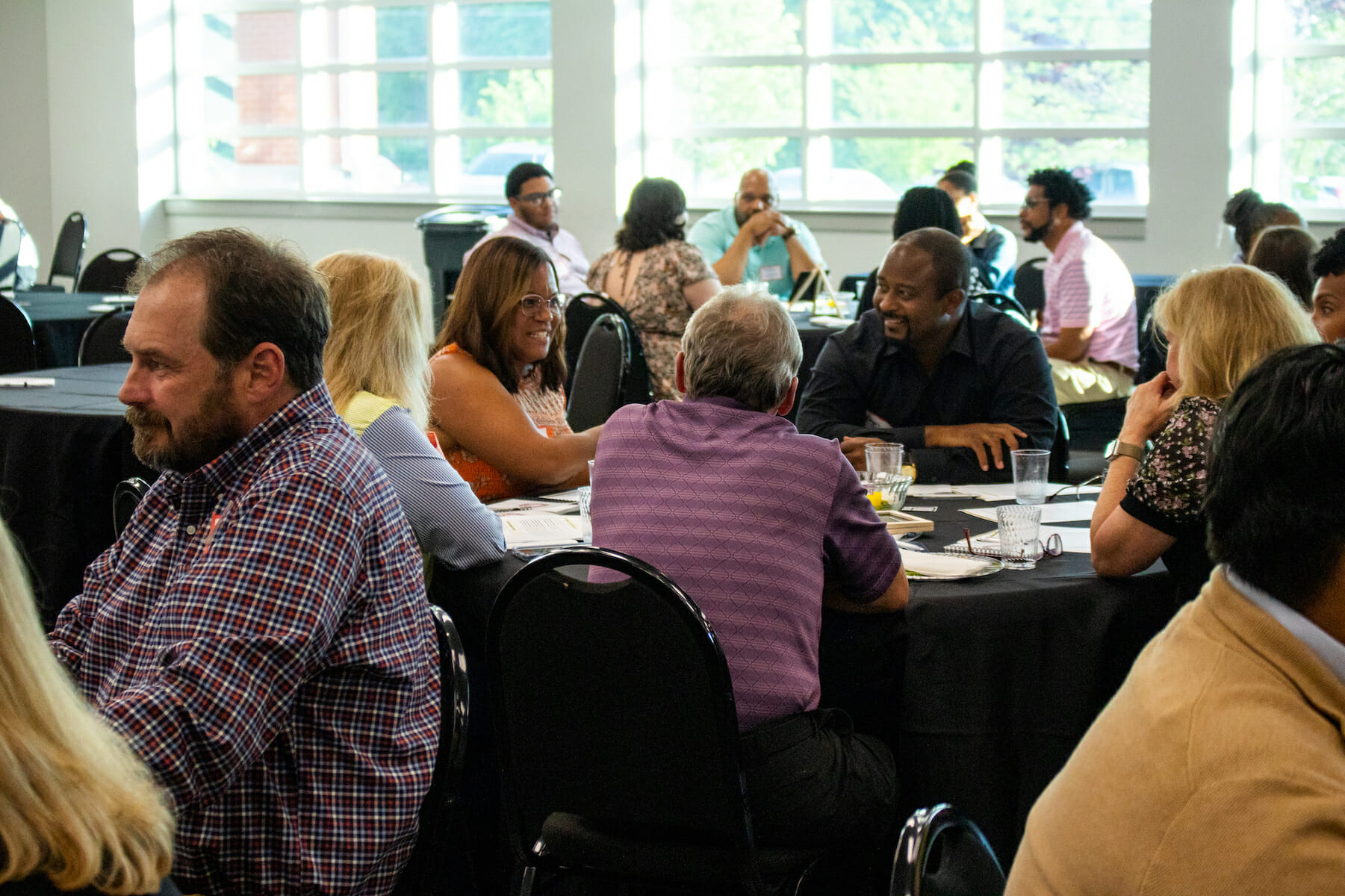
Out of Hand Theater and its community partners will relaunch in-person Equitable Dinners on September 18, hoping to engage 5,000 people at 500 tables across Atlanta in moderated, mind-changing conversations about racism by beginning the meal with a short play. Dinners and performances will continue to be held throughout October, organizers said.
On September 18, events are taking place from 10 a.m. to 6 p.m. in people’s homes, places of worship and community centers. Different Black actors will perform the same monologue, Welcome to Normal by Kennesaw State University theater professor Marlon Burnley, at all locations.
The script explores the memories of a Black adult looking back upon his late parents’ values regarding history and the racism he faced from classmates at a predominantly White high school.
“It’s going to be performed by people of different genders and ages,” Burnley said. “So it’ll be really cool to see how that affects the piece. We’re not too worried about all of these appearing the same. All of them should be unique experiences. The message is the same.”

by Marlon Burnley, will be performed at all 2022 Equitable Dinners.
Burnley, who last appeared onstage locally in Red Speedo at Actor’s Express, will be one of the performers delivering the monologue throughout the day.
“It’ll be nice to connect with this piece,” he said. “A lot of what I built in this script is pulled from actual life experience, so I’m excited to see how it comes out from me. Up until this point, I’ve just been directing other actors and having them perform it. I’ll be performing at three different venues, including the National Center for Civil and Human Rights.”
Out of Hand’s partners for the live events include the National Center and the Fulton County Remembrance Coalition. The focal point for the discussion after the play will be the 1906 Atlanta Race Massacre, the history of racial violence and how it continues to echo in the present.
The massacre took place over four days, when a mob of 10,000 White men, angered by a number of factors including yellow journalism, rape accusations and a resentment of African Americans enjoying greater access to voting rights and economic opportunity, destroyed many Black-owned businesses and left at least 25 people dead. No one was convicted of the murders.
Adria Kitchens, the director of equity and activism for Out of Hand, said there is a direct link between the nation’s violent past and the systemic issues we face as a society today.
“By bringing people together from different backgrounds to acknowledge that past and engage in vital conversations around these issues, we can inspire them to be a force for healing in their own communities and beyond,” she said.
This is the first series of in-person events from Equitable Dinners Atlanta since the 2020 pandemic outbreak. Out of Hand gained national attention for virtual events, which followed the same basic structure as the dinners, from The New York Times. Live events began in August 2019, with 120 dinners for 1,200 attendees throughout Decatur. Continuing the dinners in person was always the intention since they carry a different energy, Kitchens said.
“It feels amazing when you get to be in person, able to have conversation and sit over a meal and just feel the energy of other people,” she said. “You have to be more intentional about that when you’re online, but it’s an automatic experience that happens when you’re in person.”
The formula for Equitable Dinners works to evoke empathy and action. First, the 10-minute original monologue is presented to the audience. Then, the audience is presented with academic information as a way of contextualizing the play. Finally, dinner is served, and the audience is prompted by a facilitator at every table to hold an open, honest conversation about what they just watched.

Kitchens said theater is a means of involving the audience in experiences they might recognize in their own lives or showing them perspectives they’ve never considered before. The monologue, set in the present day, amplifies the issues from history of racial violence.
“Out of Hand always has this model of art, information and conversation, and we married it with this dinner model, which is much more intimate than even a talkback,” she said. “When you’re sitting around a table and it’s not as formal and you’re closer, you can have a more involved conversation, especially if you have a facilitator there guiding the questions. ‘What did you feel when you saw that piece? What did you experience? What is your personal experience that came up?’”
The resulting conversations are surprising, running the gamut from people who face racism every day to others who rarely recognize it, she said.
“The power of it is that we are sharing the same play and the same questions guided by a facilitator, but every conversation will be different because all the people at the tables will be different,” she said. “That’s the beautiful thing. You get so many different responses. You think you might get the same thing, but you don’t.”
She said modern society and culture are more willing to reckon honestly with the past, rather than to hide its uglier parts. The Equitable Dinners conversations are aimed at finding solutions to the systemic problems we all should address.
“There’s such a huge shift, even within a family, in what we’re willing to share with the world in our culture because it used to be that you had to hide all of these things about who you really are,” Kitchens said. “There’s a big shift in the culture that we’d rather not hide those things because we realized it’s unhealthy emotionally and physically. I think it’s the same thing in society. There’s a real hunger to admit who we are. This is not about blaming anyone. We’re not here to blame anybody. None of us who are here now created any of the things that are impacting us … We’re inviting people to recognize that there’s an issue and look at how we can resolve it.”
If there’s a system where some people are being harmed and others are benefiting from it, Kitchens said we should want to fix that.
“Shouldn’t we want to do something about that?” she asked. “Especially if we’re a society that really cares about people.”
Burnley said the structure of Equitable Dinners encourages him.
“For me, I think one of the things that I wish we did more in the theater is follow up every performance with a conversation, especially if it’s hard-hitting stuff,” he said. “If it’s triggering and if it focuses on disenfranchised people, we should definitely unpack that. It’s our responsibility as makers to open up that door and allow people to reflect. When we don’t do that, it’s like a missed opportunity. How they build the Equitable Dinners gives me hope that other theaters will follow suit, at least in the way that they conduct conversations.”
To find a location where a dinner is being held, visit Equitable Dinners Atlanta online.
::
Benjamin Carr, a member of the American Theatre Critics Association, is an arts journalist and critic who has contributed to ArtsATL since 2019. His plays have been produced at The Vineyard Theatre in Manhattan, as part of the Samuel French Off-Off Broadway Short Play Festival, and the Center for Puppetry Arts. His novel Impacted was published by The Story Plant in 2021.
STAY UP TO DATE ON ALL THINGS ArtsATL
Subscribe to our free weekly e-newsletter.

PLEASE SUPPORT ARTSATL
Your Gift Sustains the Coverage You Count On!
Related Posts