
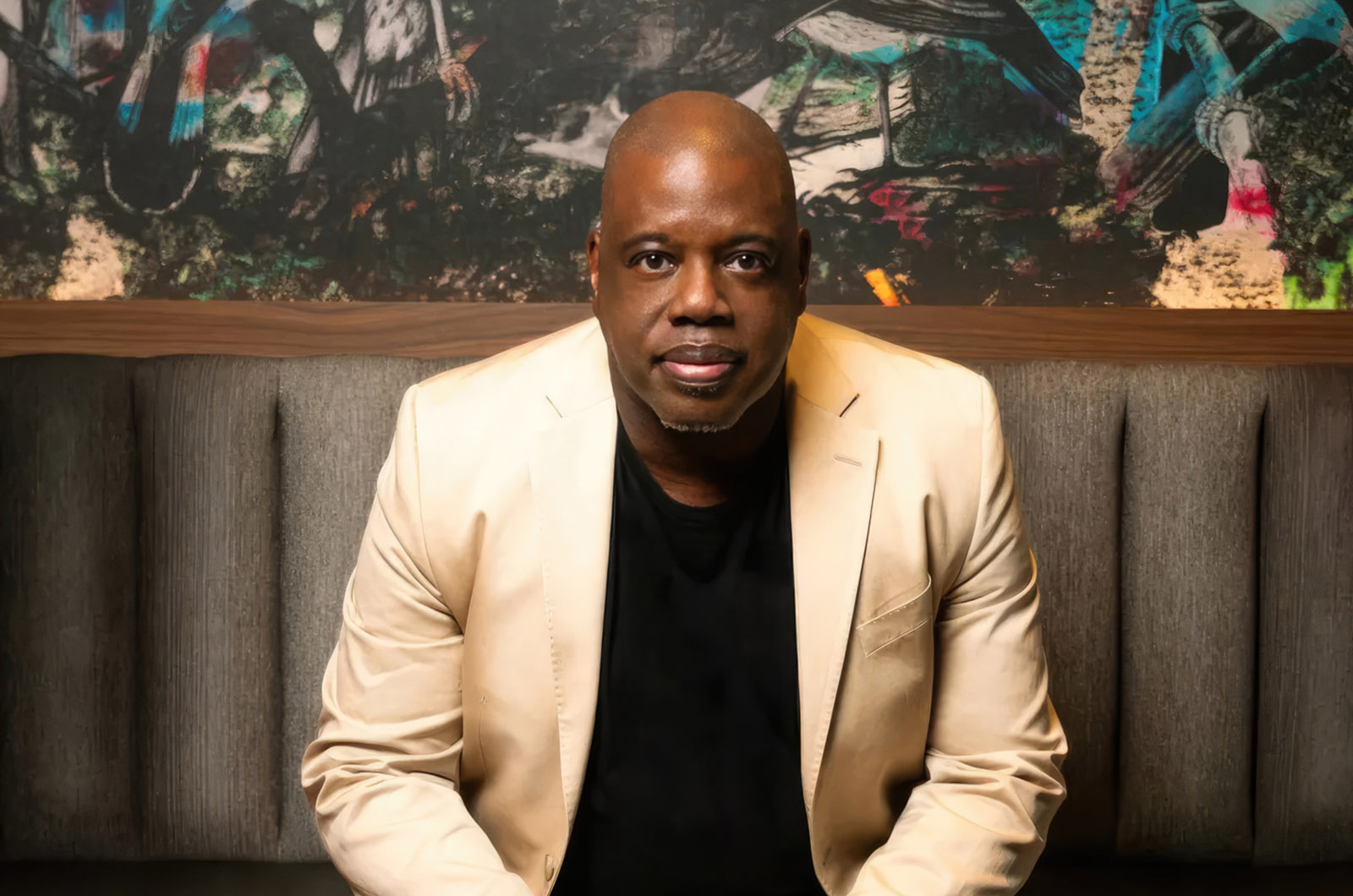
Novelist Doug Jones on why ‘Fantasies of Future Things’ was a 30-year journey
Doug Jones began his debut novel, The Fantasies of Future Things, while still in graduate school. Thirty years later, it’s finally seeing the light of day.
::

Doug Jones’ novel, The Fantasies of Future Things, took nearly 30 years to make it to print. And not for lack of effort.
Jones began writing his book during his MFA program at Columbia University in the late 1990s. “I wrote this book for me,” Jones shares in an interview. “We have so few images of the intimacy of Black gay men, how we love, how we interact. I wanted to read something in which I could recognize myself.”
Soon after graduation, Jones sent the manuscript out to prospective publishers and waited. The responses finally came back: “Great writer; interesting story; don’t know what to do with it. Maybe he should write something else.”
Years later — jobs in economic development and real estate, more rewrites but still no takers. Jones glanced one day at an email on its way to the trash, inviting him to a pitching session at Columbia. He was now living in Atlanta but would be in New York City around that time. So maybe go, he thought.
Before the event, organizers helped writers hone their pitch and instructed them to tell it to everyone they met. While chatting with other writers over good food and liquor, an agent came by and Jones grabbed his chance: “Moonlight meets Brokeback Mountain,” he blurted out. The agent was intrigued.
Jones sent her the first 50 pages, and, two days later, she asked for the whole novel. But this only began a process of more rewrites, until eventually she connected him to the buzzy, young editor Yahdon Israel at Simon & Schuster, known for his radically transparent and style-conscious approach to book editing.
But then more questions for Jones, whose novel features multiple shifts in chronology and numerous erotically charged scenes. Why all the time jumps? Too much sex? Two more years of rewrites until finally, The Fantasies of Future Things took its final shape and will be released on April 23, 2025. “Thirty years to be an overnight success,” Jones laughs.
::
When Jones first began work on the novel in the late 1990s, Toni Morrison, Alice Walker and Terry McMillan all were dominating the best seller lists. Jones talked with his father about the lack of Black male authors being read widely and asked: “Where are our Baldwin, Hughes and Richard Wright?” His father replied: “He’s at the tip of your pen.”

So Jones began writing a tale of Atlanta in the lead-up to the 1996 Olympic games and two men swept up in changes as they work for a gentrifying real estate developer. The novel captures a moment in time and a search for identity, both political and personal.
Jones cites Black gay men writing in the late 1980s — authors including Joseph Beam and Essex Hemphill — as deep influences. These men bravely chronicled their lives in anthologies such as In the Life, Other Countries and Brother to Brother. “We lost most of them to AIDS,” Jones reflects. “Imagine all the work they took with them.” And so “I write into that tradition.”
When asked about E. Lynn Harris, the much-lauded best-selling Black gay author who first came on the scene in 1991 with his book Invisible Life, Jones gives a more complicated answer: “I’ve read his work and my question is ‘who is he helping?’ Those characters in E Lynn’s books lived in secrecy. It’s like you peek behind the curtain, see what’s there and put it back. He’s not one of my literary north stars,” Jones summarizes frankly.
The Fantasies of Future Things is an ambitious book, interweaving a political and personal story in which a city’s search for growth and identity mirrors that of its main characters. The novel adeptly switches between points of view and time periods, evoking how each of our histories is layered into the present and helps shape and determine the future.
Atlanta has a proud history of books reflecting on the city, from Baldwin’s The Evidence of Things Not Seen, to Toni Cade Bambara’s These Bones Are Not My Child, to — more recently — Tayari Jones’ Leaving Atlanta and An American Marriage. With his book, Jones jostles to claim his place in this lineage, by sharing his own set of messy yet hopeful stories. The work pries into an Atlanta “Too Busy to Hate” and gives us a glimpse into what lies beneath.
Jones will hold an author event on April 23 at the Auburn Avenue Research Library.
::

Alex Burger is an author, playwright and screenwriter. His work includes South Africa’s most popular TV drama Umlilo, two sold-out plays in London and Johannesburg and projects in Hollywood. He’s an adviser to the World bank, has worked in 64 countries and grew up performing in a magic show cult.
STAY UP TO DATE ON ALL THINGS ArtsATL
Subscribe to our free weekly e-newsletter.

