Not flat; not white; not to be missed: ‘The Art of Paper’ at the Zuckerman Museum
The Art of Paper: Selections of Handmade Paper Works from the Collections of Jordan D. Schnitzer and His Family Foundation is currently on view at the Bernard A. Zuckerman Museum of Art at Kennesaw State University. The exhibition, curated by Brett Littman with co-curators Sue Gosin and Cynthia Nourse Thompson, features 66 works drawn exclusively from the Schnitzer collection, one of the country’s largest private print collections, with over 22,000 pieces.
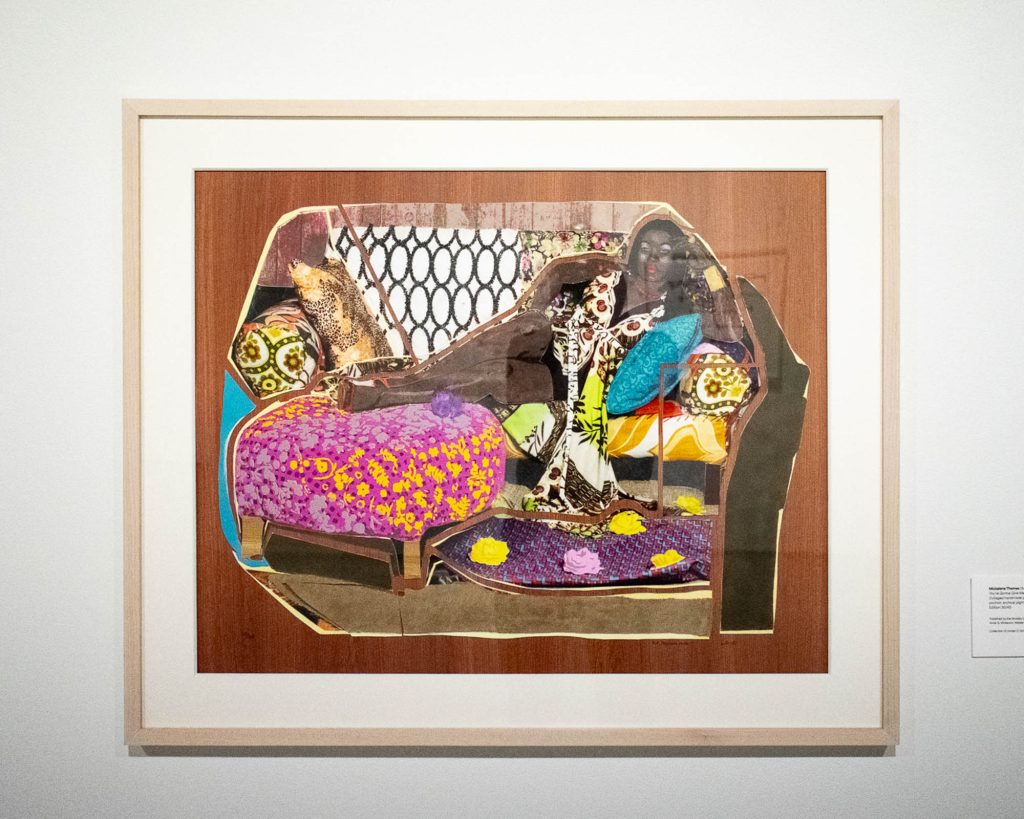
The roster is remarkable: Helen Frankenthaler, Frank Stella, Chuck Close, Jasper Johns, Robert Rauschenberg, James Rosenquist, Judy Chicago, Louise Bourgeois, Louise Nevelson, Ed Ruscha, Sonya Clark, Leonardo Drew, Sam Gilliam, Glenn Ligon, Mark Bradford, Mickalene Thomas, Mel Bochner, Ellsworth Kelly and Richard Tuttle — just to name a few. These are artists whose work you might expect to encounter at major national museums, and here they are at Kennesaw State University.
The exhibit is organized into five thematic sections — Pulp as Form, Fiber/Thread, Mimesis, Dimensionality and Historical — each exploring a different aspect of handmade paper as a medium. This is among the most significant exhibitions to come to Atlanta in recent memory, and its true achievement extends beyond the works themselves to the curatorial relationships that brought them here.
With artists of this caliber, the works speak for themselves. What distinguishes this exhibition is curatorial.
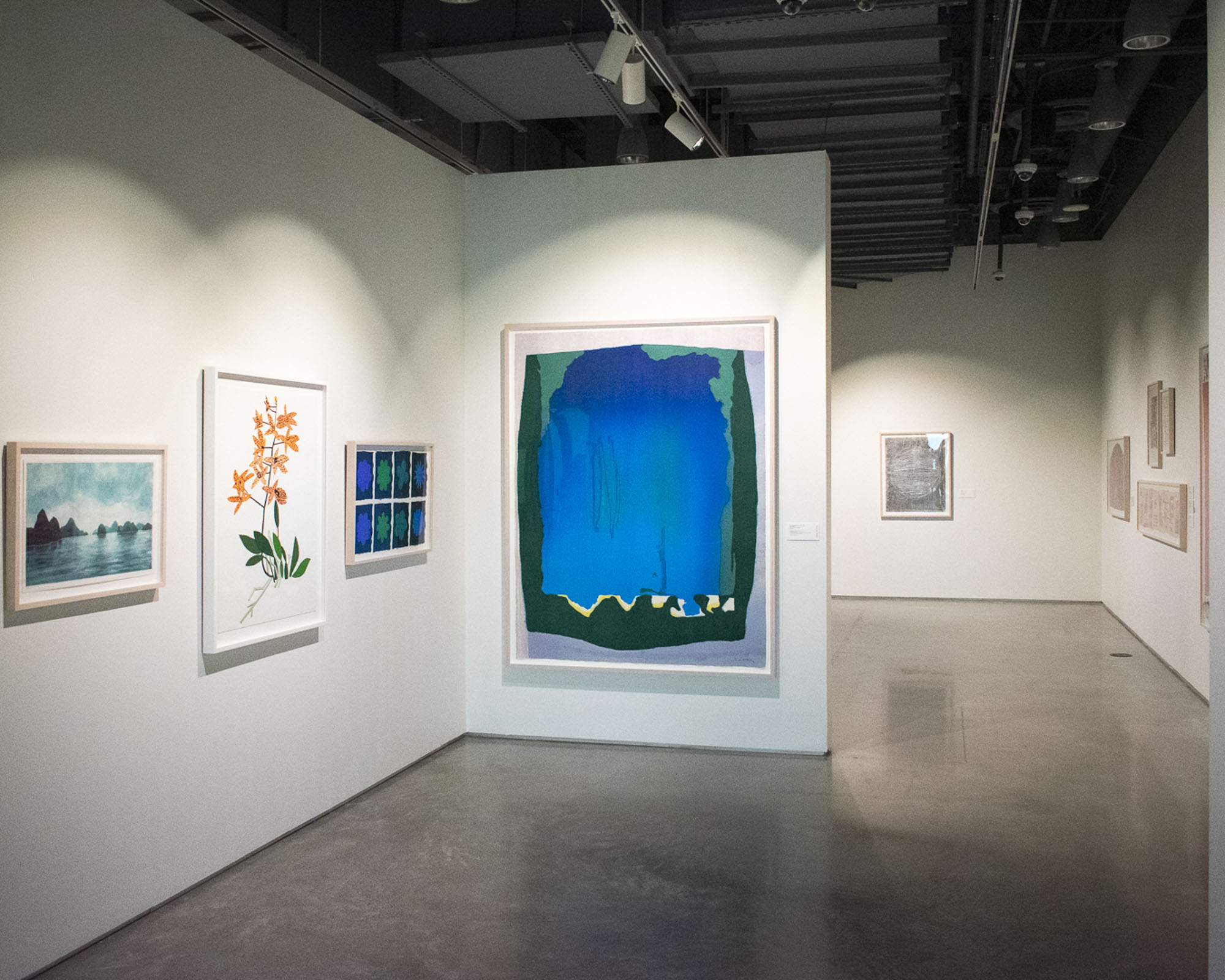
Consider the most natural concern with a show about paper: that it will be white and austere. It is not.
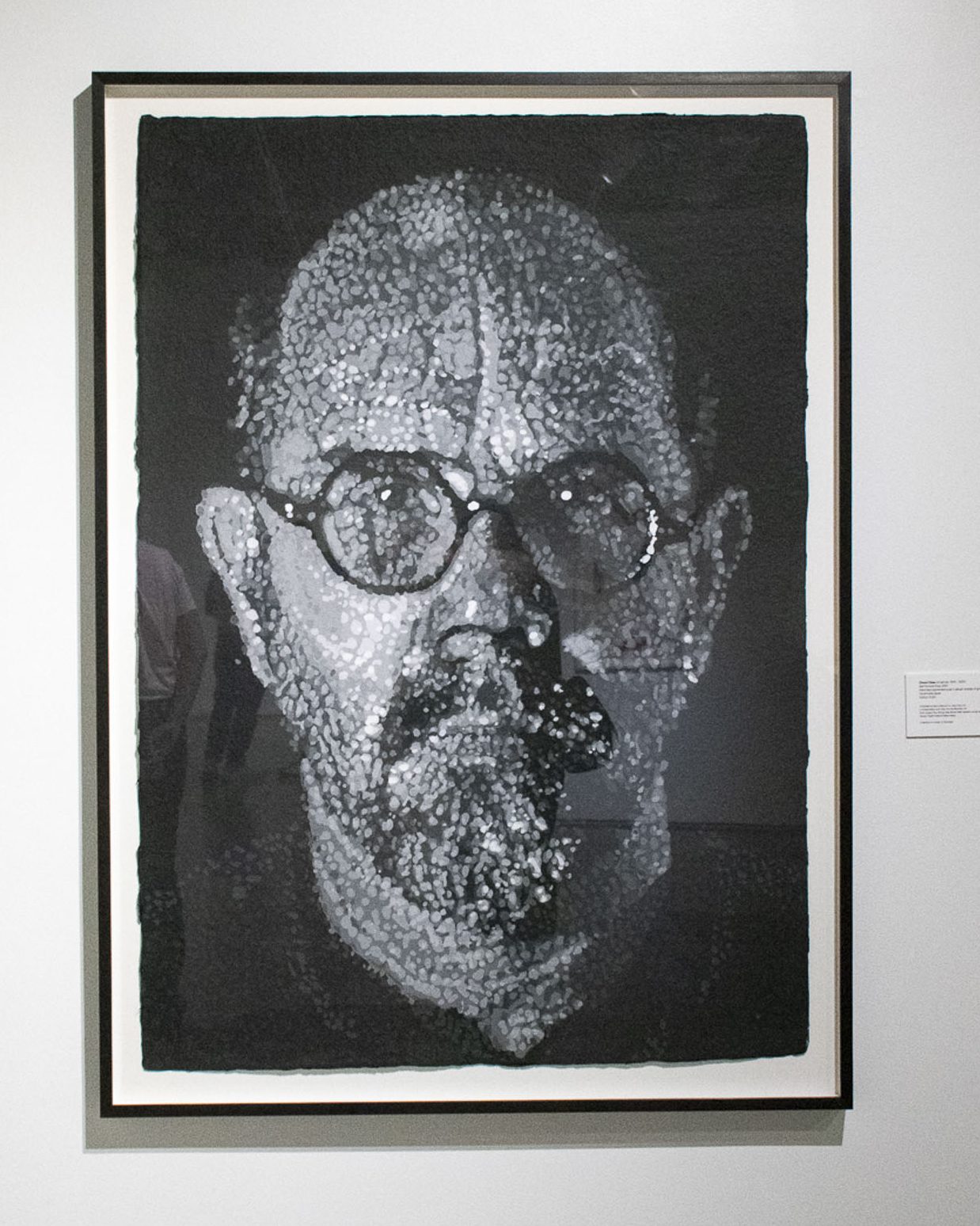
The Pulp as Form section is the first the viewer encounters, and Frankenthaler’s Freefall, a woodcut on hand-dyed paper in deep blues and greens, sets the tone. The exhibition is full of bold, saturated color, so much so that Close’s Self-Portrait/Pulp registers as one of the most striking pieces in the room despite being wholly grayscale. The portrait is not drawn or painted on paper. It is made of paper: 11 shades of gray pigmented pulp, each stenciled into the sheet to form a single continuous surface. It’s a grayscale work that commands attention precisely because of the chromatic richness that surrounds it.
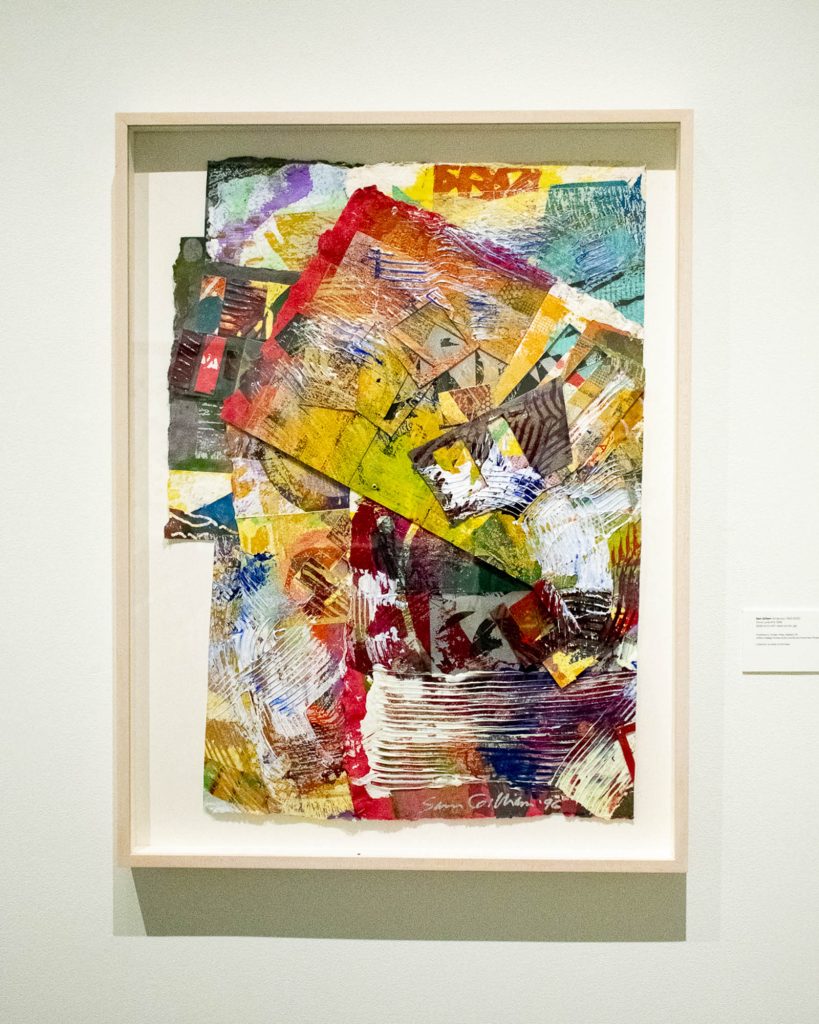
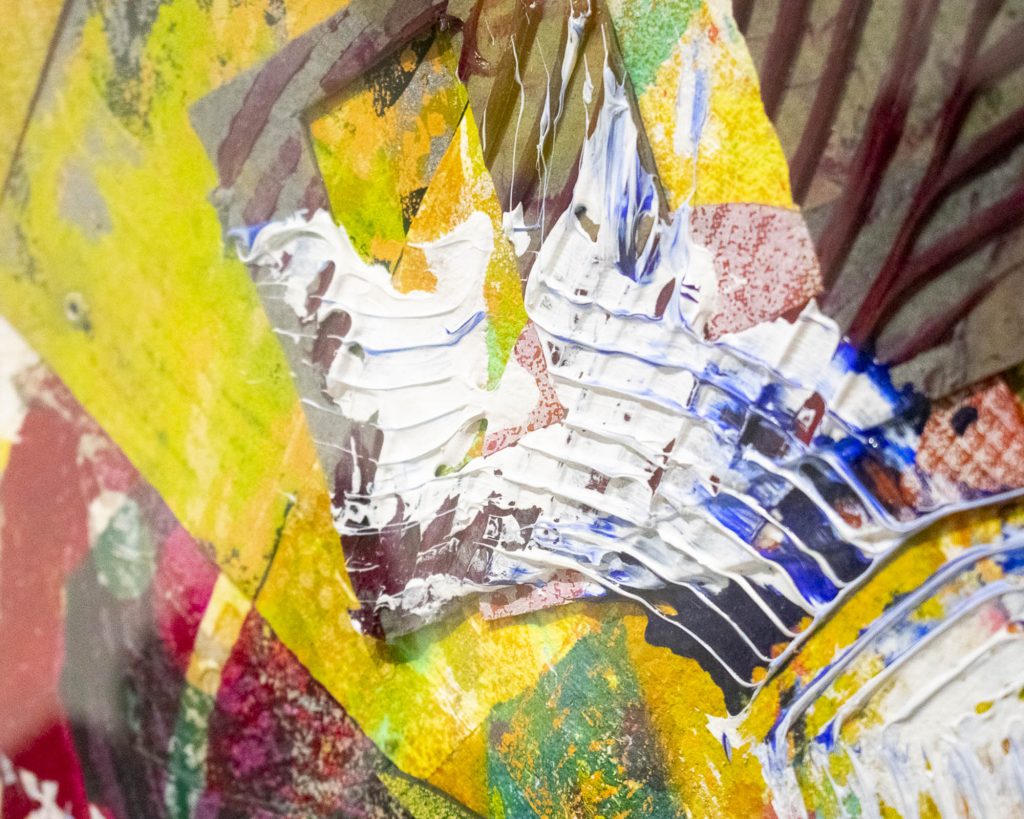
An equally natural assumption is that paper is flat. The Dimensionality section exists to correct this. Sam Gilliam’s Snow Lane #13 is a relief print in which the raked acrylic gel achieves a surprising depth, casting shadows across the rich pigments beneath and creating a genuine sense of motion. Tuttle’s The Triumph of Night combines hand-cast pigmented cotton pulp with wood and wire. It reads as sculpture in the way that any other medium would. Drew’s Number 60P is dense with texture and embedded material, its surface rough and accumulated to the point that it resembles terrain more than a sheet. These works take up real space on the wall and reward viewing from multiple angles. They are not flat by any definition.
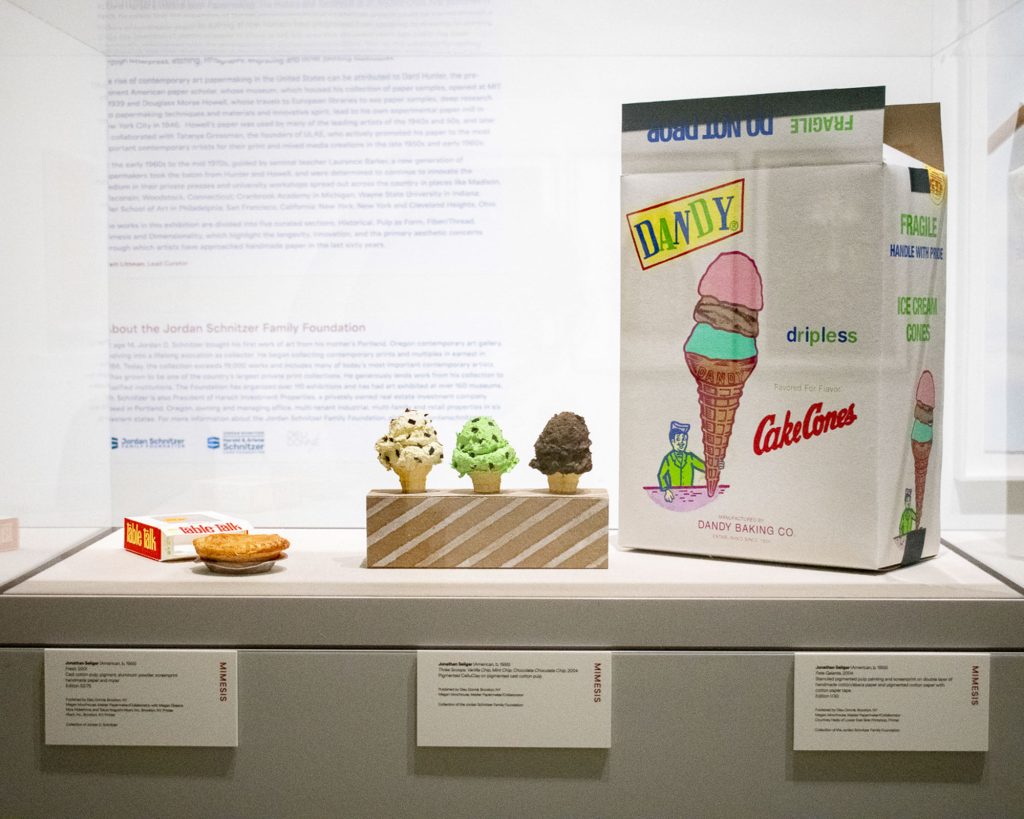
The Mimesis section is the most immediately accessible portion of the exhibition. As a term, mimesis refers to attempts to imitate or reproduce reality. The obvious crowd-pleasers here are Jonathan Seliger’s trompe l’oeil pieces — Fresh, Fête Galante and Three Scoops: Vanilla Chip, Mint Chip, Chocolate Chocolate Chip — which reproduce a bodega snack, a box of cones and ice cream scoops. The craft is impressive and the effect is fun, but no one in a museum actually believes they are looking at real ice cream.
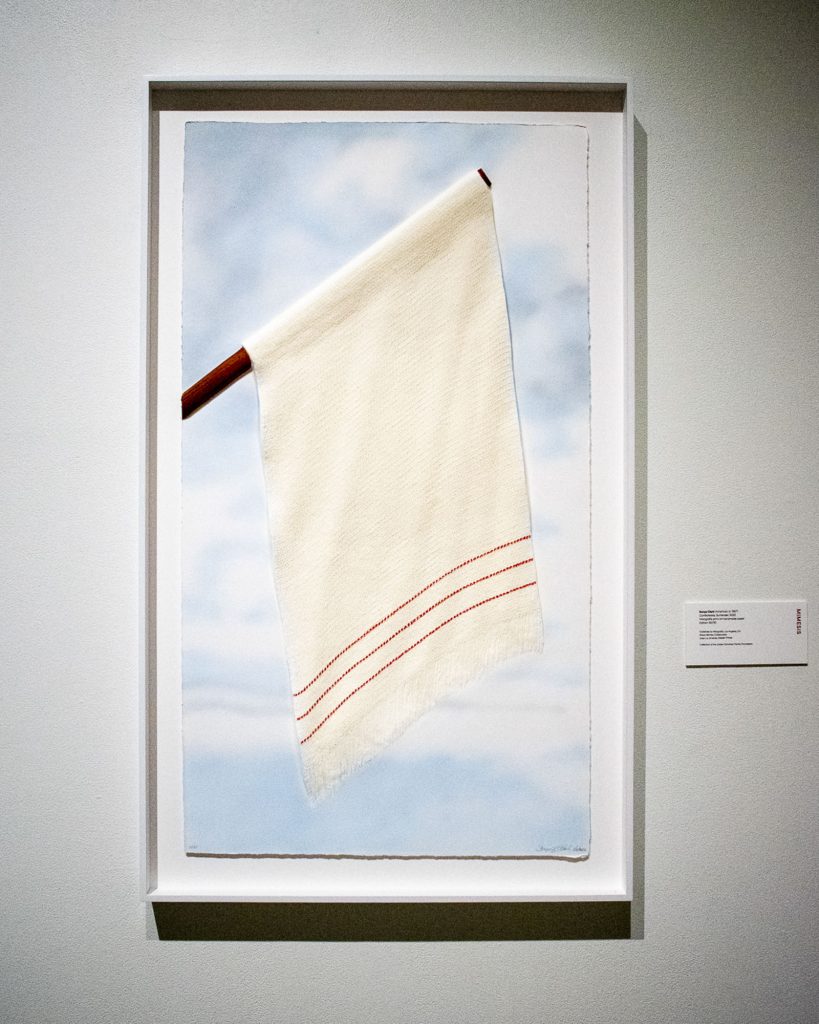
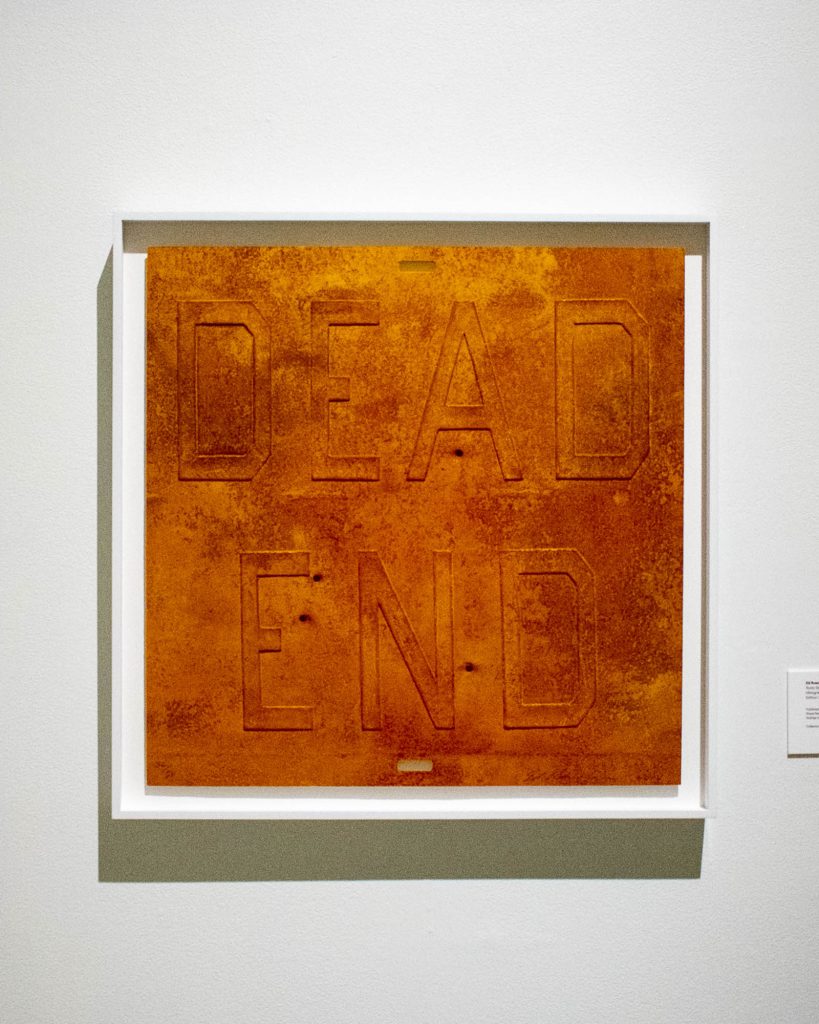
The stronger works in the section are the ones where the mimicry operates at a higher level. Ruscha’s Rusty Signs: Dead End 2 is a mixografia print depicting a corroded metal sign, and, even in an exhibition explicitly about paper, the viewer’s first instinct is that it is actually metal. The paper’s fibrous, uneven surface so closely resembles oxidation that the effect is genuine confusion: This is mimesis at its most convincing. Clark’s Confederate, Surrender does something different entirely. It depicts a white towel draped over a wooden dowel against a blue sky — a makeshift white flag of surrender — and the textile weave is rendered with extraordinary precision. But mimicry is not the point. It is in service of the work’s meaning, and the viewer’s attention moves past the craft and into what the cloth is doing: surrendering.
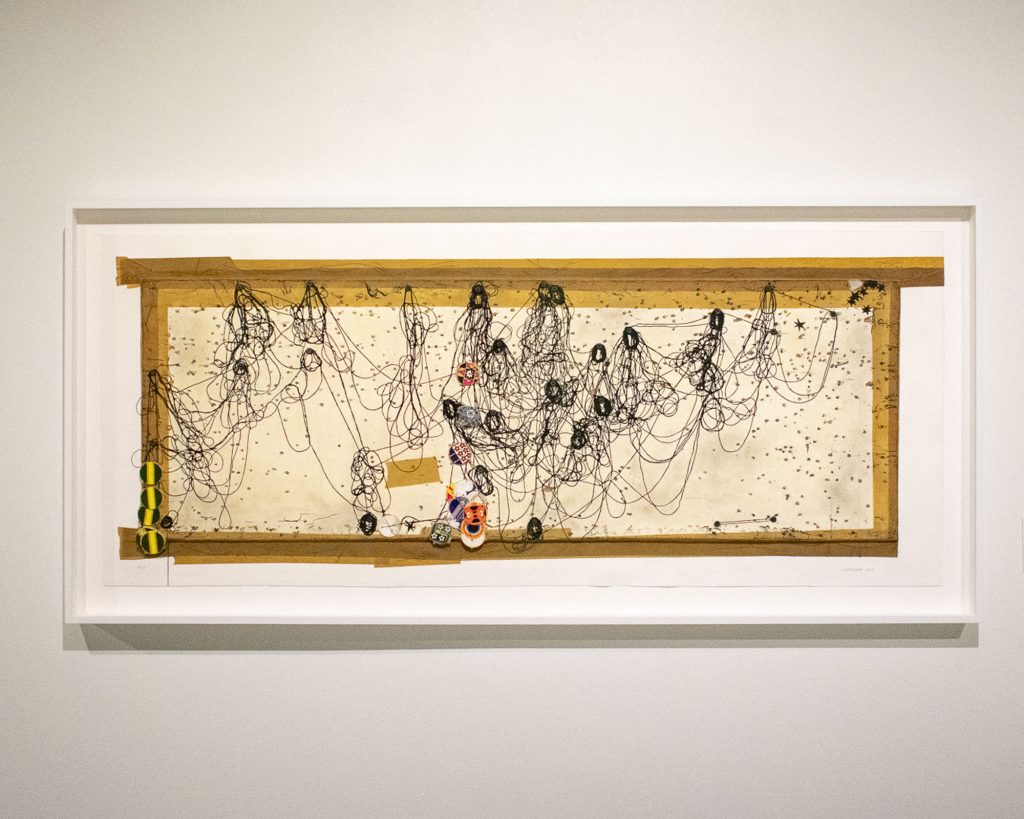
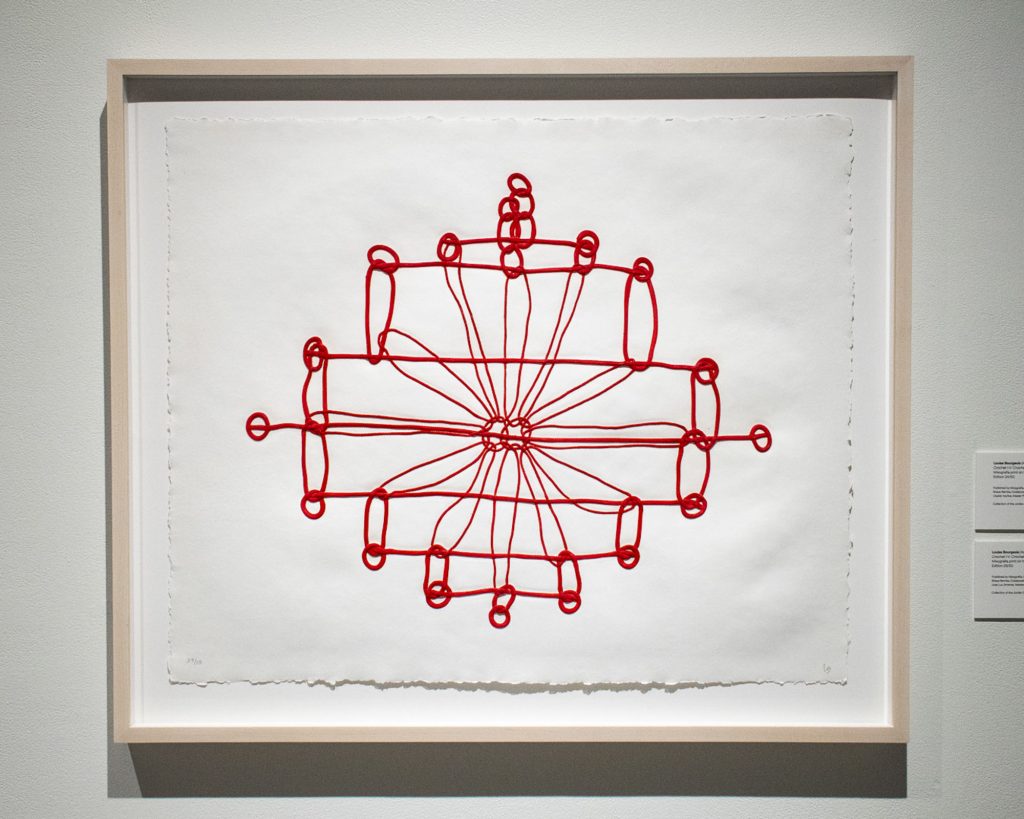
The Fiber/Thread section occupies different territory. The wall text here provides real technical depth about paper’s materiality: handmade paper is explained to be “not a neutral support but an active participant in the work,” its irregularities guiding and responding to the movement of the thread. Bourgeois’ Crochet II and Crochet III are the clearest evidence of this claim. The threading has an organicness to it — not imperfections but the visible result of the thread responding to the texture and resistance of the paper beneath it. The thread goes where the paper allows.
Jacob Hashimoto’s All These Burnt Out Comets, Unwound Ciphers and the Dark Span of Madness takes the same relationship and makes it aggressive. Black thread paired with bold and forceful gestures are a surprise given how delicate thread is as a material. Where Bourgeois’ pieces show paper gently guiding the maker’s hand, Hashimoto’s shows the maker pushing back. This section and its companion materials are enlightening even for a trained arts consumer, which makes it successful in precisely the opposite way that Mimesis is for anyone who has ever seen an ice cream cone.
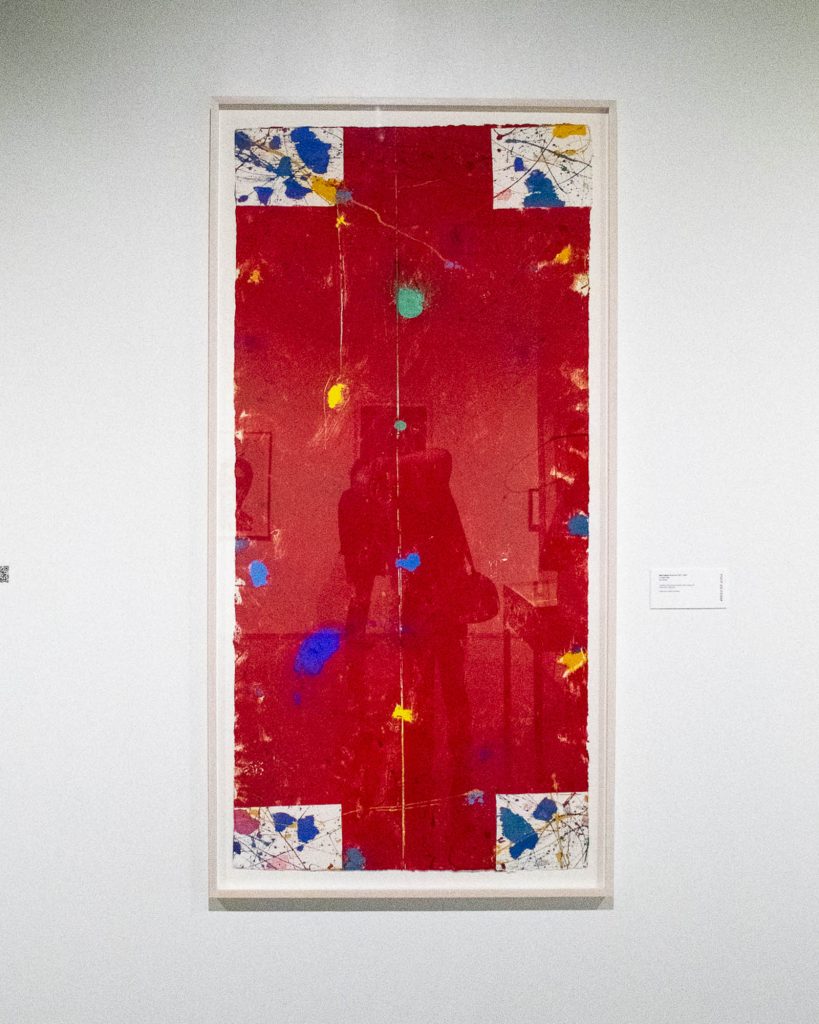
The spatial logic of the exhibition is also smart. The Zuckerman’s two gallery spaces are separated by a hallway, and the show places the more intellectually demanding sections — Pulp as Form and Fiber/Thread — in the first gallery, with Mimesis, Dimensionality and Historical in the second. Anyone who frequents exhibitions knows that consuming art is cognitively taxing. By placing the deeper material first, the curators ensure the viewer encounters it while still fresh. Sam Francis’ Untitled, a monotype in the first gallery, is the kind of quiet work that could easily be overlooked by a tired viewer. Here, it gets the attention it deserves. However, not every curatorial decision in the exhibition is this successful.
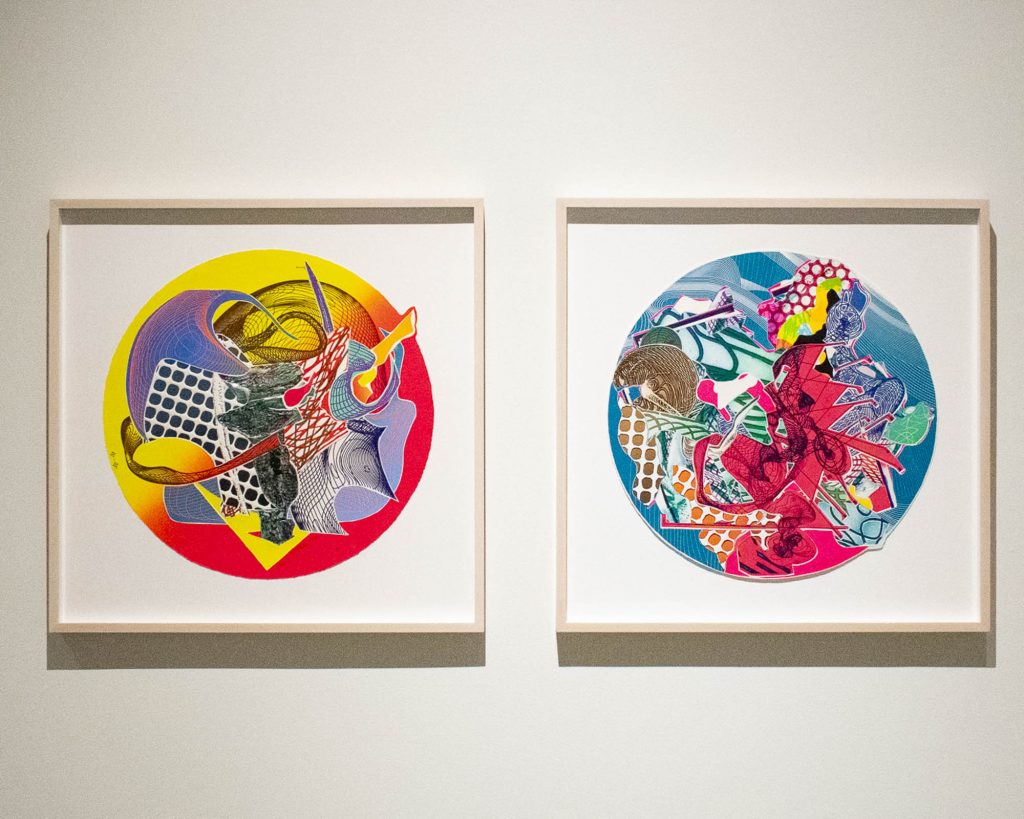
The exhibition’s five thematic sections are clearly defined, with one exception. What makes the works in the Historical section “historical” as compared to others in the exhibition is not immediately obvious, and the section appears to be a bit of a catch-all. That said, it is difficult to dwell on the framing when the works include truly breathtaking works from Stella and Chicago.
The more substantive issue is the exhibition’s density — 66 works is a lot. There is simply too much on the walls. But when the work is this good, it feels ungrateful to say so, like leaving Sunday dinner wonderfully overfull, glad for every course but unable to eat another bite. Everything here deserves to be seen, and there is something truly generous about the decision to show all of it.
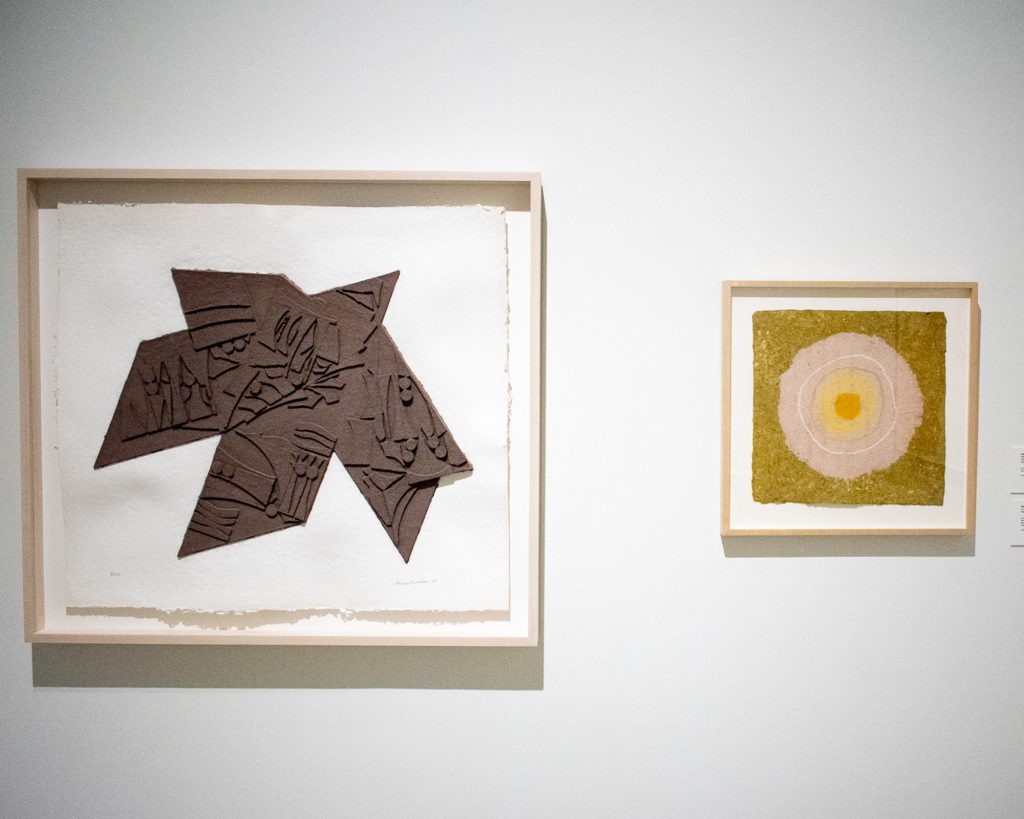
At the same time, the density sometimes contributes to less-forgivable hanging issues: Works placed in conversations they don’t belong in or displayed in ways that are to their disservice. For example, Nevelson’s Night Star, a dimensional cast paper relief, hangs beside an untitled work by Kenneth Noland in flat pressed pulp and pastel. Both were made in 1981 at the peak of the American handmade paper art movement, and the pairing likely intends to demonstrate the range of what the medium could do in that moment. But the visual disjunction between a dimensional relief and a flat color field reads as incoherent rather than illuminating.
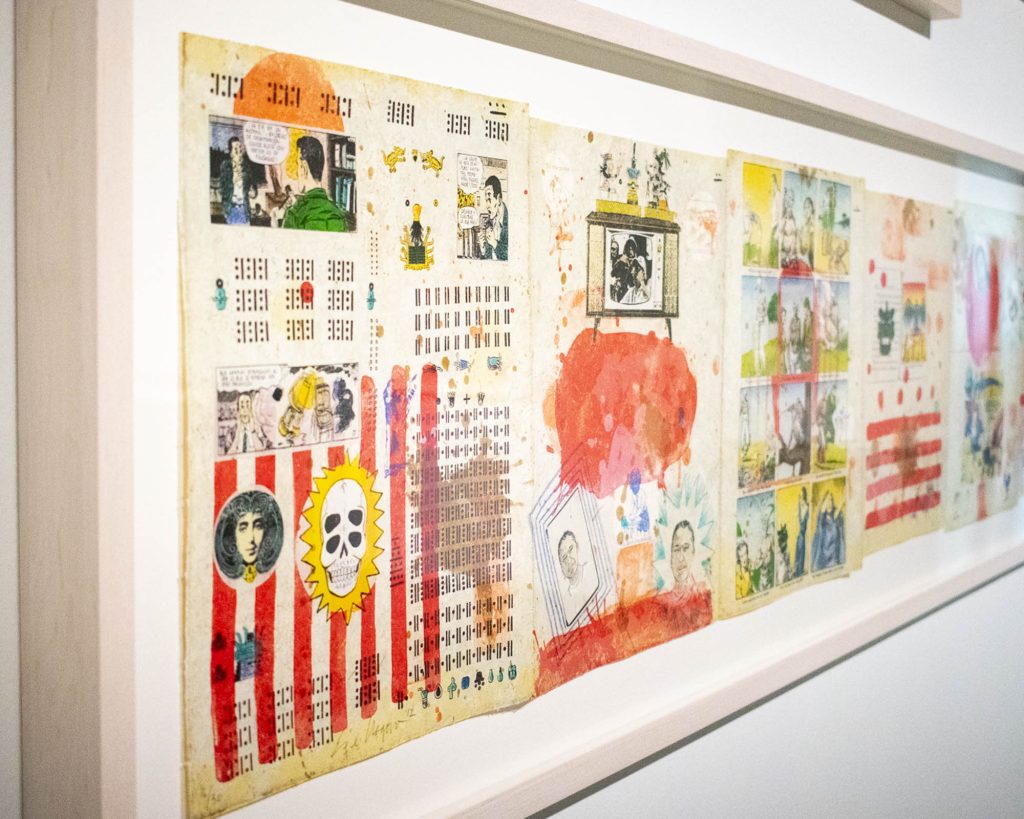
More significantly, there are several instances where works are stacked vertically in ways that make them difficult to view independently. The most problematic is Enrique Chagoya’s Illegal Alien’s Meditations on el Ser y la Nada. It is a codex-format work organized as a horizontal sequence of images within a single frame. It is displayed as the single piece on a bottom row in a set of three, with James Siena’s Dis-connected Hooks (Red) and Robert Blackburn’s Sunday Afternoon forming a top row. The vertical arrangement competes with the horizontal orientation of Chagoya’s work itself, and a piece that would otherwise be among the most impactful in the exhibition is instead interrupted by what is in its proximity.





It is the responsibility of arts criticism to seek genuine issues, even when the work is this strong. But it should be said plainly: Any other visitor would walk out of this exhibition with no complaints. A couple of misplaced nails are minor curatorial missteps in an extraordinary show. The real curatorial story here is not how the work is hung or what was selected anyway. It is the decades of relationship-building that made this show possible in the first place.
The work behind an exhibition like this is not done in the gallery. It is done over careers, through the relationships between curators, collectors and artists that make lending programs like Schnitzer’s — more than 130 exhibitions organized, art shown at more than 180 museums — possible at all.
“Trust is the essential, if often unspoken, foundation of the collaborative ecosystem that underpins handmade paper works,” said lead curator Littman. “For collectors, trust transforms acquisition into stewardship.”
“Brett Littman, Cynthia Thompson and I have been colleagues for decades,” added co-curator Sue Gosin.“At every step, open communication was critical and helped build the necessary trust to create a shared vision and protect these often one-of-a-kind masterpieces.” Thompson, the exhibition’s third co-curator, affirmed the importance of these relationships. “Trust between curator and collector is crucial for realizing a visionary exhibition that respects and incorporates the collector’s vision and voice,” said Thompson. The result is one that “celebrates collaboration on all levels.” These are the very kinds of relationships that bring MoMA-quality work to a university gallery in Georgia.
There is something in this exhibition for everyone. If you wish to see beautiful things from canonical names, that is here. If you hope to challenge your understanding of paper fundamentally, that is here, too. Exhibitions of this quality are evidence that Kennesaw State University, home to the Zuckerman Museum, is among Atlanta’s most important arts institutions and should more routinely be given that distinction.
The Art of Paper: Selections of Handmade Paper Works from the Collections of Jordan D. Schnitzer and His Family Foundation is on view at the Bernard A. Zuckerman Museum of Art at Kennesaw State University through May 1.
::

Dr. Kevin M. Storer is a scholar, critic and collector living and working in Atlanta. His internationally-awarded research spans engineering, design, the social sciences and the humanities, examining the complex relationships between people and the objects we create — especially as they shape our identities and social realities. Kevin earned his Ph.D. in informatics from the University of California, Irvine.
STAY UP TO DATE ON ALL THINGS ArtsATL
Subscribe to our free weekly e-newsletter.

PLEASE SUPPORT ARTSATL
Your Gift Sustains the Coverage You Count On!
Related Posts