‘Locals Only’ at ABV gives nod to the cultural touchstones that make Atlanta unique
Through August 9, ABV Gallery in East Atlanta Village is hosting two exhibitions — Locals Only and Six By Six — that showcase Atlanta scenes, history and cultural memories.
As the name implies, Locals Only includes only Atlanta-based artists and captures the sprawling scale of Atlanta’s culture from more than 40 individual viewpoints. The Six By Six project includes local, national and international artists but limits them to a 6-inch square canvas.
Locals Only is packed with imagery that Atlanta residents will recognize immediately. In that sense, it’s an exhibition meant for Atlanta insiders. Yet, a few noteworthy exceptions break the rule, offering something accessible to those who don’t know the city inside-out.
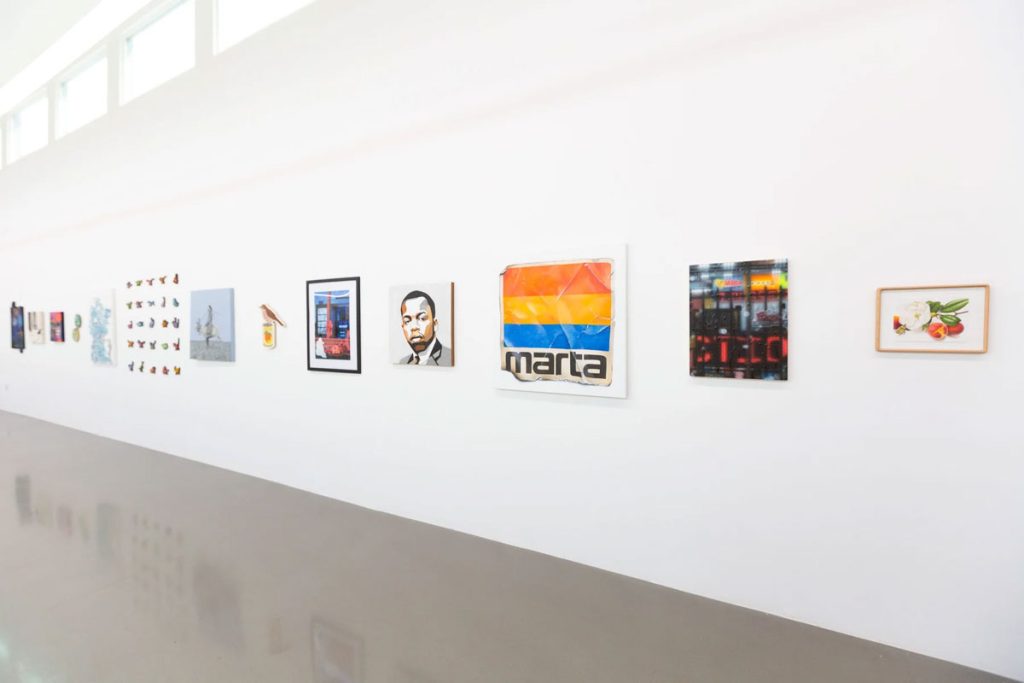
The first work to catch the eye in Locals Only is a 3-foot square painting of a MARTA sticker, crumpled and worn. John L. Hill’s hyper realistic acrylic and colored pencil work MARTA (2026) presents the familiar symbol as distressed, suggesting the nitty-gritty, daily grind faced by so many Atlanta commuters. The MARTA logo has not changed since 1972, so Hill’s weathered rendition may resonate with long-time Atlantans.
In contrast to Hill’s trompe l’oeil precision, many of the artists in Locals Only adopt a more graphic style. Chris Alvarez’s Big Kahuna (2006) presents Marietta’s The Big Chicken, the iconic 56-foot-tall red rooster with googly eyes that has stood at the intersection of Cobb Parkway and Roswell Road since 1963. The painting renders the chicken with flat areas of bright color framed by bands of white and gray billowing clouds. The title originates from Hawaiian culture; a kahuna refers to a wise and skilled expert or a person with a significant leadership role. For motorists trying to navigate Atlanta’s urban sprawl, The Big Chicken is a towering kahuna.
Also presented as a painterly illustration is Sean Winn’s Don’t Forget About the Neighborhood (2026). The work shows the ghost-like outline of a seated figure with his head buried in his arms, crossed sorrowfully on top of his knees. Behind the figure is a bench and a telephone pole. Stuffed animals and notes are piled below, surrounding a small sign that reads “Isaiah Ward, RIP.” Ward was a 9-year-old who, while walking in his Northwest Atlanta neighborhood in 2016, was killed by a driver high on heroin. The community was outraged, and the killer was convicted. The stuffed animals and bench in the foreground are colored in a red wash connoting blood and physical trauma that contrasts with the clear blues and grays of the modern building in the background.
Chris Veal’s The Floors Are Shaking (Glow In The Dark) (2026) uses acrylic, air brush and glow-in-the-dark, aerosol paint to present the legendary Masquerade theater, founded in 1989 in a century-old, abandoned textile mill on North Avenue. The Masquerade became a center for Atlanta’s alternative music scene, with three stages named for Dante’s three stages of the afterlife — heaven, purgatory and hell. The venue was relocated to Underground Atlanta in 2016. Veal depicts its original home as if it were a still shot from an animated film, in shades of blue, purple and gray. A skateboarder passes crowds of young people, some punked-out and some casual in jeans. Veal’s work is also featured in Six By Six. In those works, Veal paints cartoonish vintage sports cars with names of notorious Atlanta strip clubs against plain colored backgrounds.
Courtney Hicks’ 404 (2026) captures a punk-inspired figure with a collection of Atlanta references. The painting’s title refers to the city’s first area code, which was created in 1947 and still comprises inner-city areas of midtown, downtown, Buckhead and parts of Fulton, DeKalb and Clayton counties. The number remains tied to Atlanta’s local identify and business culture. In the painting, a young female has her head turned to the right. She is wearing a backward baseball cap with a shock of bright red, spiky hair protruding under its visor. Her torn red crop top with “Libra” written across it is visible under her black leather, studded jacket covered with buttons, stickers and patches reading “404,” “AI sux,” “H8,” “Hello I am Antifa,” “No Grid” and“Mad Chix.” Hicks’ sketch work style combines bold line work and an unapologetically gritty vibe to convey Atlanta’s rebellious spirit.
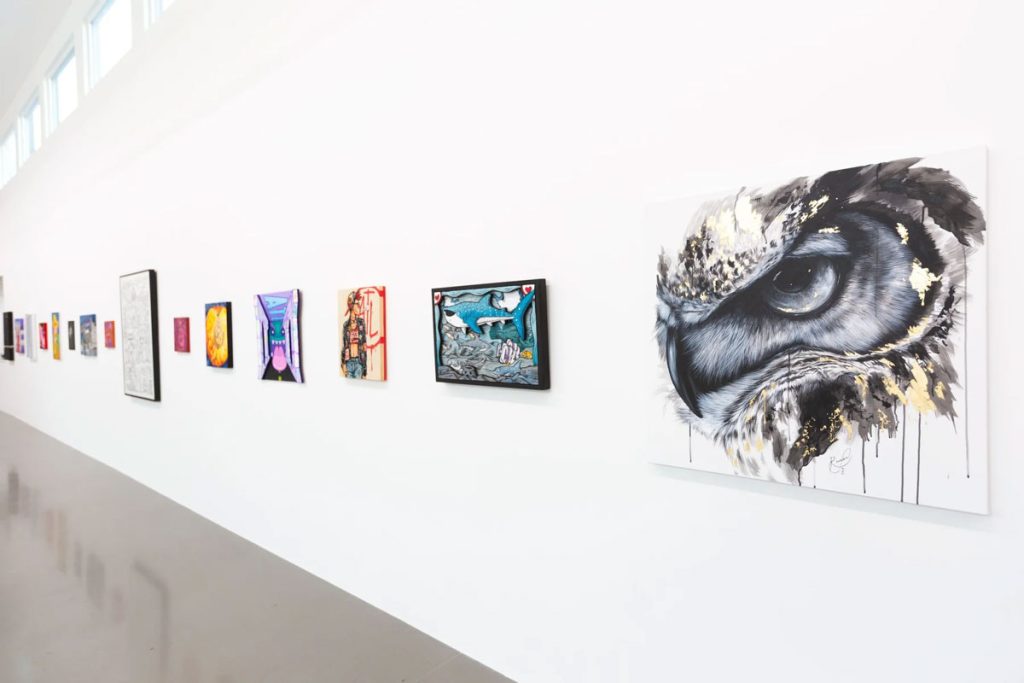
Sami Jacq, Ash Rader and Chris Noosh are Atlanta artists included in both Six By Six and Locals Only. Jacq’s Roots (2016) features a meticulously rendered close-up of a magnolia flower against a black background, painted to commemorate the Georgia Senate’s official change of the state flower from the Cherokee Rose to the magnolia earlier this year. March (2026) and Daffodil (2026) similarly feature close-ups of flowers native to Georgia on plain colored backgrounds. Rader spent a decade working in graphic design and marketing but found her love of nature and concern for endangered wildlife was best manifested in painting. Her work Vantage (2006) presents an intimate close-up of the right side of a great horned owl’s face. The artist’s highly detailed rendering captures the fine definition of every feather, with a high-contrast palette of deep blacks and crisp whites and brilliant touches of textured gold leaf that cut through neutral tones. The owl’s intense, watchful expression creates an immediate and powerful connection with the viewer. Stillwater (2006) presents a close-up of a single crocodilian eye with an arresting gaze. Chris Noosh’s oil and acrylic works are painted on carved birch, making them three dimensional. Ocean Voyager (2026), named for one of Georgia Aquarium’s most popular exhibits, features a whale shark with manta rays above, gliding past other sharks. A giant grouper, bottlenose wedgefish and other marine animals hover above the ocean floor. Not only is the artist’s aesthetic stylized and graphic, but the painting itself resembles a shadowbox with different images receding into a shallow, carved space. His four 6-inch square paintings feature cartoonish renderings of sharks, an octopus in outer space, a mouse clutching its last penny and dinosaurs grazing.
At first glance Untitled 1 and Untitled 2 by Andrew Faris (2026) resemble miniature versions of Josef Albers’ series of Homage to the Square color studies, but a closer look reveals that the concentric bands of color are 3D pieces of painted wood that undermine the flatness of Albers’ modernist series.
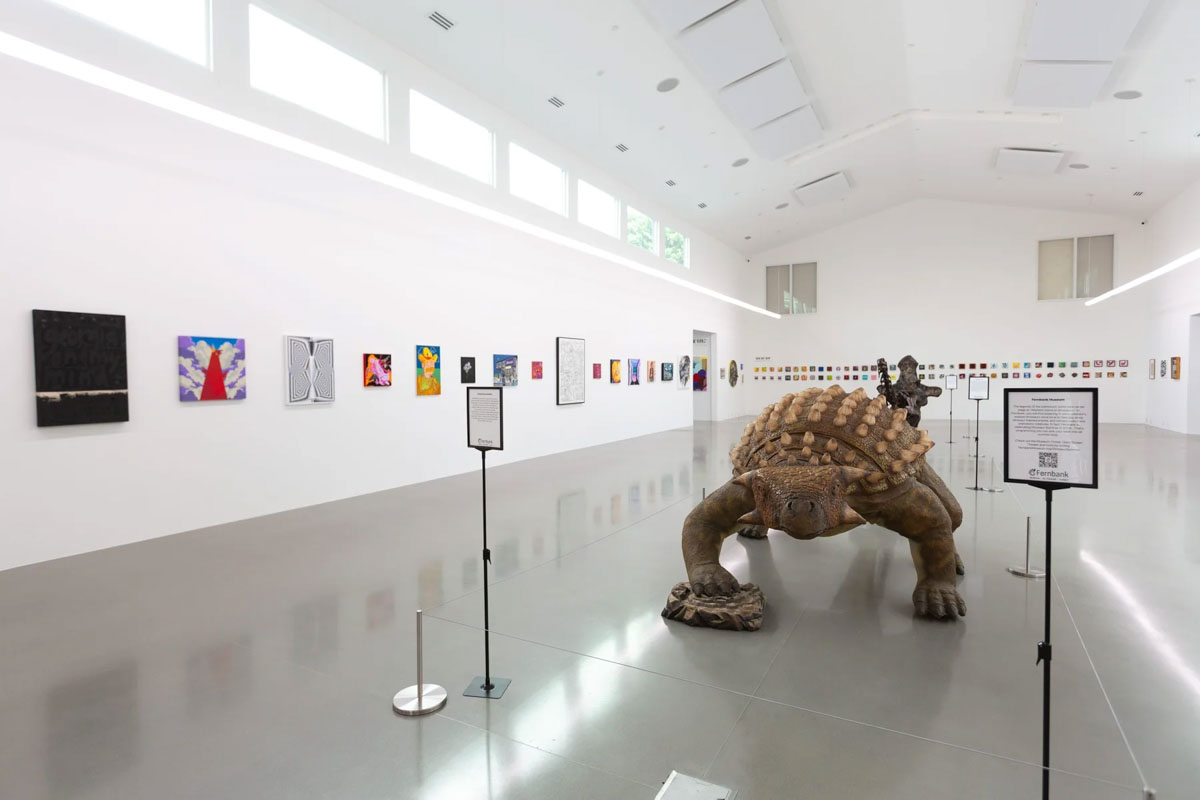
East Atlanta Village is known for eccentricity and cultural diversity, and ABV Gallery matches the neighborhood’s eclectic nature. The gallery space even includes a prehistoric dinosaur pop-up, courtesy of the Fernbank Museum — an unexpected result of ABV Gallery’s partnership with cultural nonprofits and community organizations. Locals Only and Six By Six present a wide range of artistic styles and viewpoints that underscore the vibrant, multifaceted identity of Atlanta.
::
Informed by her experience working at museums in Southern California and teaching art history at the Atlanta College of Art, Dinah McClintock excels at making art exhibitions accessible and engaging for all. Recently, she retired from teaching art history at Kennesaw State University and shifted her focus to writing for non-peer-reviewed arts publications as a continuation of her passions for demystifying art for the public.
STAY UP TO DATE ON ALL THINGS ArtsATL
Subscribe to our free weekly e-newsletter.

PLEASE SUPPORT ARTSATL
Your Gift Sustains the Coverage You Count On!
Related Posts