

‘Nobody Cares’ is an amalgam of lessons lived by Atlanta musician Jesse Owen Astin
His musical and personal evolution is reflected in the musician’s new 10-track album, which will be released at a launch concert on May 8.
::
The title track to Atlanta musician Jesse Owen Astin’s new album Nobody Cares (which will be celebrated at an album release concert at 529 in East Atlanta Village on Friday) traverses a range of sonic landscapes. Dark and moody beats begin the journey, quickly dissolving into a dreamy, more ethereal stretch.
An eerie quality creeps back in before swelling to a rock section that builds until it dips into a melodic piano bit. Exotic Moroccan instruments are woven in the center (inspired by a trip Astin took) before the track climbs a grungy, metal mountain. A cinematic taper finishes the song.
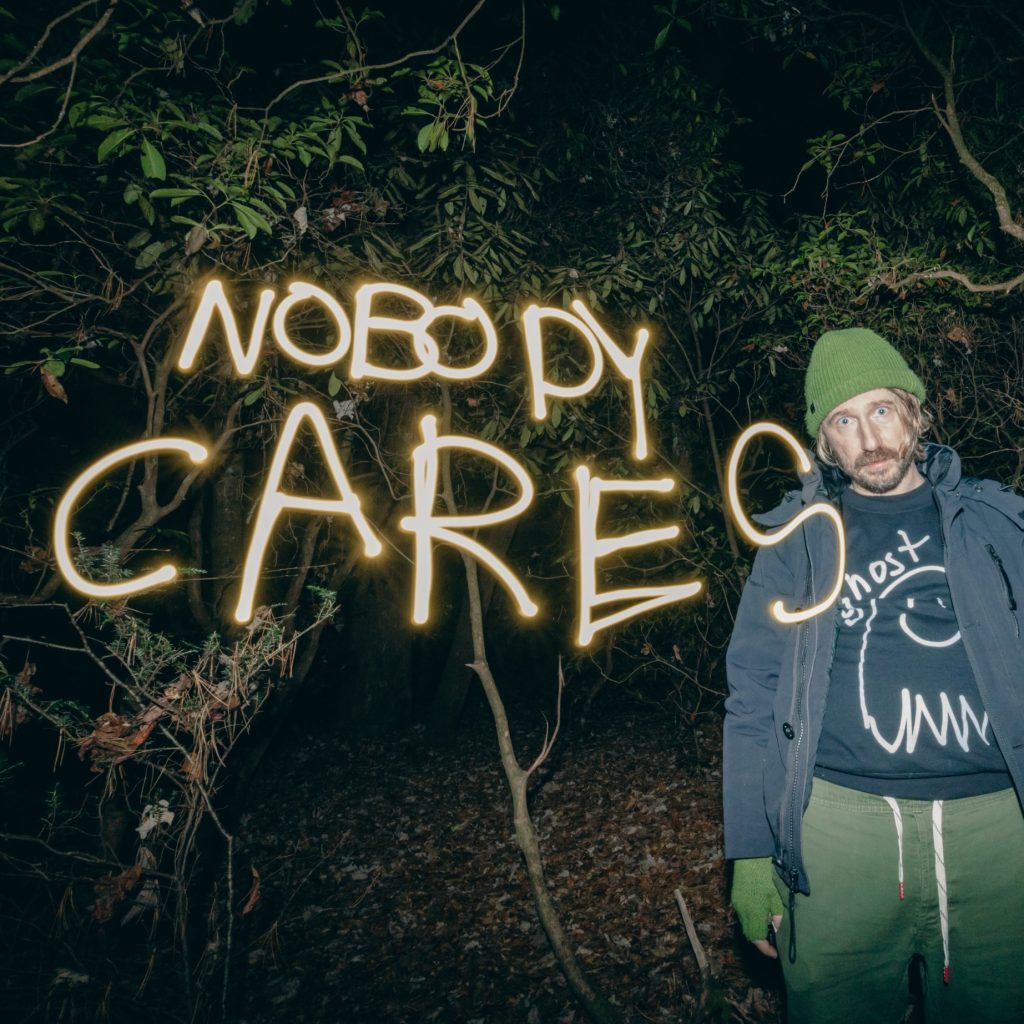
Like the sound, the lyrics shift between optimism and apathy. The song dares to dream of a utopia where people love one another, but juxtaposes that fantasy with our darker shared reality — a world in which “a fascist choir sings, quoting Martin Luther King” and where we “pray in a church to no God.” A world where nobody cares.
The song is a showcase of Astin’s perspective and musical versatility. But not all the songs on the 10-track album (which Astin wrote, engineered, produced and mixed himself) are like the first. A few are much poppier. Others are reminiscent of MTV-era rock and punk. Some layer in symphonic instruments, such as violins and an upright bass. One focuses purely on Astin’s vulnerable, vocal power.
“The bands I have loved have had metal songs next to pop songs,” Astin said. “I think that’s sorely missed in today’s music. I don’t want to hide behind something that feels uniform because the Spotify algorithm says that I should.”
The range makes sense given Astin’s diverse background. He’s a man who has worn many hats in many arenas.
He got his start young on the west side of Atlanta, where he picked up a guitar at 9 years old. Though he was innately talented on the guitar, he was characteristically shy. His father, who had no musical background of his own, recognized his son’s passion. Determined to shape Astin’s musical future, he pushed his son to break out of his shell by taking him to blues jams on school nights around the city. Astin sat in on jams at Northside Tavern, Duffy’s and other now-defunct Atlanta venues as a pre-teen.
“I got really heavy into playing blues,” Astin said. “Once I did [break out of my shell], I got really comfortable there, really quickly.”

As a teenager, Astin developed an interest in recording and songwriting. He kept a notebook full of poetry (“full of teenage angst,” Astin recalled), which became lyrics, and learned how to use a four-track cassette recorder his mother gifted him. He remembers programming drums on the family’s old-school, transparent green iMac, dumping them onto one track, recording himself playing guitar and building songs piece by piece.
While most aspects of music-making came easily, singing did not.
“It was something I’ve had to work on very hard and very extensively,” he said.
His vocal weakness led Astin’s father to seek out training for him at Atlanta’s prestigious Jan Smith Studios (home of Jan Smith, dubbed “vocal coach to the stars”), where Usher, Justin Bieber, Ciara and Rob Thomas honed their craft.
Not just anyone is accepted to train at Jan Smith, but Astin had written a song that opened a door. The song — “Do You Know Sean Hayes?” — was about a family secret kept from Astin his entire childhood that has forever shaped him.
Unbeknownst to him, Astin had a brother one year younger than him. His mother, for reasons not disclosed, placed him for adoption when Astin was only 2. He grew up sensing something was off and fixated on a photograph in his grandparents’ house of a boy whom he thought was his cousin. When his grandparents finally told him the truth, Astin wrote a song about one day playing music with his brother. That song, vulnerable and raw, caught the attention of vocal coach Dionne Osborne (best known today as Drake’s longtime vocal coach), who was teaching at Jan Smith.

“She saw past my ability to sing and into my ability to write songs,” Astin said.
Osborne taught Astin the power of voice.
“I can’t think of a deeper connection to music than the use of our own voice,” Astin said. “We’re literally using our anatomy, all of ourselves, coming together to make a note … then we use language to convey a feeling with that tone.”
Osborne taught Astin how to emote. It’s a lesson he’s carried throughout his work.
While training at Jan Smith, Astin came in contact with another young rock musician, Travis, who was forming a band called Travisty Theory. Astin, who had been studying music production on a Hope Scholarship at Georgia State University, dropped out at 19 to go on a national tour. The band did two tours with Sevendust. A video from that era still on YouTube showed massive crowds of teens at KROCK Festival in New York pressing toward the stage while a shaggy-haired young Astin played guitar.
“It went to my head in a lot of ways,” Astin recalled, laughing. “I just thought I was the shit.”
When the tour wound down, Astin’s father helped him open a recording studio in a warehouse on Atlanta’s west side near Six Flags. He called it Jam Inc. — short for Jesse Astin Music. Though Astin successfully recorded some local bands, he quickly realized his knowledge gap.
“I could stay here and fake it, or I could move to LA,” he said.
Astin sold his gear and drove cross-country, landing in Burbank, California, where he had a quick succession of lucky breaks.
He assistant-engineered a record for Forever the Sickest Kids, a pop-punk band signed to Universal Records.
He was hired as studio manager and editor at a Burbank studio where Miley Cyrus’ Breakout album — her first record after Hannah Montana — was being recorded. There he met Katy Perry, who was singing backup vocals for Cyrus, and played the room “I Kissed a Girl” before it blew up.
He landed a publishing contract with renowned songwriters Scott Cutler and Anne Preven, under whom he wrote instrumental tracks that Demi Lovato and Selena Gomez recorded to (though neither song was released). A track he wrote around that time was later placed in an episode of Shameless.
But after a quick rise came a long and humbling fall. By the time Astin left LA six years later, he was struggling with drinking, had been evicted from his apartment, spent time homeless and couch-surfing and needed a fresh start.
“I had three eggs left in the refrigerator, and I just remember feeling like, OK, there’s nothing that I can possibly do at all. I’ve extended every resource,” he recalled. “I’m just going to let go.”
He surrendered. Grace showed up in the form of an unexpected royalty check. He returned to Atlanta at 29, got sober on his birthday and never looked back. He’s been sober now for 13 years, and his path has led him full circle, back to Jan Smith Studios, where he has spent the last decade co-producing alongside Smith herself. She calls him her “left arm,” a nod to his permanent post at the sound board to her left.
At the studio, Astin has recently been juggling several projects, including a third album for Atlanta artist Scott Pryor, a new record for country singer Christian Parker, a handful of singles projects with emerging artists, including 12-year-old Tori Gideon, and his own passion project: Nobody Cares.
His winding road, from blues jams to rock tours to Hollywood studios to rock bottom and back, learning every facet of music making in a wide range of genres, is exactly what makes Nobody Cares such a rich listen. Listeners will hear his rock ethos in the grinding intensity of the title track, his pop instincts in the catchy melody of “By All Means,” the emotional vulnerability Osborne taught him in “When?” (a song about longing to be loved) and bits of his own story in the confessional lyrics of “Homeless” and “The Last Word” (a reckoning with his father that closes the album).
Nobody Cares, Astin said, is not so much a narrative as it is a carefully curated “body of work” that belongs together.
Notably absent is “Do You Know Sean Hayes?” Astin re-recorded and re-released that track last year as a stand-alone single after his brother Sean died suddenly of a brain stem stroke in 2024.
“It felt more special on its own,” he said.
The live experience of Nobody Cares to be staged May 8, Astin said, will skew grittier and more rock-centric than the recorded album. It will be played by a full band of fellow Atlanta musicians (including Matt Reagh on drums, Nate Thiel on guitar and Brandon Winslow on bass).
Fans can purchase the album on vinyl at the show and online — a format Astin felt strongly about.
“There’s something about the finality of having it etched into a physical medium,” he said. “It exists.”
It exists. It’s a fitting phrase for the moment. Ten years in the making, Nobody Cares is a culmination. It now exists.
Where & when
JOA Nobody Cares album release party with Reptile Room and Dandruff. Doors open at 8 p.m. May 8. $15. 529 Bar, 529 Flat Shoals Ave. SE, Atlanta. Tickets for sale here.
::

Danielle Charbonneau is a former arts and entertainment reporter for The Atlanta Journal-Constitution turned full-time freelancer. She covers a broad range of topics ranging from art, theater and dance to film, travel and events. She holds both a bachelor’s in print journalism and a master’s in specialized journalism in the arts from the Annenberg School for Communication and Journalism at the University of Southern California.
STAY UP TO DATE ON ALL THINGS ArtsATL
Subscribe to our free weekly e-newsletter.

