
No boundaries in Annalee Traylor’s ‘Shiny Objects’ for Terminus Modern Ballet
Fresh off the success of her dance work this thing is real and Theater Emory’sThe Other Shore, Traylor explores relationships in her new work for Terminus Modern Ballet Theatre.
::
When choreographer Annalee Traylor began her collaboration with Terminus Modern Ballet Theatre, she was immediately struck by the strong bonds between its dancers. “Two of the artists in particular have been dancing together for a long time,” she says. “That was inspiring to me, and I wanted to play into their dynamic.”
Dancers Alex Gonzaga and Christian Clark’s history together does indeed run deep. Both danced with the Atlanta Ballet. Clark was one of five dancers who left the company to start Terminus in 2017; Gonzaga has had a long relationship with Terminus, most notably as a guest artist in the company’s full-length Lore, and joined full-time for the 2024-25 season. Their shared history became a cornerstone of Traylor’s new work, Shiny Objects, which will appear as part of the mixed bill Duality at Kennesaw State University’s Dance Theater from March 7 through March 9.

“I was thinking about interpersonal bonds that develop over time, and I was correlating it to this idea of shininess,” Traylor explains. “When you first meet someone, there’s a newness, a shininess and an excitement and a spark. And then over time, what happens as that relationship develops? If you correlate it to an inanimate object, does the shininess rub off somehow? What’s revealed?”
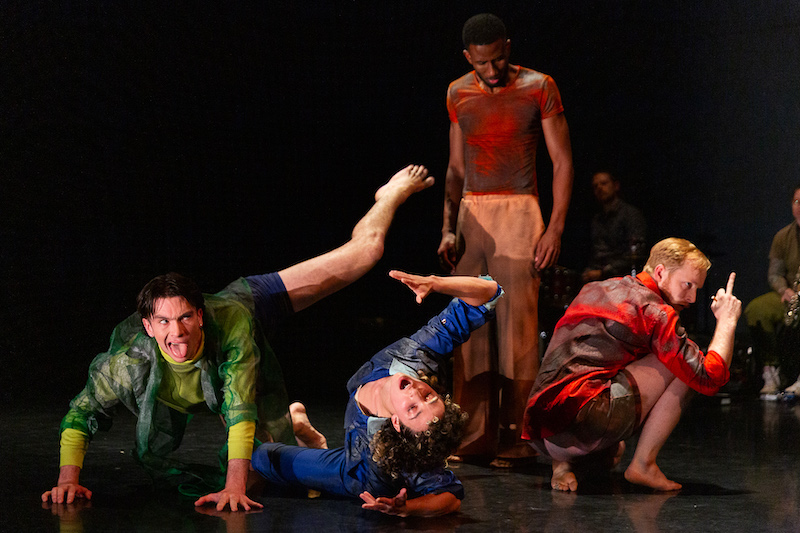
The resulting piece — one of two new works on the program — is a contemporary dance theater work performed by four dancers: Gonzaga, Clark, Elizabeth Labovitz and Lenai Wilkerson. It includes intricate partnering sequences and costumes that feature slightly deconstructed, shiny formal wear with gloves. The dynamic musical soundscape, comprised of various tracks of recorded music, including the 1963 rendering of “Sleepy Time Gal” by jazz organist Jackie Davis, guides the audience through shifting moments in time and space, re-inforcing the evolving relationships on stage.
“All of that plays into the storytelling,” Traylor says. “Who is this group of people? Are they going to an event? Did they make it to the event? I’m also working with devices, almost like jump cuts. All of a sudden, we’re in a different room, and you hear that in the music. Are they outside? Are they in front of people? And what happens when they’re behind closed doors?”
Although Shiny Objects is her first work with Terminus, the piece’s themes and methodology are not unusual for her process. Traylor often bases her choreography on the relationships between her dancers. “Getting to know each other is integral to how I work,” she says. “I’m very curious about the person that I’m in the room with. And that’s incredibly influential to how it develops.”
Working with Terminus has been a long-held dream for Traylor. “I’ve been following Terminus for quite a while,” she says. “They take risks with the kinds of art and the kinds of voices they bring into their repertoire. And as a creator, that excites you. Their repertoire is extremely expansive and showcases their dancers in such a beautiful, versatile light. They’re not bound.”
Beyond the creative process, Traylor was struck by the company’s warmth. “When I first walked in, they all gave me a hug. That’s just such a kind, warm impression to have as the first impression. They’re such a high-caliber group of artists and kind humans. But, man, they work.”

She says that one of the benefits of working with Terminus was the extended period she was given to develop Shiny Objects and describes the ability to refine and revise the piece as a rare luxury: “I didn’t have to go with my first impulse. I could go with my fourth or fifth. That’s what caught me off guard.”
Traylor has a background in ballet and felt a natural connection with Terminus’ dancers. “They all come from a heavy ballet background, and I do, too,” she says. “That’s something that we shared. I wanted to play into that classical idiom. I wanted to comment on it and reference it in my own way.”
Her journey in dance has brought her full circle to the Southeast, a region that shaped her early artistic development. Born to artist parents — her mother, a ballet teacher, and her father, a pianist and founder of the Jazz Studies program at the University of Alabama at Huntsville — Traylor was immersed in the arts from an early age. She attended the Alabama School of Fine Arts in Birmingham before moving on to the North Carolina School of the Arts, where she pursued modern dance. She later earned her BFA from Point Park University and an MFA in choreography from the California Institute of the Arts.
Her choreography has been performed nationally and internationally in Los Angeles, New York City, Atlanta, Pittsburgh and Seattle, as well as in Italy, Portugal and the Netherlands.
In 2023, she was awarded the inaugural Emory Arts Fellowship in Dance at Emory University, where she conducted research on clowning and mimetic techniques. During her residency, she premiered this thing is real, a collaborative work that was recognized as one of ArtsATL’s Notable 9 dance performances of 2024.
The Emory Fellowship allowed her to fully engage in the city’s dance community for the first time. “I tried to immerse myself, not just on campus but in the dance community, which was so welcoming to me and supportive of my work,” she says. “This community, though tiny, is mighty.” Because of that deep connection, she decided to stay in Atlanta after her fellowship ended. Traylor also directed Theater Emory’s production of The Other Shore, an avant-garde play by Gao Xingjian that explored the tension between individual identity and the collective.

Traylor’s time with Terminus has deepened her artistic exploration of relationships, movement and theatricality. As she reflects on Shiny Objects and its evolution, she sees it as part of a larger arc in her work — one that continues to dismantle the boundaries between dance, theater and storytelling.
“I don’t draw those lines at all,” she says. “Those worlds blend together, like a watercolor, seeping into every process. I don’t see a reason to separate them. My goal is to step aside and let the work speak for itself.”
::

Andrew Alexander is an Atlanta-based writer.
STAY UP TO DATE ON ALL THINGS ArtsATL
Subscribe to our free weekly e-newsletter.

