My Atlanta: The photos of Charlie McCullers chronicle a city’s iconic aspirations
Editor’s note: Our series, “My Atlanta,” turns the spotlight on photographers, using their images and supporting text to illustrate how living in Atlanta has inspired their careers and lives. Today, we feature the work of Charlie McCullers.
McCullers has used Atlanta as a home base for his photography for 40 years, with an eclectic portfolio that ranges from sports to ballet (he was the official Atlanta Ballet photographer for 20 years) to commercial projects (such as photographing John Madden for a mattress company). He graduated from the University of Georgia with a degree in fine arts, and recently received a master of fine arts from the Savannah College of Art and Design.
He has focused in recent years on a partnership with fellow photographer Cecilia Montalvo to chronicle the barrier islands off the coasts of Georgia and Florida. The Ebenezer Creek series by McCullers and Montalvo — “Places Remember What People Forget” — is part of the “The Nature of Reality” exhibit at Spalding Nix Fine Art through November 11.
::
These images are from a time when I was closest to the city of Atlanta. It was during the mid-1990s to the early 2000s. Much of the work I’ve done since then has taken me away from the city. From the Olympics to the sporting events to the museum events, it was a great time for me personally to be involved in the city.
Aspirations are key. Accomplishments are how you measure those aspirations. At that time, Atlanta was bursting onto the scene with the Olympics. Having children growing up, and having a career that was in full bloom, seemed to coincide with what the city was experiencing.

When the ballet approached me for their 75th season anniversary to be their photographer, I’d never been to a ballet before in my life. When I saw my first show, I was entirely taken by it. I became so attached to the dancers in terms of their approach to expressing their emotions. They were doing physically what I was trying to do visually.
To this day, after working with Atlanta Ballet for over 20 years, I pride myself in not knowing the basics of ballet. I purposefully tried to not learn that part of it because I wanted to bring to the ballet something that wasn’t corralled and based on technique. I never spoke in dance terms because I wasn’t qualified to do that. I spoke in emotional terms, human terms. That connected with the dancers. We had a great rapport.
The dancers were motivated by the uncertainty of that moment, the uncertainty of the crowd that would show up. All they had as a constant was “the now.” And the employment of “the now” in the arts is something that we could all aspire to. Just to take this elastic moment and somehow interpret it. No one does it like a dancer. And in a confined space. It totally lives in the moment and dies in the moment. Never to be re-created.
In my personal work, I’ve tried to take that doctrine on. To create work that only lives in the moment. It’s harder to do with a medium where you basically hang it on the wall and it’s a frozen moment in time. Which is the antithesis of a dancer’s expansion of the moment. But it is similar because you’re focused on “the now.” There’s no analyzing what just happened or being concerned about what’s about to happen. It’s just the expression of that moment.
In the late 70s, I went to the Armand Hammer exhibition at the High. That’s when I realized I wanted to be a photographer. My goal at the time, in my simple little over-achieving mind, was to have an image that would be equal to the imagery that was being shown in the museum. And in my mind, I said, “I want to have a big photograph at the High Museum.”
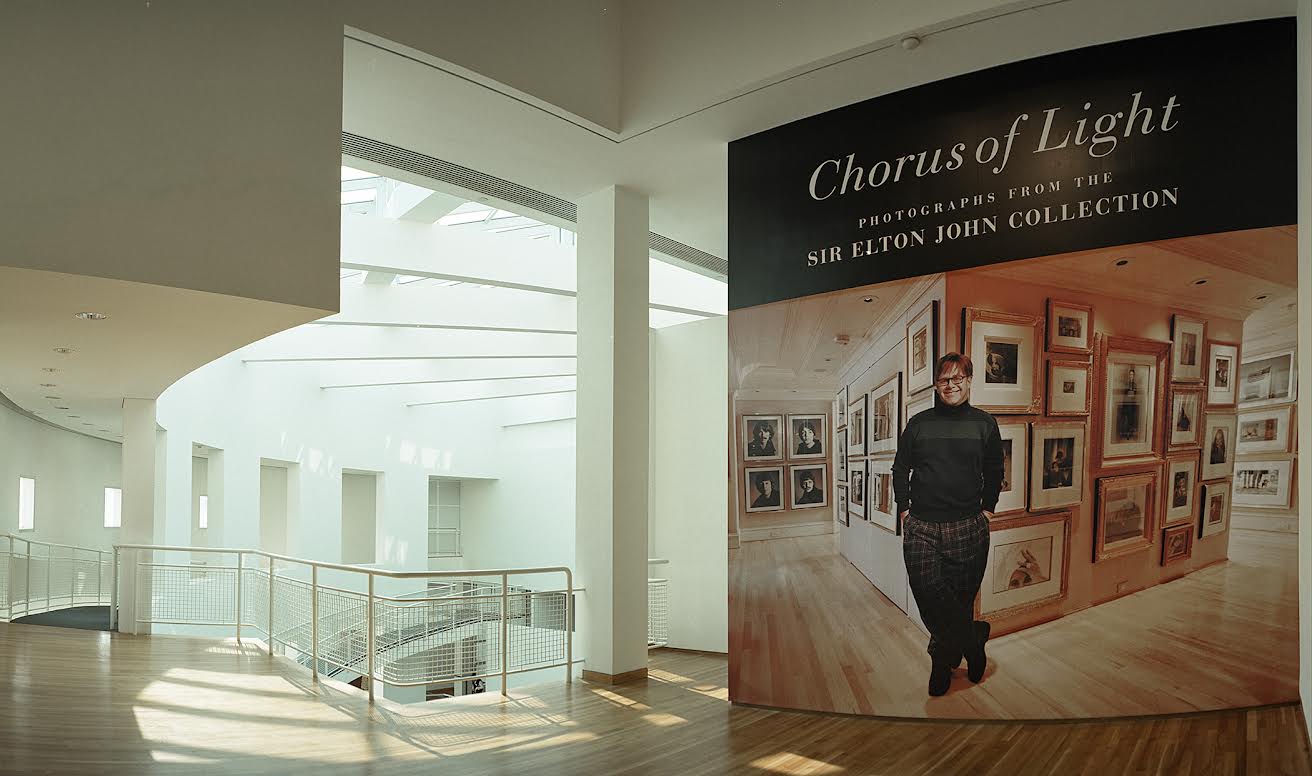
As part of the Sir Elton John project, when the elevators opened there was a photo of Elton that I took and at the time, it was the largest photo the High had ever displayed inside their building. There was some sort of full circle analogy for me in that moment. Not only was I working with the person who created the soundtrack to my life growing up, but I had realized that dream from when I was a 20-year-old kid. That was special.
Atlanta has been incredibly nurturing to me and my photography. From the first photos, with my Cub Scout camera at “The Atlanta Airport,” to a 40-plus year commercial photography career, to a recent MFA matriculation at Savannah College of Art — it’s been rewarding beyond words. The project “My Atlanta” is impossible to realize in ways that can never be adequately expressed. But, perhaps, there is valor in the attempt. This is my Atlanta.
::

Andrew Young, groundbreaking Centennial Olympic Stadium, 7/13/1993.
This image will always resonate for me as a visual preamble for the absolute act of community that would soon manifest, not only in the city of Atlanta, but the entire state of Georgia. Reverend Young raised his hands with a symbolic gesture of positive energy that felt both spiritual and sublime. On that hot, breathless, groundbreaking day in July 1993, he inspired this city to rise to the occasion and challenged the citizens of Atlanta to accomplish the seemingly impossible feat of hosting the 1996 Olympics.
::

Centennial Olympic Stadium, Track and Field Finals, 9/23/1996.
Perched high in the stadium, alone, with my cameras, I felt I was where I belonged. Minutes later, Michael Johnson would set the world record for the 200-meter gold medal race, and I had the privilege of bearing witness to the feat; one of many memories from that summer in 1996. Never before have I felt as connected to Atlanta in such a meaningful way. Four days later, a bomb would detonate in Centennial Park. To some degree, I lost a piece of my innocence and naivete that day. I look back on this optimistic, panoramic view of the Atlanta skyline and consider the consequences that were soon to follow. A city that would, metaphorically, rise again from the ashes of hate.
::

Evander Holyfield, World Heavyweight Championship title fight, the Omni, 10/25/1990.
Evander Holyfield gave the city of Atlanta an unprecedented gift by holding his first title defense at the Omni in 1990. Evander gave me a unique opportunity to document the event with unlimited access before, during and after the fight. To say the experience was surreal is a gross understatement. This image will always represent that visceral experience for me. A few years later, Evander invited me to his home to make a portrait. The two of us spent the entire day walking his property, talking of his life and his career. When he spoke of the Mike Tyson fight he suddenly became animated and expressive, recalling every minute detail of the final round; instinctively bobbing and weaving with the telling. I thought, in that moment, how wonderfully strange the whole story was — and how fortunate I was to hear it.
::
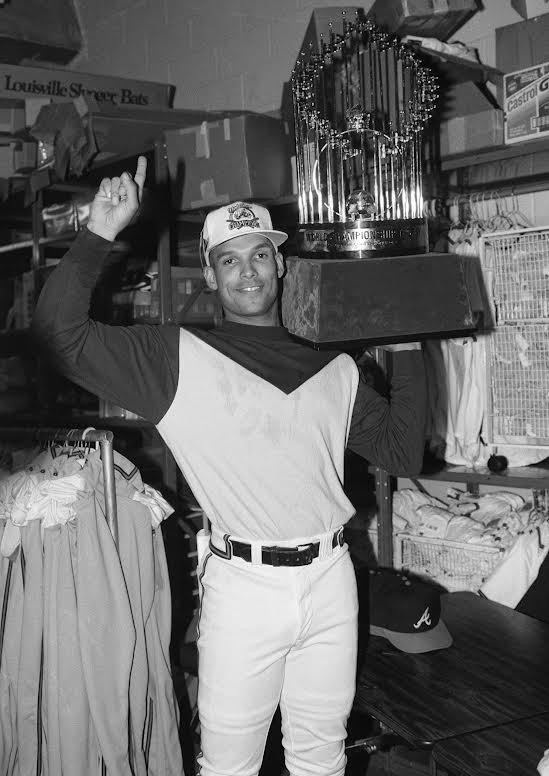
David Justice, World Championship Trophy, Braves clubhouse, 10/28/1995.
In the midst of a chaotic clubhouse celebration, David Justice tugged at my sleeve and told me to follow him. What happened next endeared me to Atlanta Braves baseball in a way that felt predestined. Behind a closed door to the equipment room was the trophy that was just carried from the field. David wanted a photo, as did Ted Turner, John Schuerholz and Stan Kasten. My camera was soaked in champagne and the flash was firing erratically, but I got the shot — all of them. I made thousands of photos of Braves baseball between 1990 and 2010, but none of them have more inherent agency than this one.
::

Nadia Mara, Fox Theatre, Atlanta Ballet’s Nutcracker, December 2003.
For more than 20 years I had the pleasure of serving as the principal photographer for Atlanta Ballet. The moment illustrated above is both unique and ordinary — much the way dance manifests itself every time it is presented. Standing alongside dancers in the wings of a stage is both intimidating and exhilarating. So many customs, beliefs and superstitions — you don’t want to exert any influence at all. You want to be invisible, but aware. Felt, but never intrusive. This photographic choreography is always a challenge but incredibly rewarding when accomplished. For me, this unremarkable moment is an integral part of the process where trust is earned and relationships are formed.
::

Tara Lee, Fox Theatre dressing room, “Madama Butterfly,” 2002.
I’ve always considered the dressing room as the first performance of the evening where the performer encounters their toughest critic: themselves. This self-appraisal is relentless and brutally honest — sometimes beyond reason, always (seemingly) justified. To bear witness to this private assessment requires a certain degree of diplomacy, but never at the expense of capturing an honest image. I am constantly amazed at the courage these dancers exhibit; never is there any refuge, even in the privacy of their personal space.
::
Sir Elton John in his residence, shown at the High Museum of Art, January 2001.
I remember that my knees buckled a little bit when the elevator doors opened and I saw the entry to the “Chorus of Light” exhibition at the High Museum of Art in 2001. Moments like that can actually take your breath away. If ever my photographic aspirations were realized in one place, this had to be it. My portrait of Sir Elton John, with his photography collection, featured in the High Museum, in Atlanta!
STAY UP TO DATE ON ALL THINGS ArtsATL
Subscribe to our free weekly e-newsletter.

PLEASE SUPPORT ARTSATL
Your Gift Sustains the Coverage You Count On!
Related Posts