Johns Creek Symphony’s 20th season centers storytelling, diversity and community
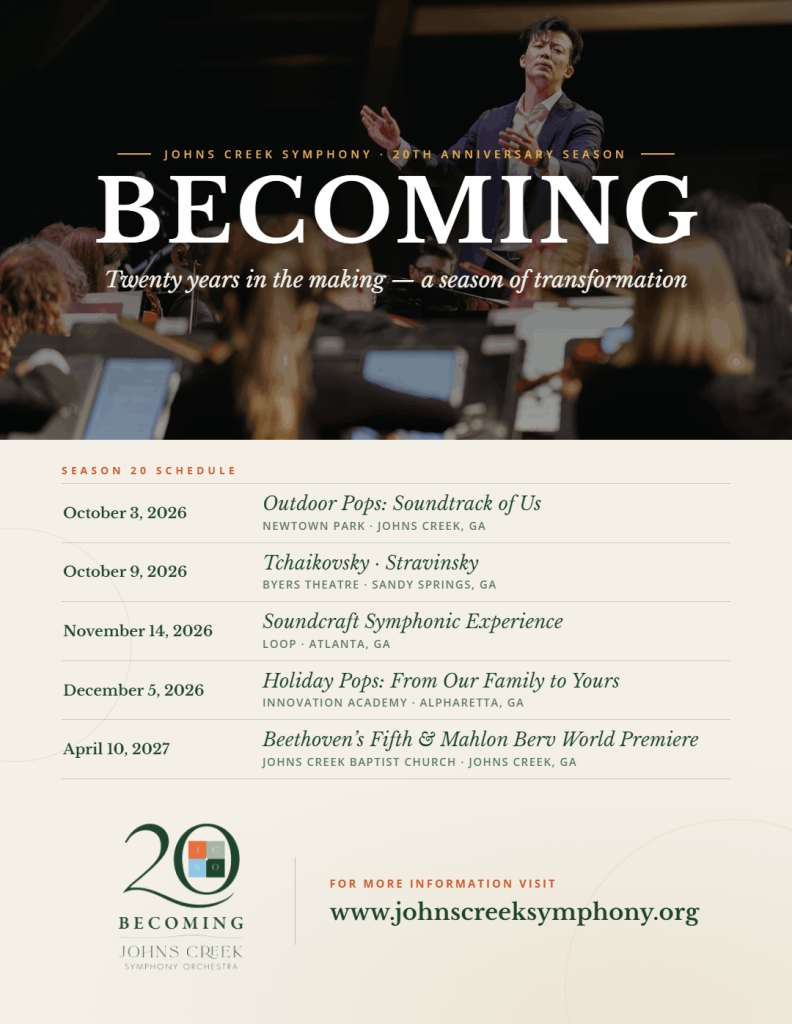
Johns Creek Symphony Orchestra director Henry Cheng is quick to point out that the orchestra’s 20th season has a very appropriate title: Becoming.
“What’s interesting about season 20 is that it parallels the growth of the city,” he explains. “Just as the city of Johns Creek is filling out its new boardwalk at City Hall and laying down infrastructure for its new city center, we’re laying down the equivalent of a new city center and boardwalk as well.”
Cheng’s fascination with how the JCSO’s growth parallels that of the city it serves is a clear echo of late founder J. Wayne Baughman’s vision for the organization as not just a local treasure but as an integral part of the city it serves. “Part of this is exploring what a professional regional orchestra can be,” he continues. “The season we just finished was called ‘Imagining,’ with the subtext of ‘imagine what we can do and what we can achieve together.’”
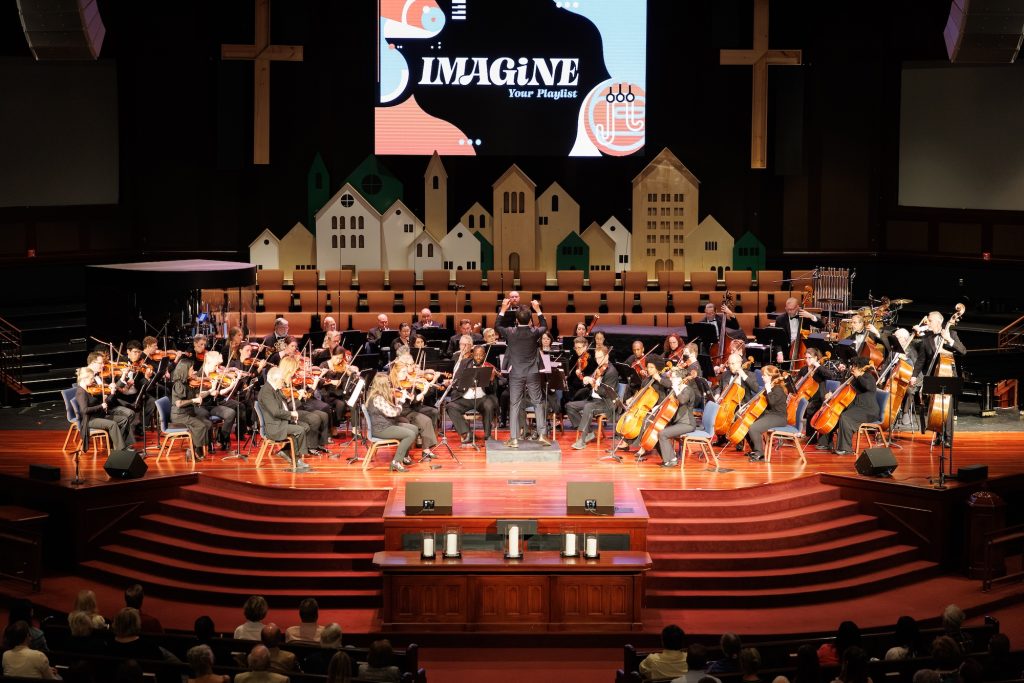
To that end, Cheng, along with Executive Director Philip Kim and the JCSO as a whole, spent the season asking the community at large what they want out of the orchestra going forward. One dimension of possibility has been their “music as healing” concept, an idea born out of the recent passage of Proposition 1007, which officially recognizes the arts as an important benefit to mental health in the state of Georgia. Another avenue of discussion was the prioritization of youth interests and the development of the next generation.
All of that research became the thematic backbone of the 20th season. “For our coming season, we’re saying ‘This is what we’re becoming. We’ve heard you,’” continues Cheng. “Arts organizations have to be a reflection of where society is today. What is our role within this ecosystem?”
To that end, both Cheng and Kim point to the orchestra playing a key role in the evolution of the city as a beacon for diversity. Cheng points out that the city’s strong ethnic diversity makes for fertile ground for cross-cultural experiments such as an examination of the compositional parallels between Beethoven and modern K-pop.
“It’s a very young city,” chimes in Kim. “It’s figuring out its own identity. It’s becoming a place that’s already diverse but wanting to bring in more folks and continue that community aspect.” He goes on to point out how the aforementioned expansion of community infrastructure echoes Baughman’s founding vision for the JCSO. “That is a special part of everyone’s experience as a human — finding their community.”
With that lofty vision in mind, we moved to the specific programming of the season ahead. Given Cheng’s love of the K-pop genre, I asked if there would be an altar to the Korean boy band BTS erected on stage.
“There will be K-pop. We’re not sure about BTS specifically yet,” he chuckles. The programming kicks off on October 3 with the JCSO’s outdoor pops concert and an emphasis on multigenerational programming. “K-pop is a part of Johns Creek’s story.” But he goes on to mention artists from other generations as well. “Why and how are those stories a continuation of each other? What journey are we painting?”
Cheng is quick to emphasize that while engagement with contemporary material is a priority, the classical canon is still critical. “The classical masters are the masters for a reason. They’ve achieved a level of mastery that has spanned generations.” The next performance, on October 9, will include works by Tchaikovsky and Igor Stravinsky’s The Firebird. Feature performances will be from Simon Zhu, one of the top young violinists in the world and winner of the Paganini international violin competition, and The Michael O’Neal Singers.
Another standout of the October 9 performance will be Songo di Volare (The Dream of Flight) by composer Christopher Tin.
“He does computer music,” enthuses Cheng, explaining that the piece comes from Tin’s compositions for the Civilization VI computer game. “Because we’re a storytelling community service organization, we have that flexibility with repertoire.”
The orchestra’s November 14 concert, Soundcraft Symphonic Experience, is derived from the digital sandbox environment of Minecraft, the popular online virtual world. The collaborative process will feature game players performing live within the game alongside the JCSO. On a symbolic level, it further represents the underlying focus on storytelling — the diversity of Johns Creek as represented by the digital denizens of the world’s most popular computer game.
And that is the “Becoming” that the season theme refers to: The JCSO is becoming a story-driven organization — one committed to delivering narrative experiences to its audience. “It’s also the idea of honoring the past and bringing it to the future,” Adds Kim. “The idea of connecting multiple generations. It’s honoring the memory of what Wayne has built and building upon that.”
::

Jordan Owen began writing about music professionally at the age of 16 in Oxford, Mississippi. A 2006 graduate of the Berklee College of Music, he is a professional guitarist, bandleader and composer. He is currently the lead guitarist for the jazz group Other Strangers, the power metal band Axis of Empires and the melodic death/thrash metal band Century Spawn.
STAY UP TO DATE ON ALL THINGS ArtsATL
Subscribe to our free weekly e-newsletter.

PLEASE SUPPORT ARTSATL
Your Gift Sustains the Coverage You Count On!
Related Posts