
Introducing the MAP Rover, Atlanta’s new mobile art projector
Those who celebrated the beginning of World Cup 2026 games at Underground Atlanta last Friday were treated not only to music by a live DJ but also to an interactive digital art projection called data game. Designed by Atlanta-based code artist and AI-product manager Neel Shivdasani, data game invited participants to stand in front of a game “screen” projected onto the top of the Best of Atlanta building while cameras and data tracked every movement before their eyes. The installation serves as a play on big tech and its invasive data-mining practices. Couples and friends alike, drinks in hand, came and went throughout the night to play this unwinnable “game.” Most, however, overlooked what made this interactive display possible: an unassuming black trailer just 30 feet away with a tall mast and a digital projector on top. This is the Mobile Art Projector, aka the MAP Rover.
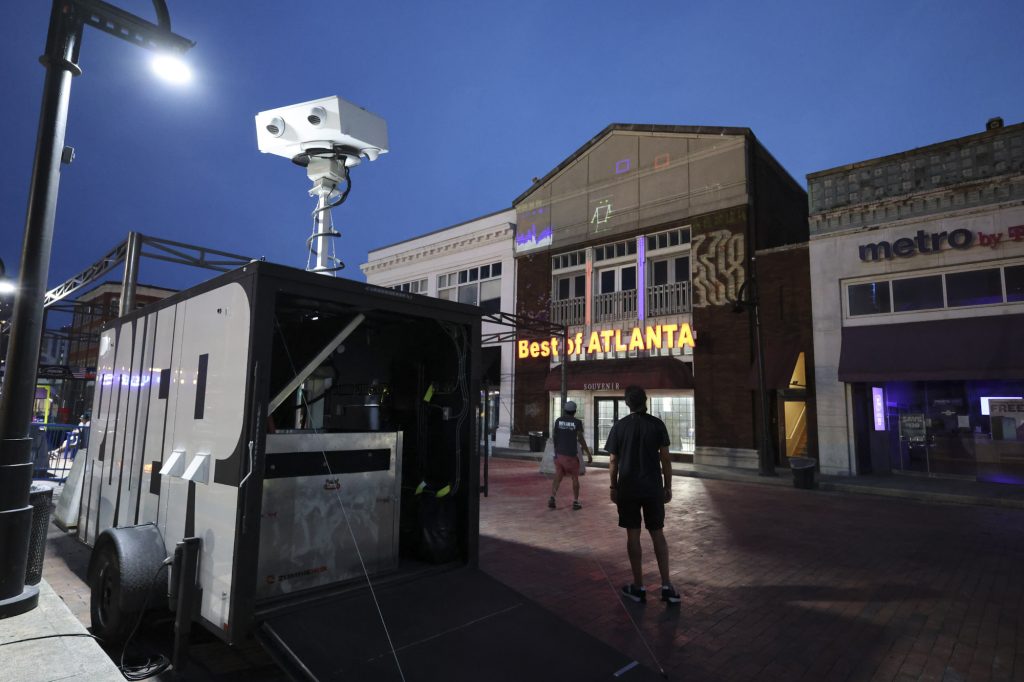
“As far as we’re aware, it’s the only one of its kind in the world,” said Alex Frankcombe, director of art and activation at Downtown Atlanta, Inc., which commissioned the MAP Rover last year. “There are trailers that have projectors, but none that have a whole studio set up [inside]. Most trailers just transport the project, whereas this is like an all-in-one creative kit.”
In addition to the state-of-the-art digital studio inside, other features that make the MAP Rover unique include an independent power source — a battery powerful enough to run all night — which allows for off-the-grid or difficult-to-access activations and a hydraulic mast to adjust the height of digital projections to suit variable landscapes. The Rover’s interior studio also is quite unique; it allows artists to bring their artwork on a USB or laptop and run their digital creations from inside. It’s akin to a mobile command center with its own monitor array and switchboard that lets creators switch between different feeds live at any point. (The interior even has air conditioning.) Perhaps most importantly, it also gives artists access to tools and technology that would otherwise be unaffordable.
To that point, Downtown Atlanta, Inc. recently partnered with Microsoft and MARTA Artbound to offer three MAP Rover residencies throughout the year. Through this partnership, Downtown Atlanta, Inc. also purchased more expensive equipment for use by these resident artists.
“I still believe that if we don’t provide artists with these opportunities and the tools to participate in this intersection of art and technology, especially in Atlanta, then they will just get left behind,” said Frankcombe. “And so, I think providing opportunities like the Public Art Futures Lab and MAP Rover give artists this chance to move beyond murals or sort of more traditional forms of art and explore what could be possible with these new technologies that are coming on board.”
To actually design the state-of-the-art projection trailer, Frankcombe tapped Ryan Kellogg — founder and design director of Techton-XD, which specializes in digital placemaking and installations — and veteran digital artist/designer and Georgia Tech faculty Daniel Phelps.
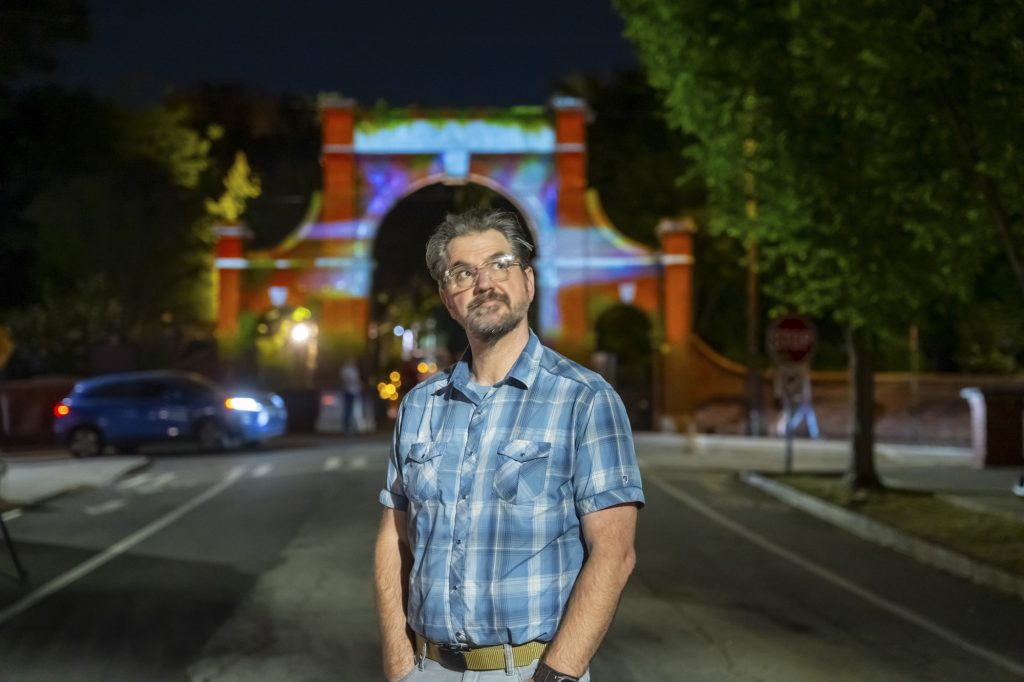
With a PHD in digital media and an MFA in integrated media arts, Phelps approached the design of this experimental roaming arts projector not as a technologist but, instead, as a creator. “I think one of the advantages of building something with artists in mind first is that you can cater to them like they haven’t been catered to before,” said Phelps. “Because this is an artifact for multimedia artists, and [it’s] something that doesn’t require much to fill their needs. They don’t have to rent anything. They don’t have to bring power. It’s just there, and it works. And I knew it would work, but I didn’t know it would work this well.” Phelps added that, to date, there hasn’t been a use case or landscape that the Rover couldn’t successfully fill.
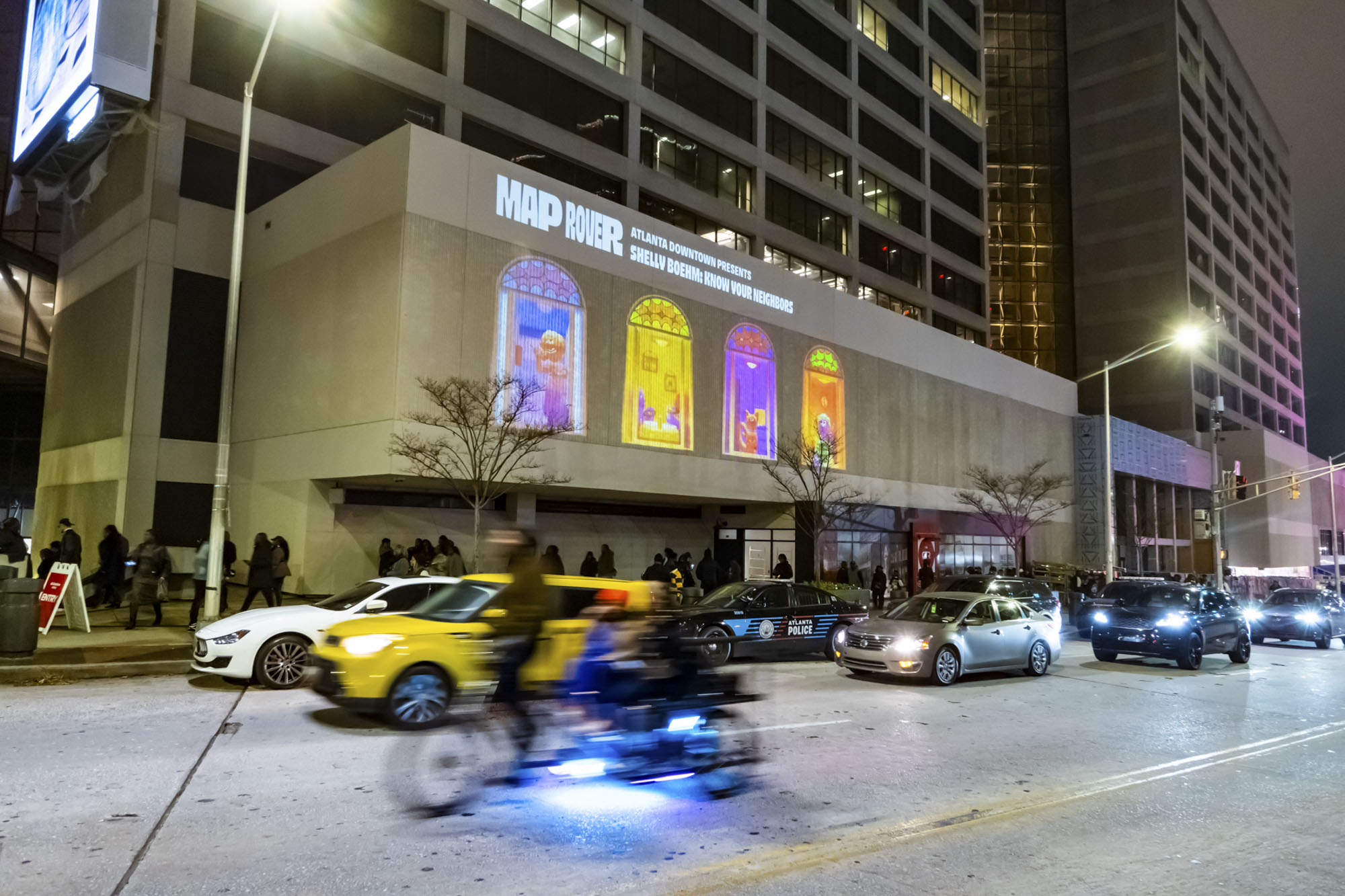
With construction of the MAP Rover coming in at $120,000, Downtown Atlanta premiered the Rover last August at Pullman Yards during the Atlanta Art Fair. The very next day, it had its second showing during SiTE at The Goat Farm Arts Center. Since then, this digital projector on wheels has been making the rounds in Atlanta, from downtown’s The Center (formerly CNN Center) to Oakland Cemetery’s popular illumine art event this past April, which included one of Phelps’ original creations designed to be projected onto the gates of the cemetery.
But what about the artificial intelligence employed in the MAP Rover? In recent years, use of AI has created a tsunami of uncertainty, anxiety and distrust among many creatives who fear replacement or competition from generative AI — justifiably so, because generative AI developers do not compensate artists or ask their permission for their creative works they use to train their products. However, and perhaps most surprisingly, this mobile digital arts center doesn’t use any AI at all. It’s essentially a combination of existing technologies, some old and some new: a mast with a digital projector on top, and a trailer with a tech media center inside. As for projection mapping –determining precisely how to “map” a digital image onto a building’s surface — that’s still done the old-fashioned way: by eyeballing it.
“The way the projection mapping works is that we can quickly set it up so we can run tests,” said Phelps. “We just pull it up and turn it on. We have cameras embedded in the actual projector, so when we do the projection, we have real-time feedback from the projector on the hydraulic mast.” Phelps notes that the MAP Rover does have a computer that can support AI models, and he has used AI in the creative process for some projects, including with the Rover.

“These tools are just tools,” said Phelps, who shared that he has embraced machine learning for almost 10 years. “If you let them become your entire creative process, then you create average, derivative art. It’s inauthentic. At this moment, AI makes good, authentic, human and emotional art stand out even more. And much like the effect creator culture has had on media, it forces us to refine and separate our message and aesthetic to ensure originality.”
During longer summer days, there will be fewer prime nighttime hours to make illuminated art, forcing an off-season of sorts for the MAP Rover. But Atlanta Downtown, Inc. and Frankcombe aren’t resting. “We’re planning our fall season at the moment, looking at partnering with some film festivals,” he said. “Since we did the Atlanta Art Fair at Pullman Yards and the Goat Farm for their SiTE exhibition, we’re exploring what that might look like for September and October.”
After not even a year of use of the MAP Rover, Atlanta Downtown, Inc. is considering the feasibility of a mini-version — something like an electric bike or ATV. This would mean no interior studio space, but, according to Frankcombe, some of the best views of the city are from the tops of parking decks, where the current Rover with its mast is too tall to access. And with a fleet of mini roving digital projectors, Atlanta Downtown, Inc. might’ve just discovered digital fire.
::

Jeff Dingler is an Atlanta-based author and entertainer. A graduate of Skidmore College with an MFA in creative writing from Hollins University, he’s written for New York Magazine, The Washington Post, The New York Times, Tiny Love, Newsweek, WIRED, Salmagundi and Flash Fiction Magazine. More information at jeffdingler.org.
STAY UP TO DATE ON ALL THINGS ArtsATL
Subscribe to our free weekly e-newsletter.

