‘Inside Out/Outside In’ finds joy and distress in the same toy chest
What happens when two artists use similar mediums to describe completely different emotional truths? A toy can be an object of joy or an accusation. In the hands of Rial Rye and Jeffrey Wilcox Paclipan, it can be both.
That tension, between seemingly opposing truths, anchors Inside Out/Outside In, opening Saturday, September 5 at Rampant Gallery at the Goat Farm Arts Center.
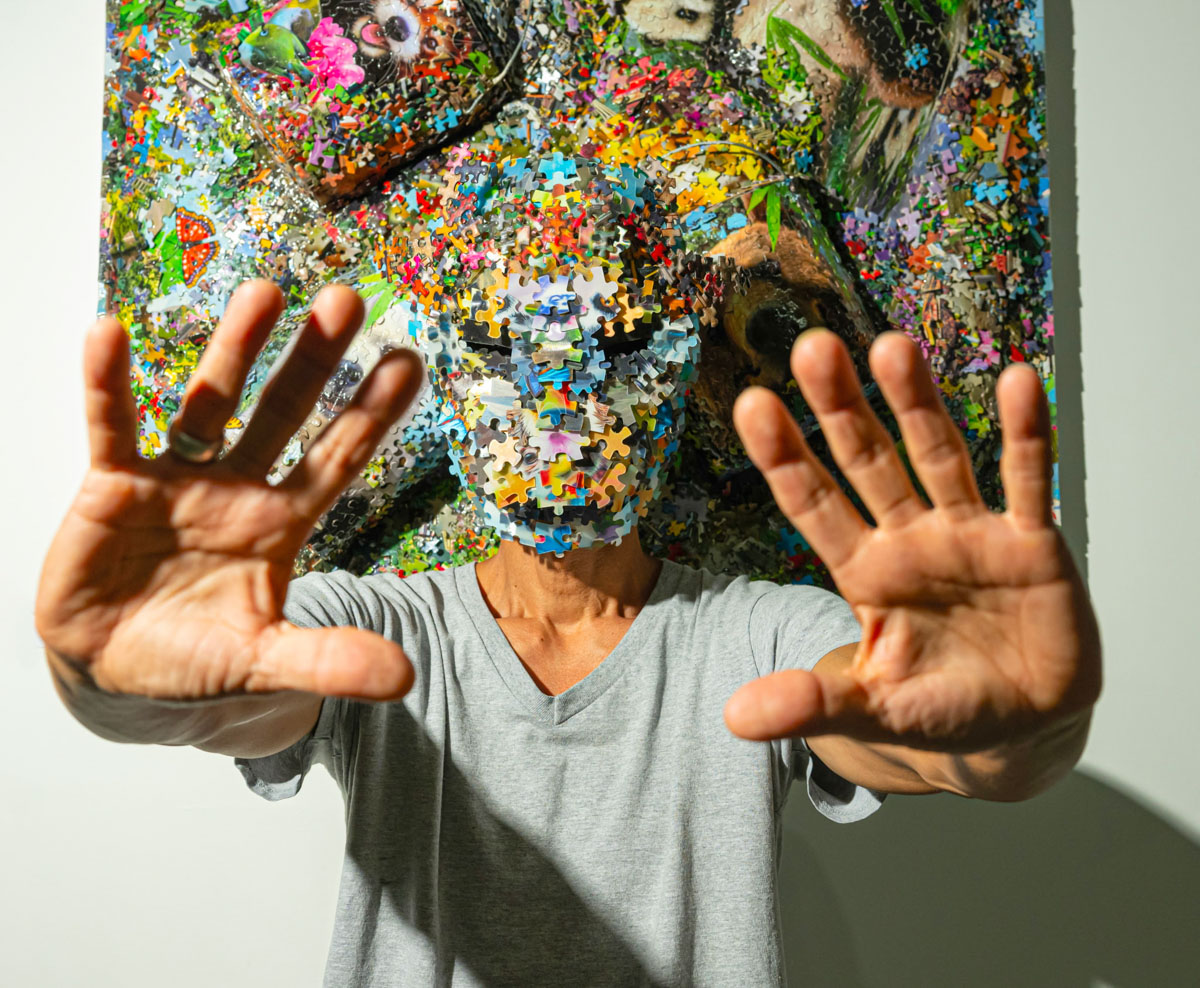
The exhibition juxtaposes the two self-taught, biracial artists, showing how they use similar visual vocabularies — toys, found objects, puzzles, plastics and explosive color — to arrive at different emotional destinations.
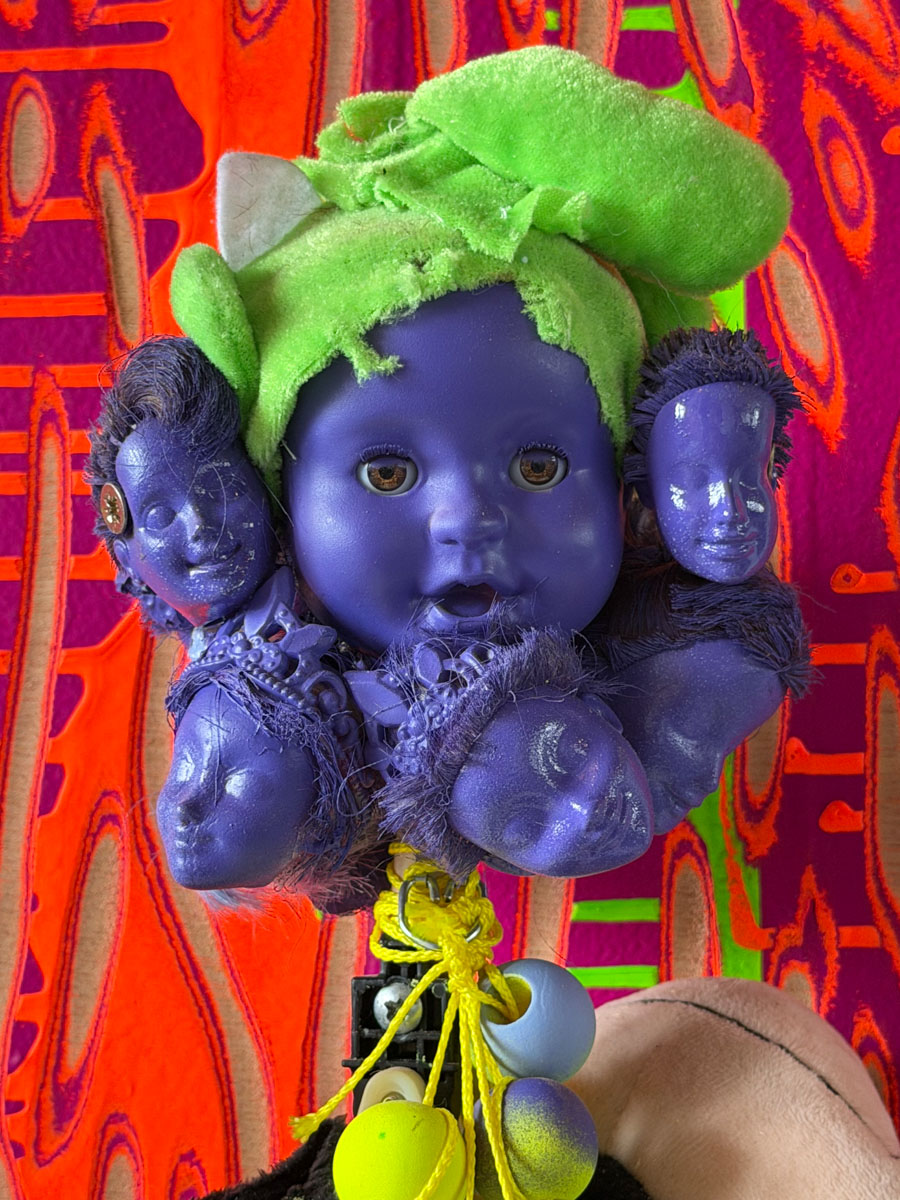
Rye’s Son of a Griff plays with griffins as a symbol. A griffin is a creature of two inheritances: part lion, part eagle, made whole by what might otherwise seem contradictory. For Rye, the symbolism is personal. While researching his family history, the biracial artist found ancestors of Black and Native ancestry labeled as “griffs,” a derogatory term, in census records. Rye reclaimed the image, rendering the griffin as majestic, mythical and impossible to reduce to either half.
The works emerge from a volatile place, Rye said. He distresses, fragments and reconstructs familiar objects to address race, religion, cultural erasure, queerness and the instability of existing outside dominant identities. The bright colors are deceptive.
“I think people look at our work and they think, ‘How fun,’” Rye said. “And for me, I don’t see it as fun.” He calls the approach “sugarcoated medicine.”
Some of Rye’s works also deploy nostalgia. He realized nostalgia could be a tool after watching a viewer react to a Raggedy Ann doll he had stuffed inside a toaster fashioned into a car. The piece referenced his grandmother’s story of growing up as a sharecropper’s daughter in rural Alabama, where white ranchers once shot the windshield of her family’s first car. The viewer, Rye noticed, was deeply distressed by the endangered doll.
“Toys are a safety item,” he said.
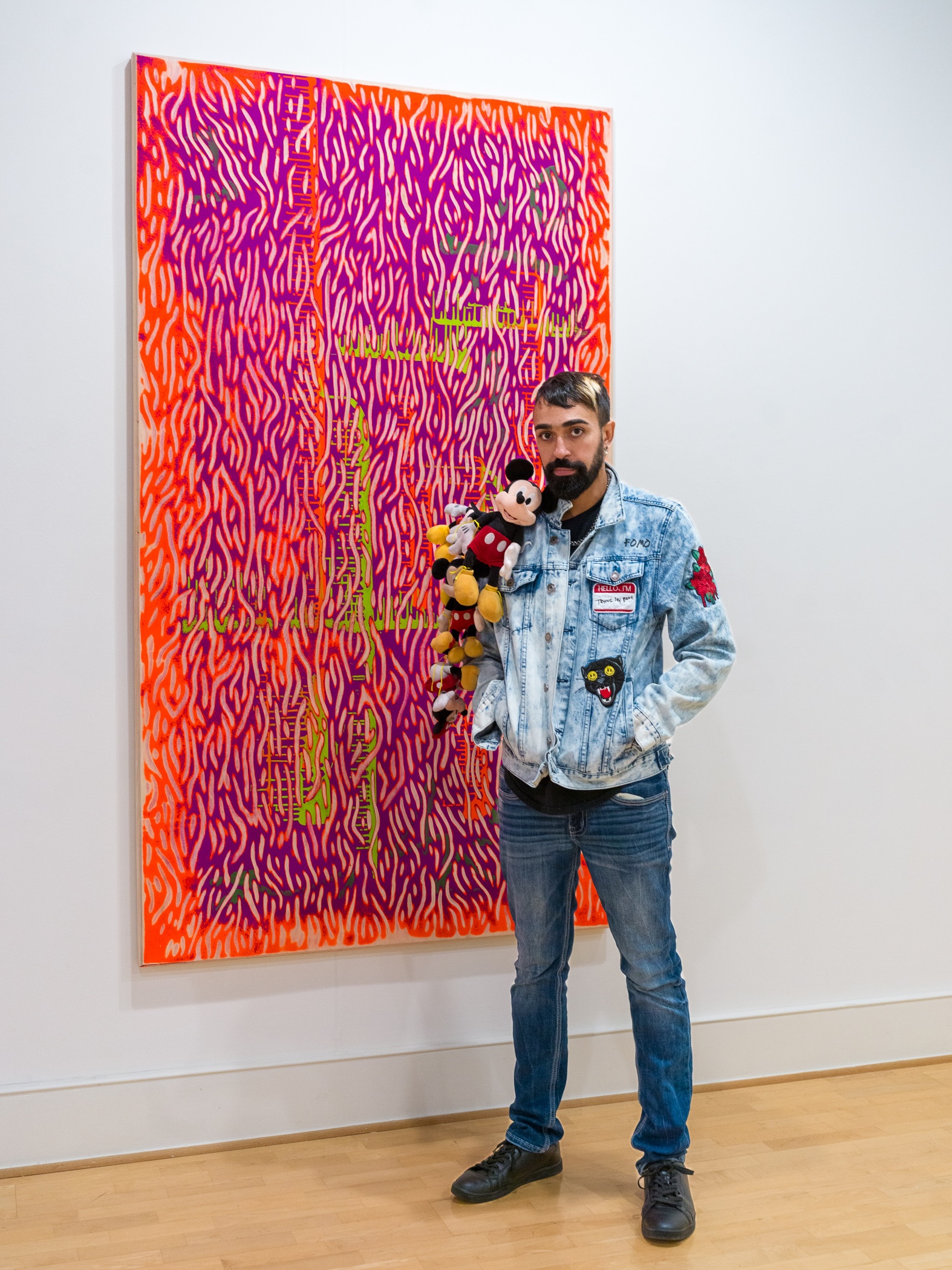
The encounter showed Rye that someone who might distance themselves from the suffering of a Black or brown person could still feel protective of an object connected to childhood. By disturbing that object, he could disturb the viewer.
Across from him, Paclipan understands his own multiplicity differently. The Filipino and white artist grew up moving every few years in a military family, repeatedly re-inventing himself while wrestling with being Asian, American and gay. Even now, Paclipan considers identity something unfinished.
“I’m letting my materials kind of define me as an artist,” he said, “but I don’t know who I am as a person yet.”
Paclipan begins with a similar emotional origin to Rye, yet moves in another direction.
Where Rye dismantles, Paclipan embellishes. Disney figures, wrapping paper, puzzles and discarded plastics become opportunities to recover the wonder of objects that have been consumed, forgotten or left behind.
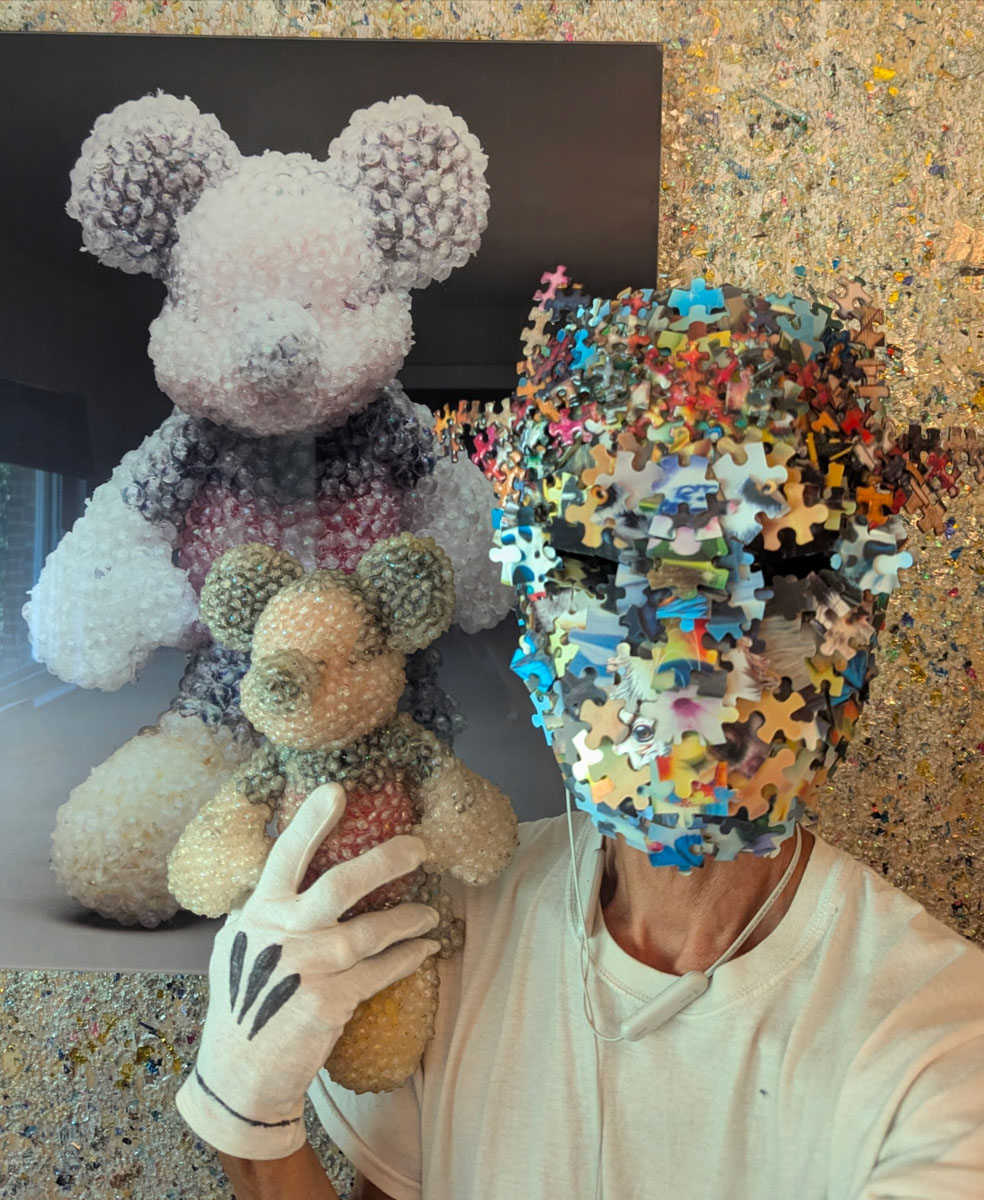
Paclipan remembers growing up fascinated by markers of American culture his family did not necessarily buy, such as Disney toys, Levi’s jeans and other coveted objects. He now finds many of them abandoned in secondhand stores. In his hands, their second lives are exhumed.
“I’m trying to show what’s inside and pull it out,” Paclipan said, “and to not be shameful and celebrate your color.”
His influences include Jean Dubuffet’s philosophy and the material experimentation of Mark Bradford, Mike Kelley, Jack Whitten and El Anatsui. Like those artists, Paclipan resists the idea that art must belong to a single material, method or traditional surface.
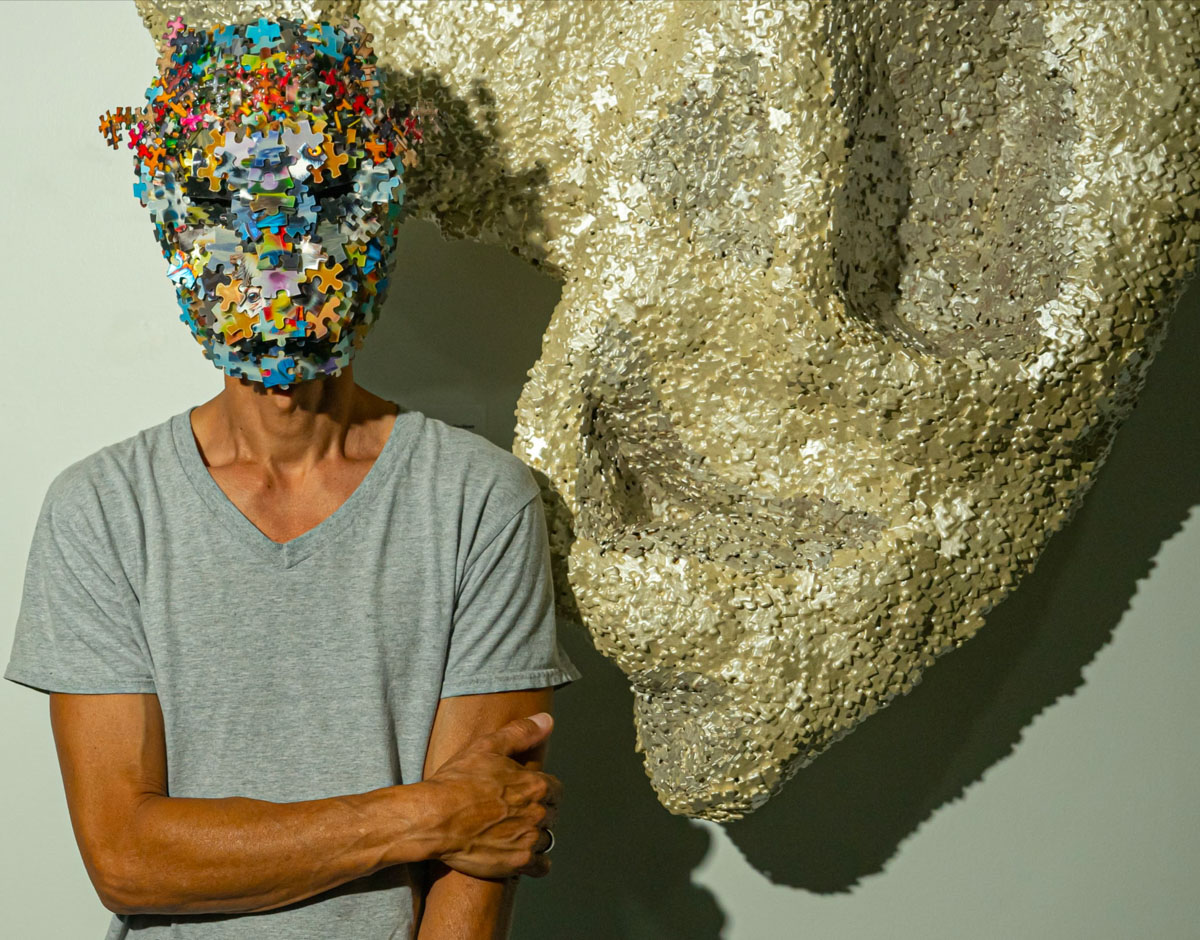
Puzzles have become one of his signatures. He was initially attracted to them as overlooked, discarded materials but gradually began to notice their potential and metaphorical weight: different cuts, images, surfaces and pieces that remain distinct also belong to something larger.
Paclipan even created an alter ego, Jigsaw, that gives him permission to speak more freely and claim the material as his own. Experimentation, for him, is part of self-discovery.
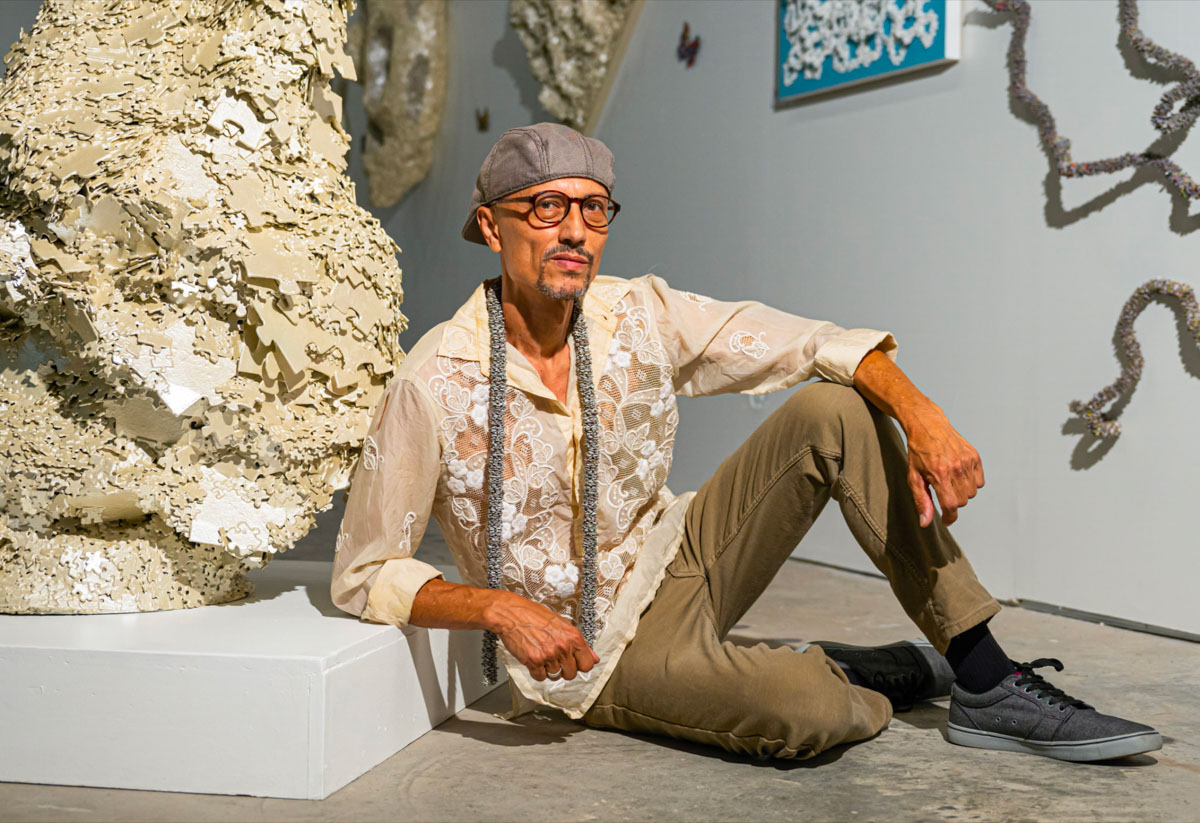
His joy, however, is not the absence of pain. Paclipan remembers once being ashamed of being Asian and afraid to say he was gay. He describes himself now as “hyper positive,” intentionally pushing against the anger around him. Happiness, anger and confusion all enter the studio — all pieces of the puzzle. What emerges is a choice to exalt, rather than to conceal.
Rye makes another choice. In A Great Southern Minstrel Show, an animatronic work combining Mickey Mouse and California Raisins imagery, turns childhood familiarity toward questions of minstrelsy and the consumption of Black creativity. Behind the figure is a mirror. The viewer cannot look without entering the picture.
One artist uses recognition to make the viewer less comfortable; the other uses it to make the viewer more comfortable becoming themselves. Neither approach stays neatly contained.
Rampant Gallery will be physically divided between Rye’s The Distressed and Paclipan’s The Exalted, with tape and curtain marking the threshold. But the artists deliberately undermine that binary. Objects and visual elements cross the boundary in what they call a “spillover effect.” The distressed enters the exalted; the exalted enters the distressed.
That porous boundary may be the most revealing part of the exhibition.
Rye’s work contains beauty. Paclipan’s joy carries anger, displacement and uncertainty. Their toys can evoke innocence while carrying histories their childhood owners could not yet understand.
Like the griffin, Inside Out/Outside In makes room for more than one inheritance.
Rye weaponizes nostalgia; Paclipan restores it. One asks what our childhood comforts might conceal; the other asks what they might still give back. Both begin with the same toy.
What we find inside depends on who is holding it.
Inside Out/Outside In opens Saturday, September 5, from 5 p.m. to 9 p.m. at Rampant Gallery at the Goat Farm Arts Center and remains on view through October 10. The opening reception will feature the debut of Catching Mangoes Dance’s Lotus Take Notice, a duet choreographed and performed by Madison Lee and Chi Rung that blends ballroom techniques with contemporary movement and draws inspiration from Asian pop culture, memes and social media trends.
::

Brittany Mackins is an Atlanta-based writer and creative with a deep love for the intersections of art, healing and community. Blending her background in journalism, brand storytelling, creative writing and event production, she writes to honor the stories behind the art, the lived experiences, emotions and cultural roots that shape creative expression. Her lens centers diverse artistry in all its expansive forms.
STAY UP TO DATE ON ALL THINGS ArtsATL
Subscribe to our free weekly e-newsletter.

PLEASE SUPPORT ARTSATL
Your Gift Sustains the Coverage You Count On!
Related Posts