

How Amy Hale helped the Tate revive Ithell Colquhoun’s ‘sex magic’
Atlanta-based art historian Amy Hale has spent decades ensconced in the world of Ithell Colquhoun, a forgotten British surrealist artist. Now Hale’s research has helped make sure the artist gets her due.
::

Art historian Amy Hale, author of Sex Magic: Diagrams of Love, Ithell Colquhoun (2024), is a gateway to Celtic, Surrealist and Cornish worlds. An Atlantan, Hale is a folklorist with a doctorate from UCLA, an ethnographer, a critic and a curator, as well as an author. She has spent her life delving into, immersing herself in and living all things Celtic.

For a long while, Hale led a bifurcated life. She taught writing online when the delivery format was brand new. This meant she was physically and geographically untethered while her heart and mind were in Cornwall. It was there where Hale discovered the British artist Ithell Colquhoun who was born in India, raised and educated in Britain and lived and worked in Paris and Greece before establishing a studio in Cornwall. That is where Hale “found” Colquhoun and subsequently was the first to begin to sort through Colquhoun’s vast archive, neglected in a dusty shed.
Hale’s work comes to the fore helping to organize the first major exhibition of Colquhoun’s work, opening in February this year at the Tate St. Ives in Cornwall. Hale explains: “It’s ‘EYE-thell. Her middle name” and “Col-HOON with ‘qu’ silent.” The surname is Americanized as Calhoun.
Colquhoun, who was born in 1906 and died in 1988, is primarily considered a forgotten surrealist. She strove in her art and writings to achieve enlightenment, by which she meant a sense of ungendered divinity. In 2020, after nearly two decades of “living” with Colquhoun and her art and writings, Hale published Ithell Colquhoun: Genius of the Fern Loved Gully: The Supersensual Life of Ithell Colquhoun, Artist and Occultist. The book is an engaging, in-depth, illustrated biography and art history. Hale writes, “Perhaps, Colquhoun should be recast primarily as a woman occultist with a tremendous output of writing, esoteric art and theory that greatly contributes to our understanding of what occult practice looks like.”
Hale writes that as an occultist, Colquhoun was “not the possessor of a superstitious or gullible mind.” She was a “creative actor commenting on and rejecting power structures and working to shape her own reality with a different set of tools.” Colquhoun “believed in a highly structured, idealistic universe with many layers, forms and entities that could be reached by the sensitive and the adept. Most of her artistic and esoteric projects were in support of this vision.”

Hale came to understand that Colquhoun was constantly “pushing against the tide; she was oppositional” yet at the same time she sought “public engagement and audience.” Colquhoun “remained unsettled because of who she was — uncompromising, bisexual without admission, an outsider in Cornwall” and “dedicated to an unconventional spirituality that recognized that the natural state of the divine is a fusion of male and female.”
To have such an interpreter of such a complex woman as Colquhoun at hand in Atlanta is fortuitous. Hale is easy-going, unburdened by social expectations, some would say quirky; she and the world she offers are fascinating, compelling, intriguing and unapologetic. Her dedication in Genius of the Fern Loved Gully provides a welcome: “To all the women magicians, past, present and future. May our stories continue to be told.” With this, she introduces to us, not only the unique and forceful Colquhoun, but also herself — both determined to not be constricted by the male-dominated worlds of art, Celtic customs and occultism.
Among the projects simmering simultaneously in Hale’s and Colquhoun’s merged spheres is Sex Magic: Diagrams of Love, which includes a dozen poems and more than 50 sketches and paintings in ink, graphite, gouache and, most frequently, watercolor. Hale selected and arranged the poetry and images, and her introductory text, “Exploring the Magical Erotic Corpus of Ithell Colquhoun,’’ establishes the book’s context: “From around 1939 to 1942, during the most intense and frightening years of the Second World War, Ithell Colquhoun created a body of obscure and explicit visual work focused on the principles of sacred sexual union.”

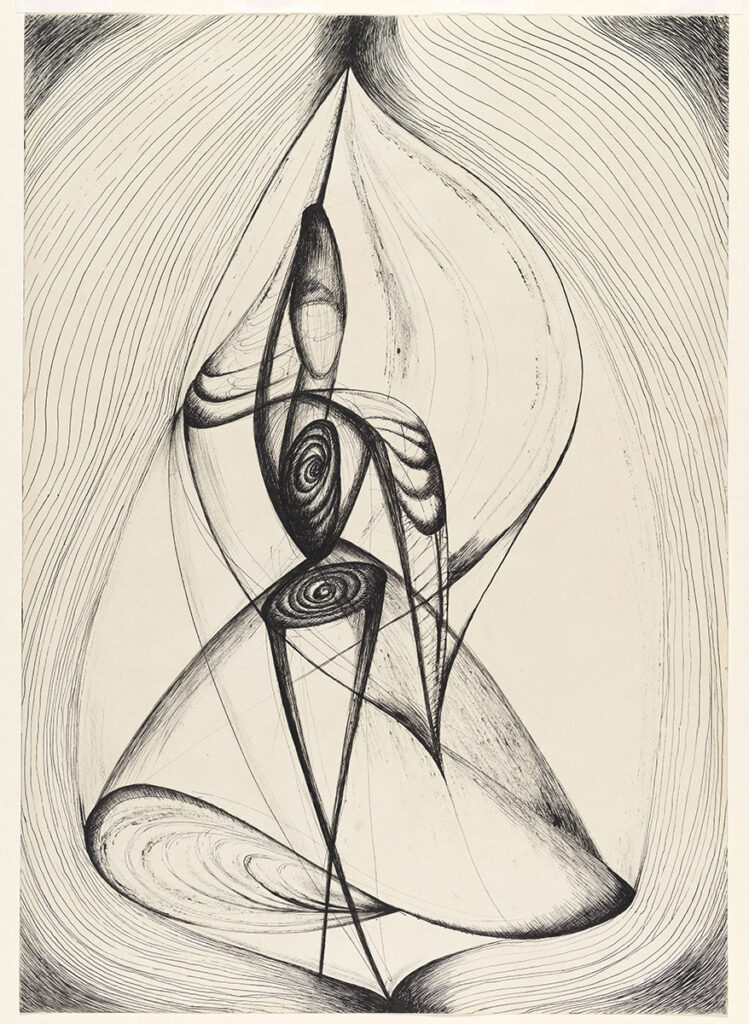
Colquhoun’s work gathered in Sex Magic “incorporates queer desires,” subverts “the male gaze” and centers “women’s sexual pleasure.” Hale cites historian of religion Hugh Urban that the concept of sex magic is “part of a wider program of reform and revolution.”

Hale writes, “Much of Colquhoun’s erotic body of work, and indeed many of her visual magical experiments, can be understood within the emerging discourses of science and technology in the first part of the 20th century, when boundaries were permeable. Although Colquhoun was concerned with the notions of spiritual enlightenment that today seem wildly subjective, 20th-century magical culture was inherently entwined with ideas about empiricism, science and progress.”
Hale herself describes Sex Magic as “bold and edgy” with “explicit sexual imagery.” However, the book is concerned with surreal aesthetic imagery that is as much scientific as sexual. In the beautiful Alchemical Figure: Androgyne, azure and magenta figures combine, with colors alternating and opposing so that the figures become one. Describing the complex Diagrams of Love: The Bird or the Egg? in which one also sees a phallus, a vulva, a heart and breasts, Colquhoun writes “The plaited water/Of the midstream/Flows between us/Links and divides/Purple and red/Blood in circulation.”
In her essay “Faith” from her unpublished autobiography Until Twelve, circa 1949, Colqhuoun writes, “If I say that at 10 years old, I imagined Christ as a hermaphrodite I shall not be believed. Yet it was so. Uncared for by my distant parents and needing shelter, I fused the red-hearted Jesus with the blue-cloaked Mary and made a god with breasts. I did not know the word El-Shaddai, not any word to express this image. I simply made the image and worshipped it.” This is Colquhoun’s painting Diagrams of Love.
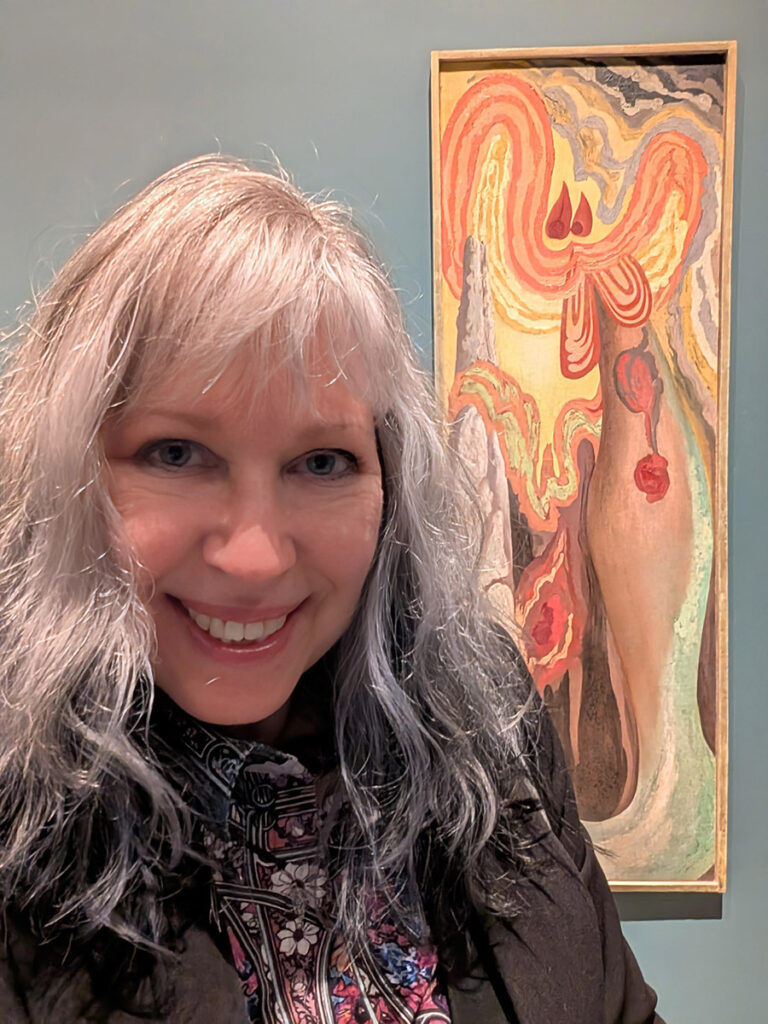
For the Tate exhibition of Colquhoun’s work, Hale not only assisted in selecting the works but also guided the curators, handlers and installers of the exhibition and contributed to the catalog. The Tate website announces that more than 200 artworks and archival materials will show that “Colquhoun explored the possibilities of a divine feminine power as a path to personal fulfillment and societal transformation. Her understanding of the world as a connected spiritual cosmos brought her to Cornwall, where she deepened her creative explorations, inspired by the region’s ancient landscape, Celtic traditions and sacred sites.”
In an effort to continue advancing knowledge of Colquhoun, Hale shares her knowledge with multiple audiences, such as the Philosophical Research Society, the podcast “Great Women Artists with Katy Hessel” and on her website. Her forthcoming book shifts the focus to Colquhoun’s writings: A Walking Flame: Selected Magical Writings of Ithell Colquhoun.

“Ithell Colquhoun was a challenging personality and the most consequential, creative and committed female occultist of the 20th century; she was ahead of her time,” concludes Hale.
“What she wanted was for women to be free, to do as they wanted, free of harassment. It may be that Colquhoun from her earliest days was breaking boundaries and embracing taboo as a spiritual exercise, helping to move herself and her audience toward liberation, which also became a theme of her work to know that they were divine.” This is what Colquhoun was searching for — “a divine feminine.”
Perhaps Hale wants the same. “Expressive and contextual writing about art” is her profession. She declares: “The fact that I don’t fit into neat tidy boxes is, in my view, a feature, not a bug.”
::
Pearl McHaney, Kenneth M. England professor of Southern literature emerita at Georgia State University, is a former associate dean of fine arts at GSU, an avid reader and an appreciator of the arts. She is the co-founder of Revival: Lost Southern Voices and founding editor of the Eudora Welty Review.
STAY UP TO DATE ON ALL THINGS ArtsATL
Subscribe to our free weekly e-newsletter.

