Review: Heather Bird Harris sees the Earth’s future at Spalding Nix

Heather Bird Harris’ love as large as grief demands is a captivating exhibition, one of four that can now be seen at Spalding Nix Fine Art. It explores the intersection of the materiality of natural pigments native to Georgia, the problem of industrial waste upon our environment and the personal implications Harris reckons with as an artist, educator and mother.

This poignant and thorough exhibition displays a beautiful series of works on paper, many of which are mounted on wood panel and conceptually point to something much darker that lies beneath the surface. They are airy yet sturdy, fiery yet gentle, strong yet soft in image with their luminosity and atmospheric fields of pigmentation. They also spell out a sordid reality of ecological crises.
At first glance, these works are lovely expansive abstractions, peppered with the occasional suggestion of landscape and childish drawings. There is an elegant quality in which Harris allows the materials to run their course, pigmentation dispersed through water diffuses and dries in formation as its physics demands. This creates a visual that connotes both an airiness and fluidity.
The works are muddled but in the best possible way, allowing viewers to delve into the ethereal nature without getting lost. This blending of paint and pigments is warm and welcoming, inviting viewers into their bright embrace.
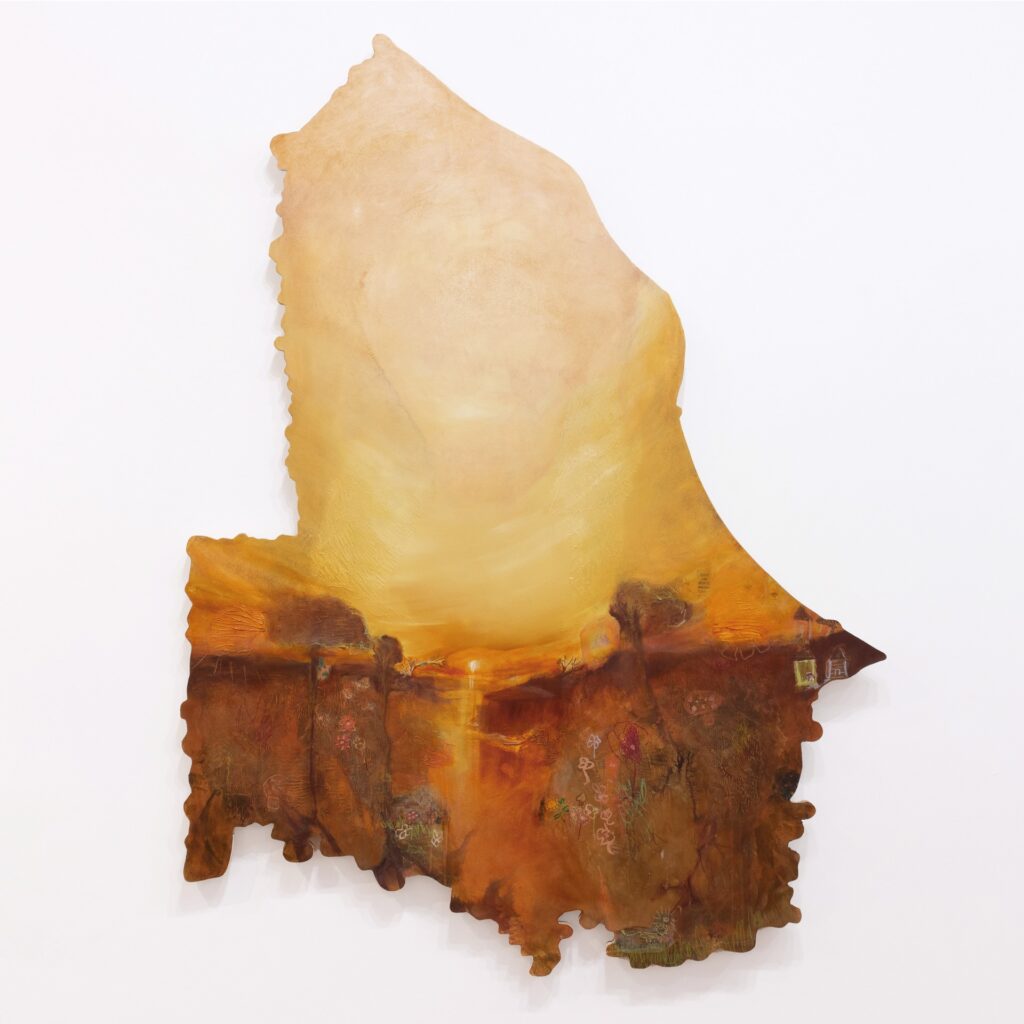
In Entropic Possibilities & the Impossibility of Cop City, the shape is peculiar, of something delineated by the state, a boundary seemingly arbitrary, attempting to destroy a forest in our city. Its top portion is a swathing wash of golden yellow, thickening to ochre as it meets the horizon line. A sun punctuates its middle, casting the foreground in a willowy russet. Toward the bottom of the piece, one will find patches of grass, flowers and houses crudely drawn in what looks like crayon but imbued with a sincerity that could not have been faked.
Fleshy colored and sensuous, Affordances of Water (Atchafalaya Basin) presents a rich wash of red ochre and clay from the Mississippi River, where concentrated moments of pigmentation disperse in a manner like fine roots, while other moments become like a silken heart of deep red with lush expanses of pulpy pinks in between. The edges where water dries more translucent are rendered soft and delicate.
Harris notably uses pigments derived from local sources and site-specific materials. Wild flora and fauna such as wild grape, Georgia clay found in her backyard and walnut can be found in the materials listed.

However, inorganic and man-made chemicals also play their role in some of these works, with coal from a shipwrecked coal-burning vessel and weathering rinds (the outer layer of weathered rock) that have undoubtedly been tainted through the years by continuous industrial and residential growth. A process, developed by Harris, extracts the pigmentation from these elements, utilizing them throughout the works.
Weathering in the geologic sense is the process of deterioration of rocks and minerals over time. This happens both naturally and unnaturally, and it is this difference to which Harris draws attention. By using weathering rinds, the works reveal aspects of how our topsoil and surroundings have been changing. It is this disparity between various natural and unnatural factors and their effects on the environment that Harris elucidates, chronicling changes in geologic strata over the years.
This is also made apparent throughout many of the paneled pieces; their irregular shapes trace the outline of various sites of environmental harm happening in Georgia and Louisiana. Such locations include a DuPont chemical factory, the infamous Atlanta Public Safety Training Center known as “Cop City” and Georgia Power’s Plant Hammond in Floyd County, Georgia, which was “retired” in 2019 but whose effects may be reckoned with for generations to come. Harris’ work underscores the trauma done by these industrial developments and superimposes her own visions of an alternative landscape, a brighter future.

In addition to the use of locally sourced materials, Harris incorporates the drawings of her children. These tender moments within the works draw upon and coalesce the complex reality of environmental ruin and future generations, pointing toward a question of what comes next, what kind of world will our children inherit and how can we sow seeds of hope?
The scrawl of children’s doodles depicting rudimentary wildlife sprouting throughout the works are endearing and heartwarming. One can read “MOMY BIRD” in a portion of one piece, and it’s hard not to consider how these works, our ecosystems and the young collaborator will age if our current course isn’t corrected.
As grave and ominous a reality as the works imply, they offer an equally radiant and stunning image of what could be. All together love as large as grief demands is a spectacular culmination of environmental investigation and personal reflections presented in a concise and considered manner that should not fall on deaf ears.
::

Noah Reyes is an artist taking steps in many different directions, resulting in a continuous dance between curating, writing and artmaking.
STAY UP TO DATE ON ALL THINGS ArtsATL
Subscribe to our free weekly e-newsletter.

PLEASE SUPPORT ARTSATL
Your Gift Sustains the Coverage You Count On!
Related Posts