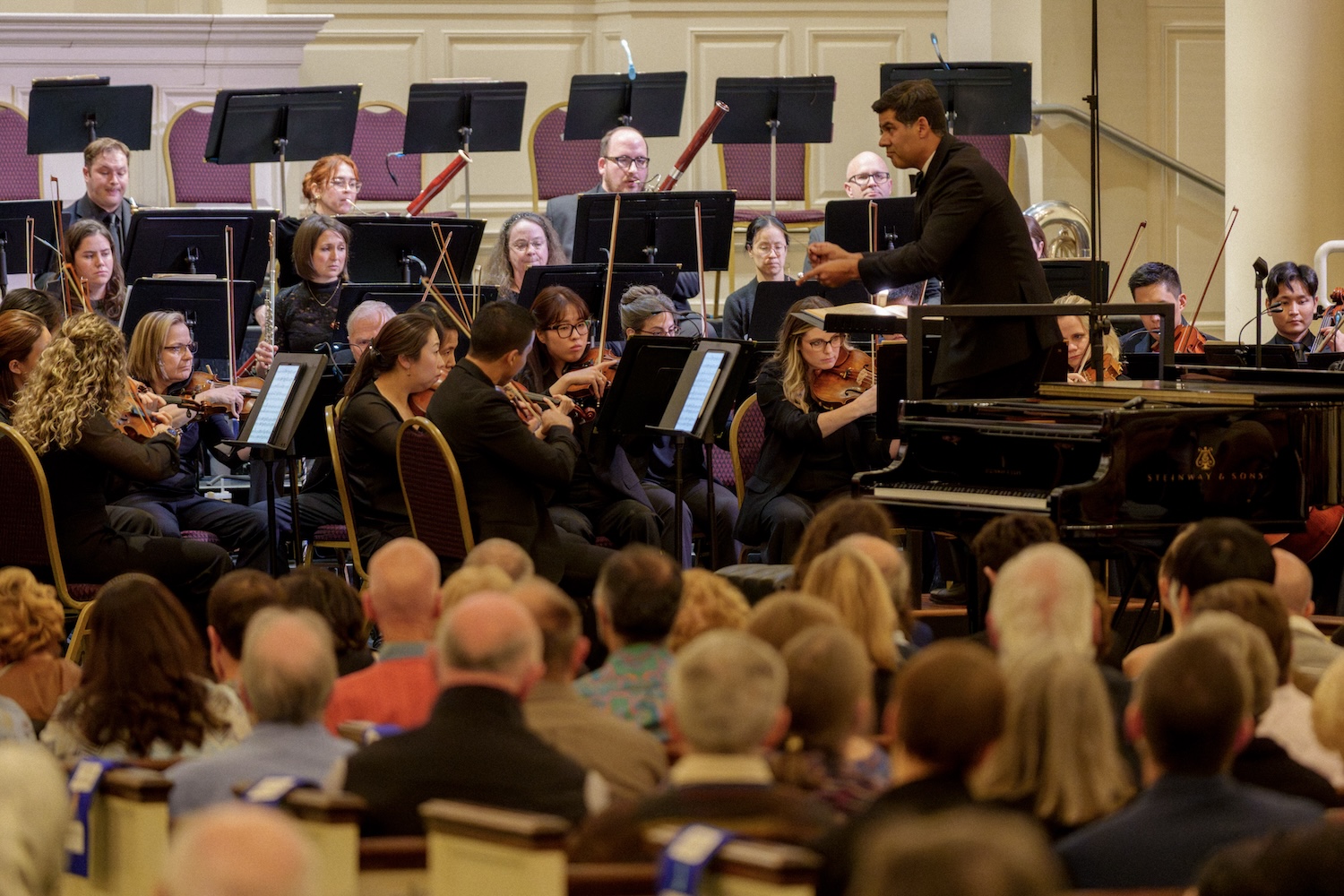
DeKalb Symphony gets a venue upgrade and shines with newfound cohesion
The DeKalb Symphony Orchestra’s November 4 concert was, first and foremost, a triumph of architecture. It’s doing the majority of its current season at First Baptist Church of Decatur, and the acoustics are a far cry from orchestra’s usual haunt at Georgia State University’s Marvin Cole Auditorium, where even the most lush and majestic of orchestras sound like gridlock traffic.
The warmly conversing woodwinds in the opening strains of Maurice Ravel’s Le Tombeau de Couperin confirmed what I’d long suspected was holding the DSO back: They just couldn’t hear each other well on the GSU stage. Now, the sonically pristine chapel of First Baptist was affording them the opportunity to play with, rather than at, each other, and the results were nothing short of transcendental.
Listening to the orchestra’s newfound integration reminded me of an old joke: A man goes to his doctor because he’s concerned his wife is losing her hearing. His doctor advises him to stand at the top of the stairs and ask, “What’s for dinner?” repeating the question as he gets closer to see how long it takes her to respond.
So the man stands at the top of the stairs and calls, “What’s for dinner?” Nothing. He goes halfway down the stairs and tries it again. Nothing. Finally, he comes right up behind his wife and shouts, “What’s for dinner?”
His wife spins around and says, “For the third time: chicken!”
That stark reality, that it’s often not readily apparent who can’t hear who, can make or break any musical ensemble. In the case of the DSO, I thought back to my first review of the orchestra and recalled that I’d speculated even then that the acoustics were impacting the ensemble cohesion.
Le Tombeau de Couperin was a good piece to introduce the newly cohesive DSO. Ravel knows how to strike that delicate balance between memorable, engaging melodies and the potential for complex underpinnings afforded by the classical orchestra. As such, Le Tombeau can be heard on multiple levels, both as melodic escapism and a virtuoso gauntlet. Tonight, the oboe and English horn section — led by principal Rebecca Testerman — carried the orchestra in striking an excellent balance between the two.
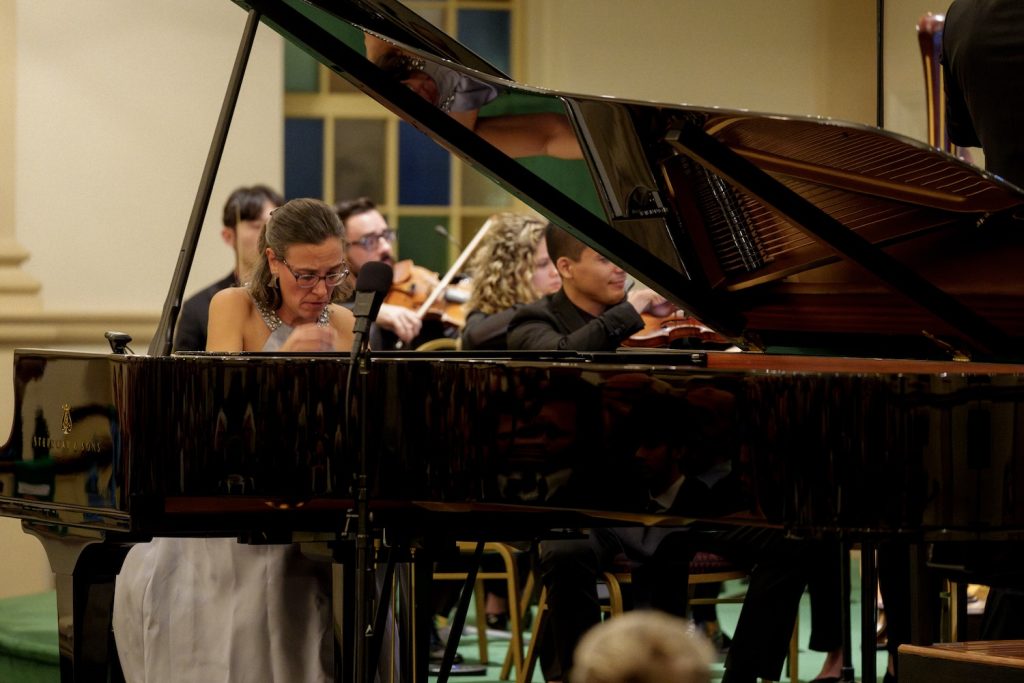
The evening’s guest soloist was Dr. Heather Conner, who serves as chancellor’s chair of piano and professor of piano at the Blair School of Music at Vanderbilt University. Conner joined the DSO for Sergei Rachmaninoff’s Piano Concerto No. 2 in C minor, Op. 18, and commenced the piece with a defiantly strong left hand that felt as much like a slap across the face as an opening harmonic statement.
That ominously solemn gesture set the stage for a rather interesting dialogue between orchestra and soloist, one that at times threatened to tip the carefully stated sense of tonal balance that had been established with the earlier Ravel. There are points where the orchestra creates a sort of sonic wind tunnel around the piano, and these harmonically dense passages seemed to be pitting Conner against the ensemble rather than complementing her.
Those treacherous passages aside, orchestra and soloist both shone during the concerto, with the technically adroit Conner shining brightest during the Allegro scherzando and the delicate sensibilities of the DSO coming through on the Adagio sostenuto.
The expansive, all-encompassing nature of Rachmaninoff’s second piano concerto covers so much ground that it almost seemed like overkill to include Tchaikovsky’s Romeo and Juliet Overture-Fantasy for the evening’s second half. Nevertheless, it was a consummate joy that spoke to the earlier sense of inner cohesion felt during the Ravel.
Tchaikovsky is to the classical canon what Friedrich Nietzsche is to philosophy: so endlessly quotable and ingrained in the public psyche that many people are familiar with his most popular ideas, whether they know it or not. Romeo and Juliet is a perfect example of that, with one theme after another that’s shown up in film and television to the point of cultural ubiquity. As such, the piece is a pretty safe bet and one that was well chosen this evening, affording the DSO an enthusiastic standing ovation from the capacity crowd.
Orchestras have their own unique personalities. In the local area, there’s the Atlanta Symphony Orchestra, that long-standing bastion of regal prestige. Around the corner is the Johns Creek Symphony Orchestra, a more theatrical neighbor with modern crossover leanings. And then there’s the DeKalb Symphony Orchestra, which I’ve always thought of, affectionately, as the Little Orchestra That Could.
Even with the recent and controversial round of layoffs, that scrappy upstart energy was intact Tuesday night, though tempered by a newfound sense of maturity. There may be rumblings behind the scenes at the DeKalb Symphony Orchestra, but this was, nevertheless, a concert that showed that its front-facing edifice remains intact and even a little more pristine.
::

Jordan Owen began writing about music professionally at the age of 16 in Oxford, Mississippi. A 2006 graduate of the Berklee College of Music, he is a professional guitarist, bandleader and composer. He is currently the lead guitarist for the jazz group Other Strangers, the power metal band Axis of Empires and the melodic death/thrash metal band Century Spawn.
STAY UP TO DATE ON ALL THINGS ArtsATL
Subscribe to our free weekly e-newsletter.

PLEASE SUPPORT ARTSATL
Your Gift Sustains the Coverage You Count On!
Related Posts