Conversation is the goal for the Atlanta History Center’s new film, “Monument”
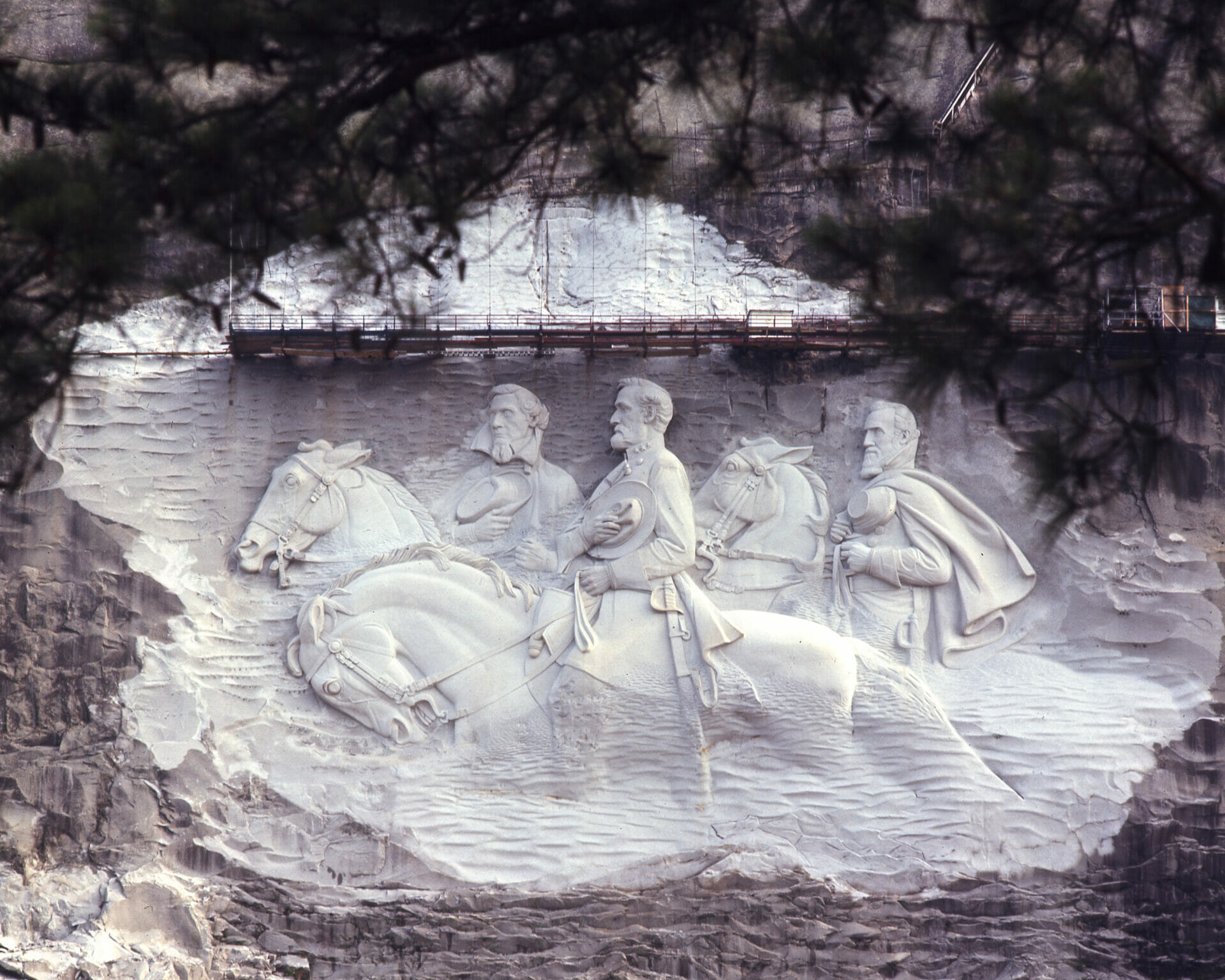
Grappling with the immovable problem of the Southern Civil War leaders carved into its colossal shoulder, Monument: The Untold Story of Stone Mountain is the Atlanta History Center’s admirable attempt to come to terms with the state’s thorniest memorial. The question hanging over the documentary might be phrased like this: Can those Confederate figures — Jefferson Davis, Robert E. Lee and Stonewall Jackson — be seen as riding their horses safely into the distant past, or are they stampeding uncomfortably across our state’s present and future?
“It is literally the largest Confederate monument in the world . . . And that is really weird,” says the Atlanta History Center’s vice president of Democracy Initiatives, Claire Haley. She’s one of many talking heads in the 32-minute film, which includes perspectives from other social activists, public figures and scholars across multiple disciplines, trying to put the tainted, Atlanta-adjacent landmark into context.
Given its complex history, the mountain can be seen alternately as a breathtaking natural wonder — or as a massive psycho-sociological pimple erupting from Georgia’s body politic.
Front-loaded with salient quotes from its onscreen commentators, Monument underscores one point right away: The mountain itself played zero part in the history of the Civil War. It held its ground with stony indifference, 20 miles away from General Sherman’s burning of Atlanta. Nevertheless, it is preserved in Georgia law as a Confederacy memorial. A state code explicitly protects the carving from ever being “altered, removed, concealed, or obscured in any fashion.”

The history of the chiseled artwork on the mountain’s side reflects wider national events of the 20th century. It’s fitting that Monument is a movie, since another film plays a big part of the story here.
In 1915, D.W. Griffith’s The Birth of a Nation dazzled viewers with camera angles, tricks and edits that became standard filmmaking tools for decades to come. It moved people, including president Woodrow Wilson, who may or may not have said it was like watching history written with lightning.
Problem is, the story the film told was based on a fictional piece of twaddle that glorified the original incarnation of the Ku Klux Klan, White vigilantes during the first seven years of Reconstruction. The film’s yeehaw racist power on some of its viewers led to the creation of the second Klan, inaugurated with cross burnings on the top of Stone Mountain that same year.
The next year, spearheaded by a charter member of the United Daughters of the Confederacy, the carving on the mountain’s side began to emerge under the chisel of Gutzon Borglum. With only Robert E. Lee’s head partly depicted, the project was left incomplete after 12 years. (Borglum would carry his chisels next to Mount Rushmore.)
The initial carving was a physical manifestation of the Jim Crow era following Reconstruction, giving rise to segregated facilities for Blacks and Whites and 700 Confederate memorials erected around the nation decades after the actual end of the Civil War. Carving on Stone Mountain resumed in the mid-’50s as part of Georgia Governor Marvin Griffin’s campaign promise of “massive resistance to integration.” The sculpting continued through the 1960s, marching stroke-by-stroke in opposition to the steps being taken by civil-rights marchers.
A later Georgia governor, Roy Barnes, interviewed in the film, removed the Confederate stars-and-bars from the state flag in 2001, sparking a backlash that he calls “the most overwhelming thing I had seen.” Barnes recalls that due to the South’s glorification of the so-called Lost Cause, it wasn’t until he was in high school that he learned the Confederacy actually lost the Civil War.

That chimes with my own recollection. Even at the progressive high school I was lucky to attend, the prominence of slavery in American history was given much less study than it warranted. The Civil War came to my attention most prominently via a film as reckless with the facts as Birth of a Nation — that is, Gone With the Wind. But that’s another conversation.
And conversation seems to be the ultimate goal for viewers of Monument, no matter what their initial thoughts about Stone Mountain might be. Crisply shot, well-paced and filled with interesting observations, the film gives equal time to a young Decatur activist involved with the removal of the Confederate obelisk there, as well as the daughter of the sculptor who completed the Stone Mountain carving, rightly proud of her dad’s work.
In addition to being a record of the monument’s creation, the History Center’s film serves as a vital jumping-off point for discussions not only about our city’s past, but very much about its future. Overseen by Kristian Weatherspoon, the Center’s vice president of Digital Storytelling, it’s the sort of short film you’d most like to see in institutions that undertake to tell us who we are and where we might be going.
To watch online, visit atlantahistorycenter.com/monument/.
::
Steve Murray is an award-winning journalist and playwright who has covered the arts as a reporter and critic for many years. Catch up to Steve’s previous Streaming column here.
STAY UP TO DATE ON ALL THINGS ArtsATL
Subscribe to our free weekly e-newsletter.

PLEASE SUPPORT ARTSATL
Your Gift Sustains the Coverage You Count On!
Related Posts