
Streaming in January: “The Pale Blue Eye,” “Amsterdam,” racial history, more
APPLE TV+: Emancipation
An original Apple TV+ film inspired by a Civil War photo and a Hulu series adapted from an admired 1970s novel are both problematic in differing ways. Together, though, they transcend their flaws to raise a crucial, ongoing question: How do we depict and talk about American slavery in popular media?
A big part of that question is, what’s the appropriate emotional approach to this nationally defining subject? Put another way and with all due respect intended: Have we reached a point where slavery is something we consider entertaining?
The Apple TV+ film Emancipation — seen in some quarters as Will Smith’s bid to jumpstart his career after that Oscar-stage slap — announces its ruthless sincerity in its look. Shot in a desaturated palette, it’s virtually black and white. That’s cinematic shorthand for serious.
Gaunt, bearded and working a Haitian accent, Smith effectively plays Peter, the enslaved man engraved in our collective conscience via the horrifying photo of his viciously whipped back. Learning of Abraham Lincoln’s Emancipation Proclamation in 1863, Peter runs for freedom through the Louisiana swamps, seeking to join Union troops. He’s pursued by the stoically vicious slave catcher, Fassel (played by Ben Foster with the matter-of-fact brutality he’s employed in a few too many roles).
Directed by Antoine Fuqua, who directed Denzel Washington to his Best Actor Oscar with Training Day, Emancipation is impressively bloody, muddy and brutal. It delivers the war-is-hell message with muscle, and makes the swamps look both gorgeous and terrifying. But it doesn’t tell us anything new about either war or slavery. The film holds only two surprises. One is the unexpected death of a major character. The other is an alligator attack that belongs in the sort of movies Smith used to do, when he was just making popular flicks for the box office and not trying to burnish his screen legacy.
Underscoring the hideousness of human enslavement, Emancipation lacks any ripple of emotional relief or humor. That’s not exactly a criticism. Personally, though, I think stories about even the worst human situations are improved with a hint of levity. That’s how most of us get through this absurd thing called life, especially in the worst of times.
::
HULU: Kindred
Having said that, I have a caveat about Hulu’s adaptation of the late Octavia E. Butler’s speculative, engrossing 1979 novel Kindred. It sometimes comes perilously close to easy, fish-out-of-water comedy.
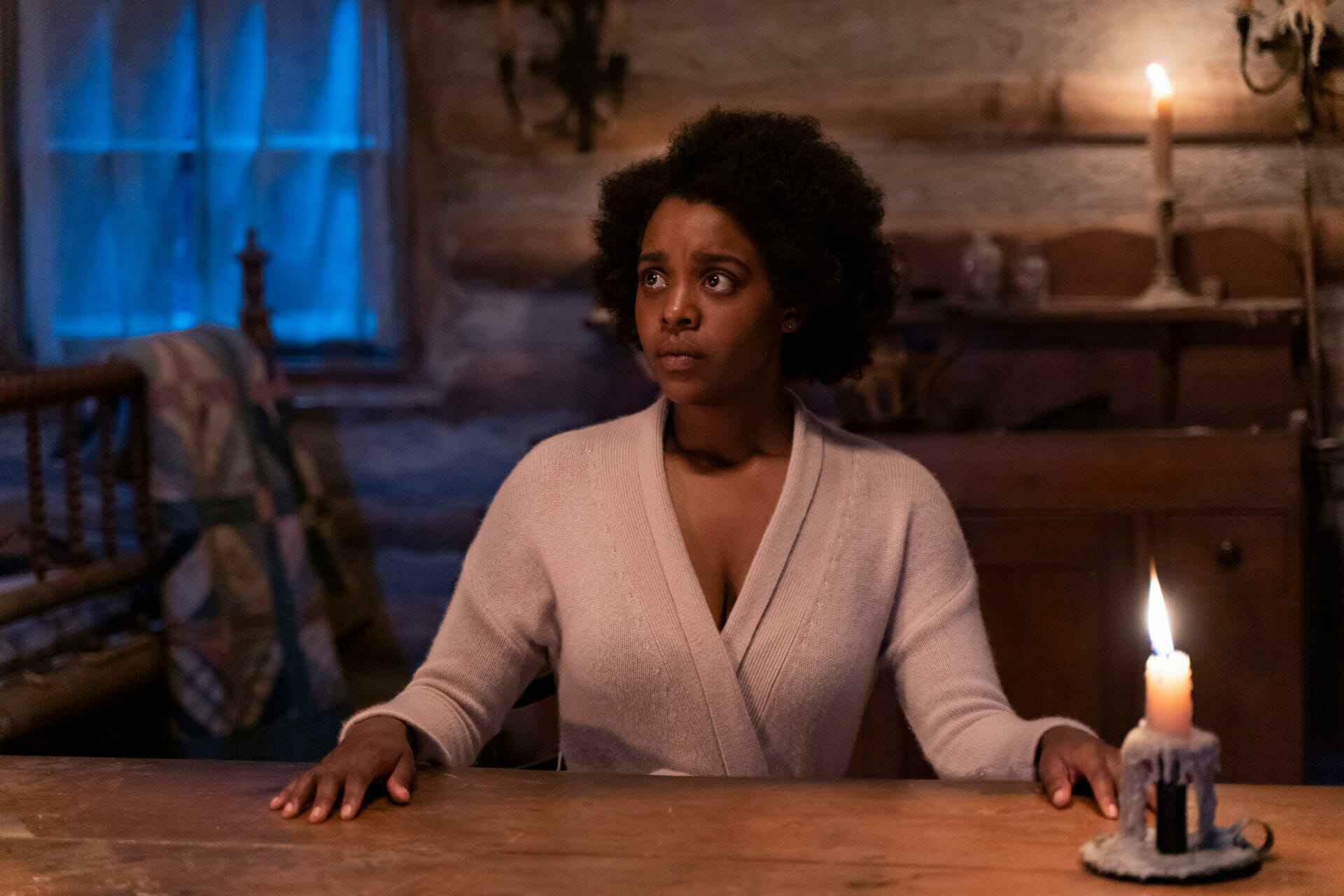
Developed by playwright Branden Jacobs-Jenkins (An Octoroon) and partly shot in Atlanta, the series centers on Dana, played with freshness by newcomer Mallori Johnson. She’s an aspiring TV writer, recently relocated to Los Angeles in 2016 and studying episodes of 1980s’ Dynasty for inspiration. Um, OK.
Orphaned and with a prickly relationship with her aunt and uncle (among the many characters and subplots Jacobs-Jenkins has added to the more austere novel), Dana has had one date with a waiter named Kevin (Micah Stock) when something very weird starts happening. She finds herself transported, in the flesh, to antebellum Maryland. The cause of her time travel is an unknown emotional connection to Rufus (David Alexander Kaplan). He’s the school-aged, spoiled son of slaveholding farmer Weylin (Ryan Kwanten) and his neurasthenic wife Margaret (Gayle Rankin).
As Dana time travels against her will between the 19th and 21st centuries, Kevin is inadvertently brought along for the ride. In Butler’s book, Kevin is Dana’s older, stable, devoted husband. The show’s Kevin is a chubby schmo played almost too well by Stock in a state of perpetual double-take. Transported to the doilied chambers of the Weylin estate, sexually propositioned by a neighboring male landowner (another Jacobs-Jenkins invention), he always seems on the verge of launching into a standup routine about the wild shit he’s seeing.
In the book, we see the action through Dana’s eyes. The character’s practical, even-headed response to her literally unbelievable situation adds to the reader’s sense of dislocation. Same goes for the series adaptation. Stretched over eight episodes with significant side plots added about Dana’s nosy L.A. neighbors, the show can feel both padded and uncertain about the story it’s telling. Covering only about half of the book’s narrative — before Rufus grows into manhood with all its attendant, sexual complications — Kindred is incomplete and dependent on another season to give Butler’s story its due.
Hulu’s adaptation made me wonder what shape it would take if the author were still with us. (She died in 2006, long before the new surge of interest in her work.) While I’m sure she would appreciate the recognition for her writing, intelligence and imagination, I’d love to know her thoughts on seeing the history of slavery teased out in this streaming format for popular consumption.
::
PRIME VIDEO: Nanny
Slavery, in almost every way but the word itself, is also at the core of Nanny. Clumsy but worth watching, writer-director Nikyatu Jusu’s drama sends Senegalese immigrant Aisha (a fine Anna Diop) into a sleek designer condo to tend the young daughter of entitled American couple Amy and Adam (Michelle Monaghan and Morgan Spector, stuck with thinly written roles).
Nanny belongs to a recent subgroup of independent suspense-ish films that feature female protagonists vaguely menaced by a shadowy… something (often a metaphor for racism/sexism). These movies are heavy on scenes of the heroine(s) looking pensively out windows and being startled by a scary vision that usually turns out to be a nightmare. Here, Anna is haunted by specters from her homeland: the trickster spider Anansi and a vengeful water siren called Mami Wata, both visiting her in dreams and visions. What this has to do with the young son Anna is trying to bring over from Africa, well, you will probably be ahead of that plot revelation.
If you’re in the mood for a savvier, layered, often fiercely funny look at contemporary racial politics in the world of domestic caregiver-for-hire, I recommend Kiley Reid’s 2019 novel Such a Fun Age.
::
NETFLIX: Glass Onion: A Knives Out Mystery
The contemplative, cool-to-freezing weeks from Halloween to the New Year always seem like an ideal time to curl up by the fireplace (modern translation: whatever screen you watch the most) and enjoy a good mystery. Or even not so good.
Peel back a few layers of Glass Onion: A Knives Out Mystery, and you realize what a fun but facile writer-director Rian Johnson can be. As you watch, the cleverness of early films like Brick and Looper offer a great ride, but the stories don’t stick with you. When Johnson aims for semi-profundity, the party falls apart. Consider Star Wars: Episode VIII — The Last Jedi. His weird middle installment (a buff and shirtless Kylo Ren, Luke and Leia’s extreme Jedi powers) nearly derailed the franchise’s last sequel cycle.
With Glass Onion, Johnson goes shallow with fine results. Once again, we’re in the nest of wealthy vipers, and Daniel Craig’s ridiculously accented “Southern” detective Benoit Blanc, a combo that gave Johnson a pleasant bounce back from Star Wars with his original Knives Out in 2019. While no one asked for a sequel, any more than we were clamoring for more blue-skinned adventures from James Cameron’s Avatar critters, here we are.
This time, the group of suspects involved with a murder (or two?) is a welter of influencers/hangers on played by Kate Hudson, Kathryn Hahn, Dave Bautista, Janelle Monáe and Leslie Odom Jr. They’re all materialistic strivers, summoned to the private isle of their frenemy, a loathsome, Elon Musk-y billionaire played by Edward Norton. The Mona Lisa also plays a supporting role, but to tell more would be a shame. Enjoy the experience yourself. Despite an over-the-top final 10 minutes or so, it’s great fun, with VIP work from Monáe.
::
HBO MAX: See How They Run and Amsterdam
For a more traditional mystery, you might consider See How They Run. But when people say “They don’t make ’em like that any more,” there’s a reason. This affectionate but wan tribute to old-timey, British detective yarns features a charming Saoirse Ronan and an underpowered Sam Rockwell as two London detectives in 1953 London, one young and perky, the other a seen-it-all sot. They’re investigating the backstage murder of a slimy Hollywood producer (Adrien Brody). He’s in town to work on a screenplay adaptation of Agatha Christie’s famously unfilmed West End whodunit The Mousetrap. Suspects for his death include the fastidious playwright hired to pen the screen script (David Oyelowo, of Selma), the stage show’s stern producer (Ruth Wilson), actor Richard Attenborough (Harris Dickinson), and so on.
Feeling like a first draft, See How They Run isn’t weird, funny or surprising enough. If you name one of the detectives Stoppard, as in the famously witty, word-playing British playwright Tom, your screenplay needs to be a lot cleverer than Mark Chappell’s. And the direction should be livelier than Tom George’s. The two men have worked together previously on a couple of BBC programs, but their resumes are pretty thin. The movie is the sort of thing you’d put on TV on a lazy weekend day if an old, drowsy relative is visiting … which has its place.
::
In another theatrical release now on Max, writer-director David O. Russell (Flirting with Disaster, Three Kings, Silver Linings Playbook) gives us Amsterdam, also a mystery, in its way. At the made-up story’s core is a real historic incident that happened in 1933 New York, but you’ll have to wade through a real movie mess to get to that realization.
Christian Bale, in hyper mode, plays a New York physician named Burt who lost his eye in World War I and is now dedicated to helping battle-scarred veterans like himself. His best pal is fellow veteran and attorney Harold (John David Washington, handsome but wooden as always). Witnessing the murder of a socialite seeking their help in investigating her father’s own mysterious death, they’re accused of the killing themselves. The attempt to clear their names leads them to poor little rich girl Valerie (Margot Robbie), and this encounter briefly winds the film back to 1918.
That’s where these three initially met, when Valerie, a nurse, tended to the two wounded soldiers, falling in love with Harold and forming a fast friendship with Burt during a magical time spent living together in Amsterdam. Back in America, the three former amigos solve an artificially manic mystery that involves White nationalists, a lot of forced whimsy and a killer, underserved cast including Zoe Saldana, Michael Shannon, Alessandro Nivola, Anya Taylor-Joy, Chris Rock, Mike Myers, Robert De Niro, Rami Malek and Taylor Swift. Well, at least they look like they had fun.
There’s one small, potent idea buried at the heart of Amsterdam, and in its title. The same notion — of a lost time and place that haunts its characters’ present-day dreams — is also at the heart of another Robbie film now in theaters, Damien Chazelle’s Babylon. If you’ve seen that very long Hollywood fantasia, you’ll know that Robbie is the unofficial muse of two acclaimed writer-directors, swinging big and going splat …
::
NETFLIX: The Pale Blue Eye
One last mystery starts airing January 6. Directed by Scott Cooper (Crazy Heart) and adapted from a Louis Bayard novel, The Pale Blue Eye once more stars Bale in a less frenetic mode than in Amsterdam. Here he plays a prototypical private eye in the snowy Hudson Valley of 1830. A loner whose wife is dead and young adult daughter has fled, Bale’s Augustus Landor is brought from his isolated homestead to the military academy at West Point. There, he’s asked to investigate the seeming suicide of one cadet. But the young man’s hanging begins to look like murder, especially when his heart is removed by someone while his body’s on the coroner’s slab.
Landor’s inquiry is unexpectedly aided by one military student known as Edgar Allen Poe (onetime Harry Potter star Harry Melling, who chews the scenery a little but looks the part). The film’s story involves not only evisceration of hearts, but a secret, devil-worshipping cult. Good times! Actually, in Eye we get a double-decker mystery — one of them a partial fake out that camouflages a crime we didn’t know we were witnessing. Here, Poe plays a real-life version of the sort of detective he invented with 1841’s “Murders in the Rue Morgue” (considered the first example of detective fiction, decades ahead of Arthur Conan Doyle’s Sherlock Holmes).
This enjoyable but forgettable cockamamie is delivered by an overqualified cast that includes Toby Jones, Gillian Anderson, Timothy Spall, Charlotte Gainsbourg and a virtually unrecognizable Robert Duvall. The film’s greatest strength is its intense wintry atmosphere. After the cold Christmastime weather we’ve all just endured, that might be less of an attraction than it was for me when I first watched Eye.
::
Also on Netflix, I hear there’s a documentary series about Harry and Meghan. From what I understand, the attractive young couple spend their six hours using the vast media exposure at their disposal to complain about all the vast media exposure they’ve endured. You do you, but I’m not interested. It’s almost a new year, and I’m ready to move on, even if they aren’t. Happy 2023!
::
Steve Murray is an award-winning journalist and playwright who has covered the arts as a reporter and critic for many years. Catch up to Steve’s previous Streaming column here.
STAY UP TO DATE ON ALL THINGS ArtsATL
Subscribe to our free weekly e-newsletter.

