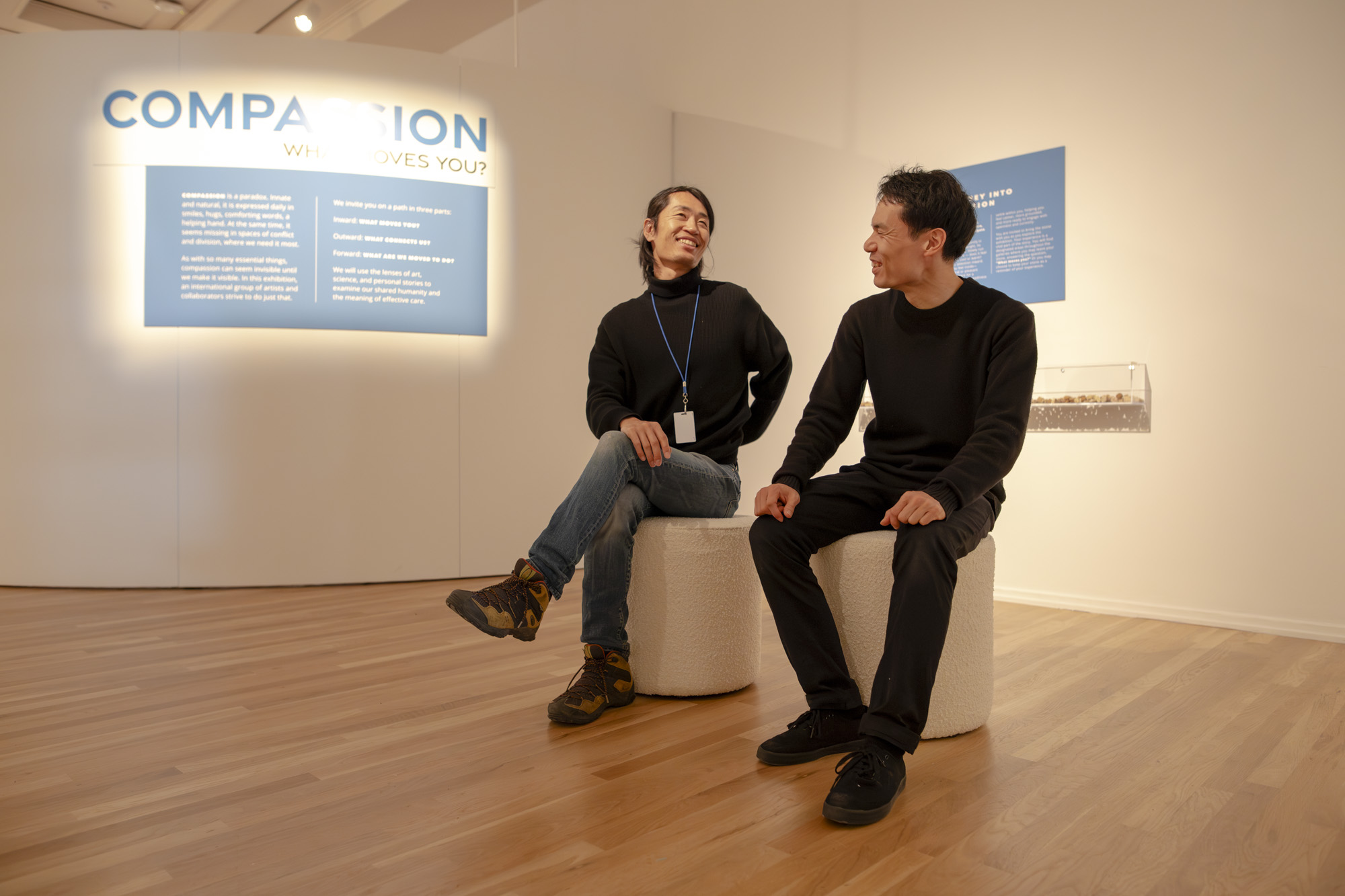
‘Compassion’ exhibit evokes collective tenderness and shared humanity at the Carlos Museum
“How can empathy become visible?” This was an essential question that the curatorial team considered when designing the exhibit Compassion: What Moves You? on view now at the Michael C. Carlos Museum. This group exhibition features an international slate of compelling photography, video, letter-writing and a biometric light installation all centered around the theme of compassion.
According to the Mirriam-Webster definition, compassion is a sympathetic consciousness of others’ distress combined with a desire to alleviate it. This consciousness must inherently come first from a place of awareness and recognition. It stands to reason that no problem can be solved before first coming to light. The works in the exhibit at the Carlos do just that — build a visual language that can explore the nuance of caring for one another.
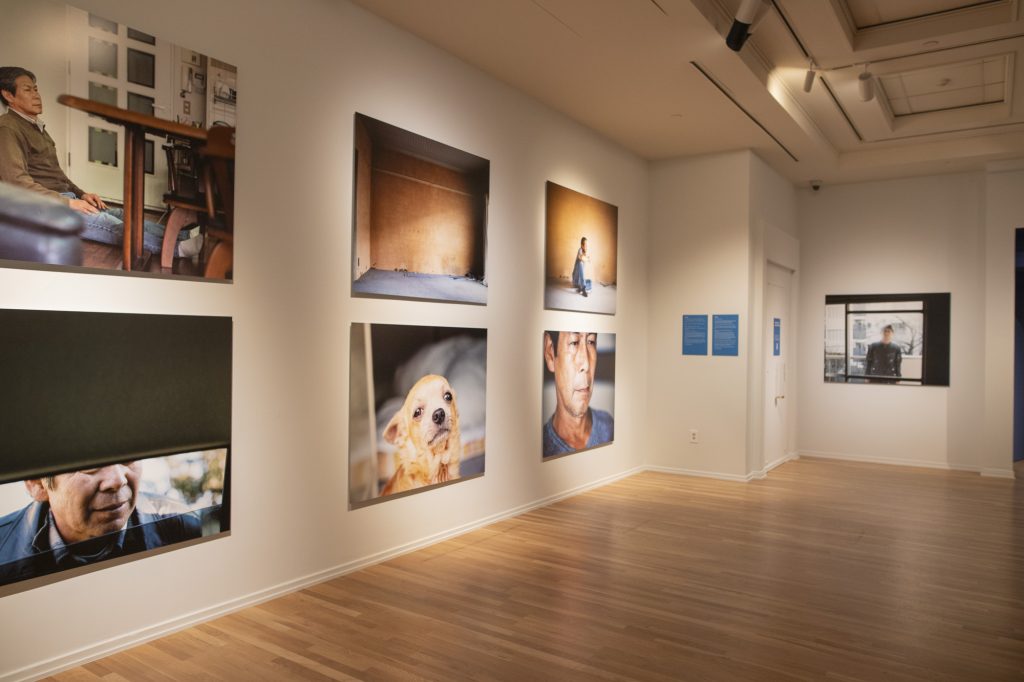
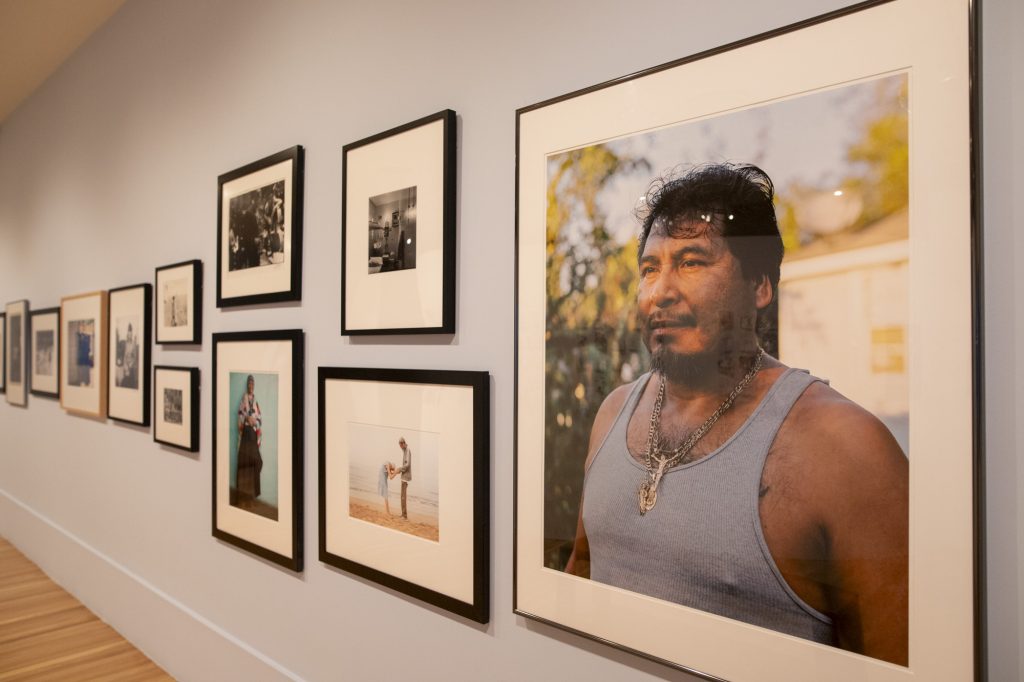
Immediately upon entering the gallery, oversized portraits from Shingo Kanagawa’s father series captured my attention. While technically correct and aesthetically pleasing in composition, it’s the haunting nature of the untold story within these photographs that ekes in from the edges and overtakes the experience.
The artist’s often-absent father appears in a series of portraits in which he is pictured both intimately and at an arm’s length. On the artist’s website, he writes that his father disappeared from his life for some months, and when he returned he seemed careless — as in, without care — for anything or anyone, including himself. To try to connect with his father in this new dynamic is painful and confusing to the artist, made visual through photography.
Where the Kanagawa exhibit confronts, the adjacent INOCHI THEATER: If Your Life Were Light exhibit whispers. Around a curved, dark wall is a doorway closed off by a black curtain. Inside, in the pitch dark, a biometric-infused art installation awaits. Inside, I was instructed to place my hands on sensors on the table in front of me that would measure my heartbeat. Around the room, as others sat and also placed their hands on the sensors, beams of light burst from our fingertips in time with our heartbeats and traveled from our hands and up into the canopy of a twisting tree above us.
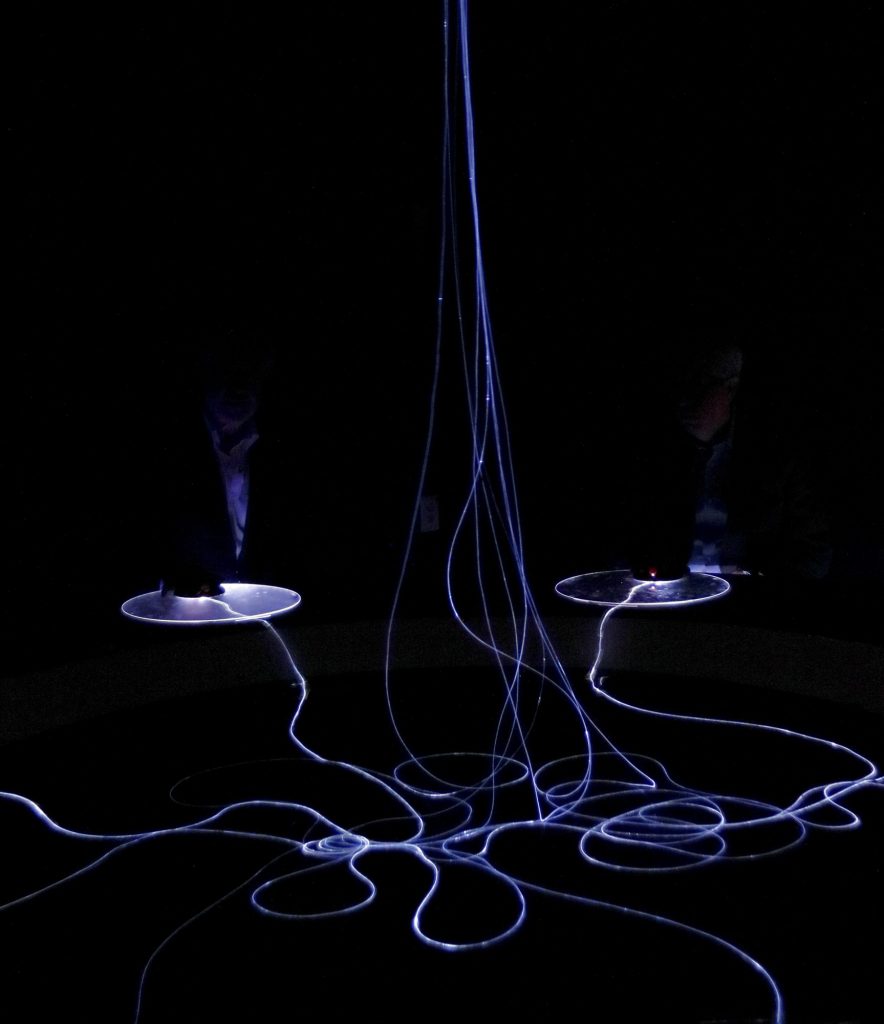
Designed by Kosuke Matsushima, Masashi Fujimoto, Ryoji Yukino and Sui Nacazima of the Japanese artist collective ARu, Inc, this installation seeks to bridge the gap between who we think we are as individuals and the way that our energy can be in community with one another. The concept for using biometric technology to capture and transmute our heartbeat actually came, originally, from a fascination in how we keep time.
Matsushima was putting the finishing touches on the work when I visited the exhibit, and he patiently showed me how to use the technology. Through further conversation, he explained that he had grown interested in the way that different animals have different heartbeat frequencies and how, in contrast to clocks and traditional commonly accepted timekeeping, one might have a different experience with the world and with time itself based on one’s heartbeat. Indeed, there is a negative correlation between the frequency of an animal’s heartbeat and its lifespan — the more heartbeats per minute, the shorter the lifespan. This fascinated Matsushima and led him to play, and explore, what other ways we could visualize not just our own personal heartbeat as a means of timekeeping but also how we could see and interact with those of the people around us.
The resulting exhibition is both a welcome respite from the real world — soft drapes muffle sound; the all-encompassing darkness is like an embrace — and also a reminder of our relationships with those around us. In the dark, I don’t know anything about the other humans in the room with me and can’t make any assumptions about who they are based on visual cues. The exhibit seems to ask for a meditative silence, and, as hands grace the tops of these sensors, one is quickly reminded of the simple humanity of the people near us.
That’s my heartbeat, and, look, there’s another and a few more, I thought, marveling at the experience. Look how they join together and illuminate the sky. Now I can see the tree.
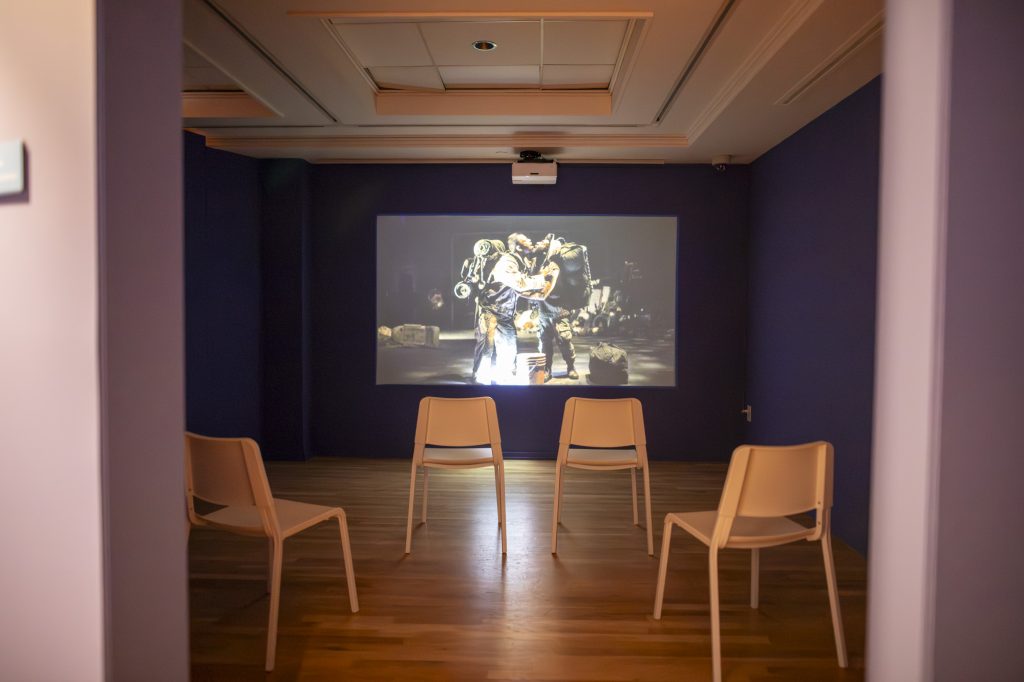
Deeper into the gallery, there are side rooms with smaller exhibits, including a segment of The Water Station, a wordless play written by Japanese playwright Shogo Ota and directed by Emory Theater Studies Professor Héctor Álvarez. In the performance, black represents silence or absence, and a stream of water from a broken pipe slowly drips into every scene. The series is a joint collaboration between Theatre Roots & Wings and the Japan Foundation that explores themes of fragility, of conflict, of love and the relationship between one another.
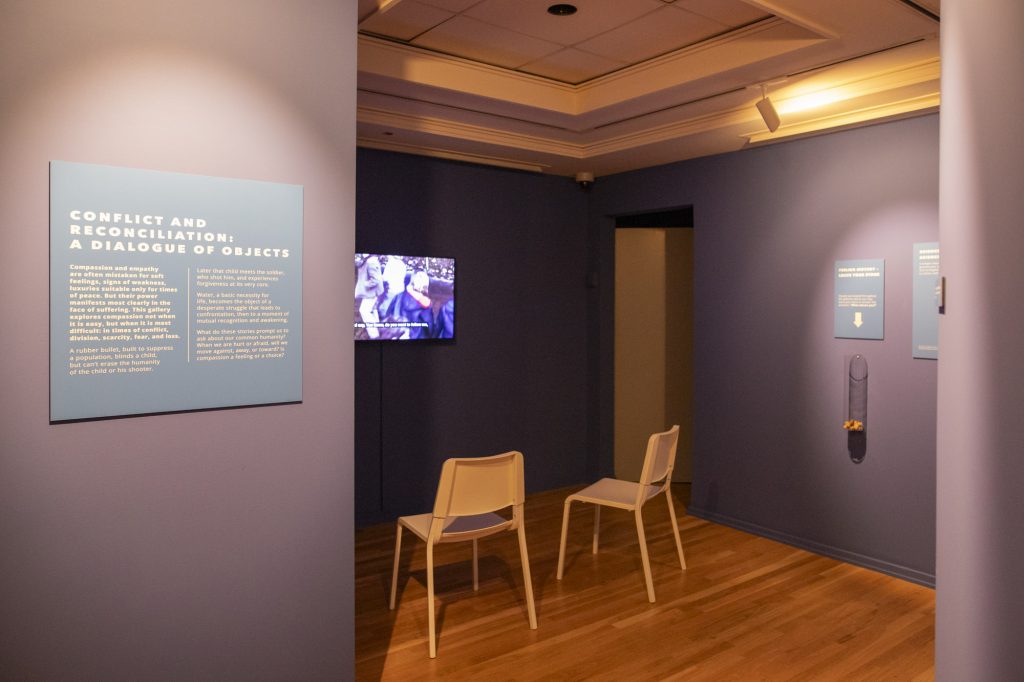
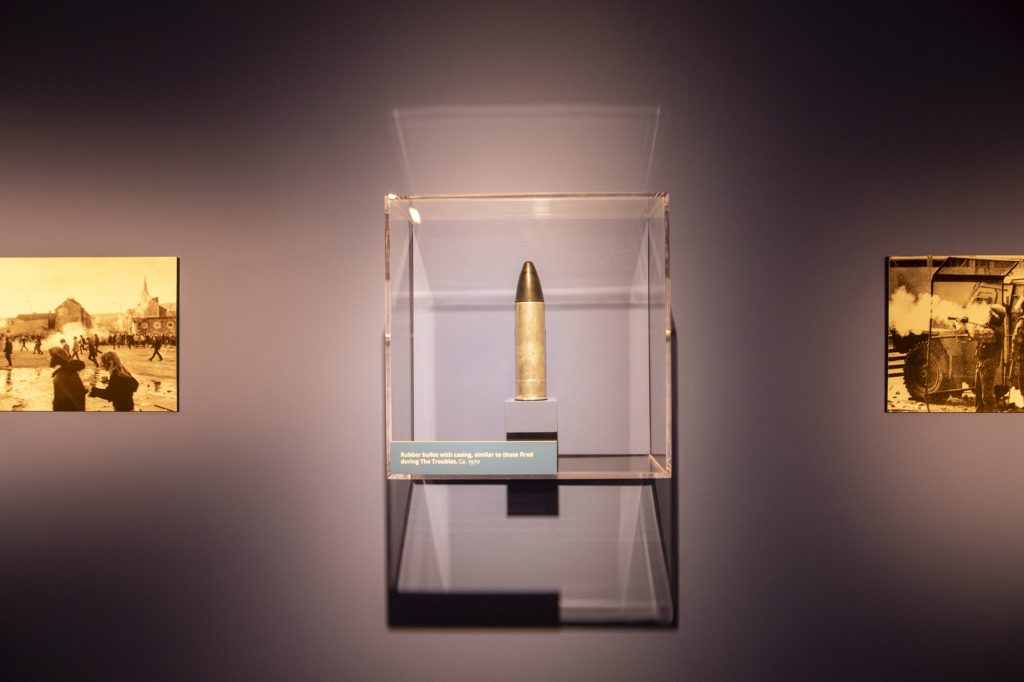
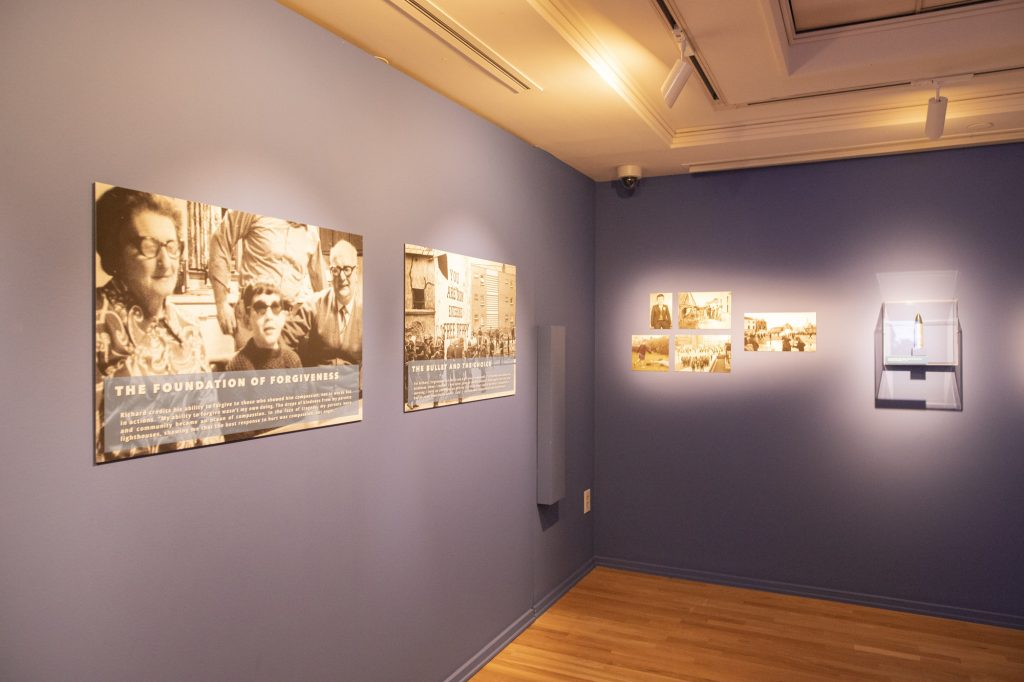
An adjacent gallery features images from the life of Richard Moore, an Irish man who was hit by a rubber bullet as a boy in 1972 in Derry during conflicts with British soldiers in Northern Ireland. At only 10 years old, a British soldier fired a rubber bullet at close range directly into Moore’s face, and it blinded him for life. Instead of becoming bitter, Moore channeled his energy into a life of kindness and charity, later running the Children in Crossfire organization addressing injustice among the poorest children in Tanzania, Gambia, Ethiopia and Ireland. He has also since made amends with the very soldier who shot him, becoming a moving example of compassion in action.
The exhibition was curated by Brendan Ozawa-de Silva, associate teaching professor in the Center for Contemplative Science and Compassion-Based Ethics at Emory University and global professor at Keio University, in collaboration with Jennifer Knox, director of character education, and Ron M. Brill, chair of ethical leadership, at Woodward Academy — and facilitating curator Andi McKenzie, curator of works on paper at the museum.
“Many don’t know it, but Emory is a major international center for the study of compassion,” said Ozawa-de Silva. “This work has been going on in various ways for the past three decades across multiple schools and departments from primatology to ethics to health care to politics. Through their research, work and life, Emory faculty members have changed the way we look at morality, emotions and who we are as human beings.”
Another area of the gallery displays works from the Carlos’ permanent collection of works on paper, featuring photographs by Danny Lyon, Manjari Sharma, Kristin Capp and José Ibarra Rizo, among others. The pieces displayed here explore themes of connectivity, memory and identity. Knox also coordinated Youth Voices, a large installation of K-12 students’ responses as part of Emory’s SEE Learning Foundation, which embeds compassion into curriculum.
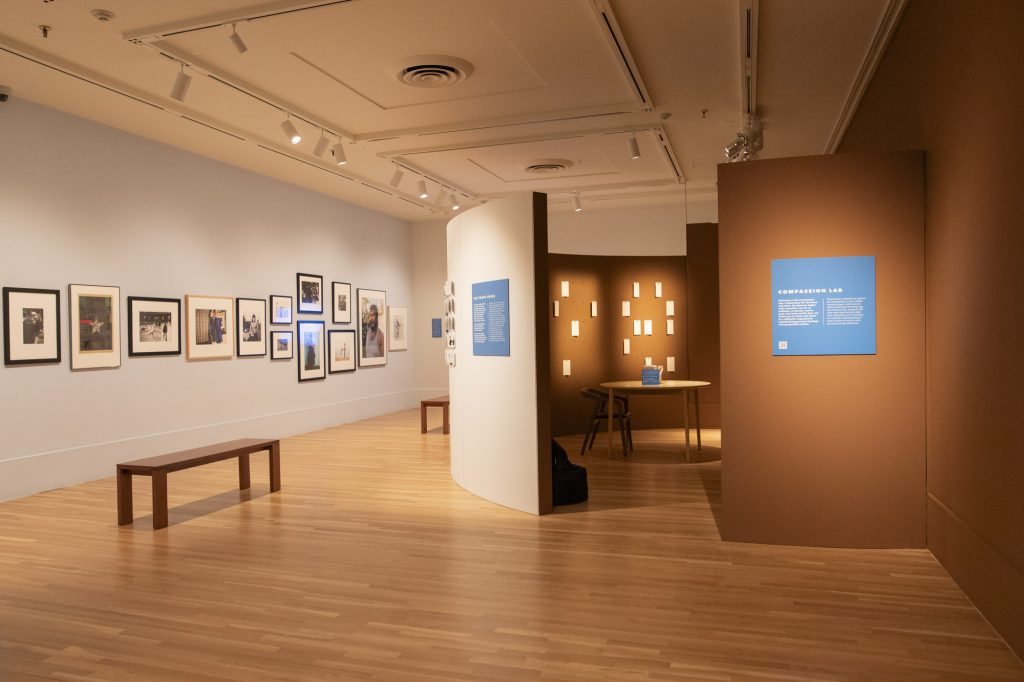

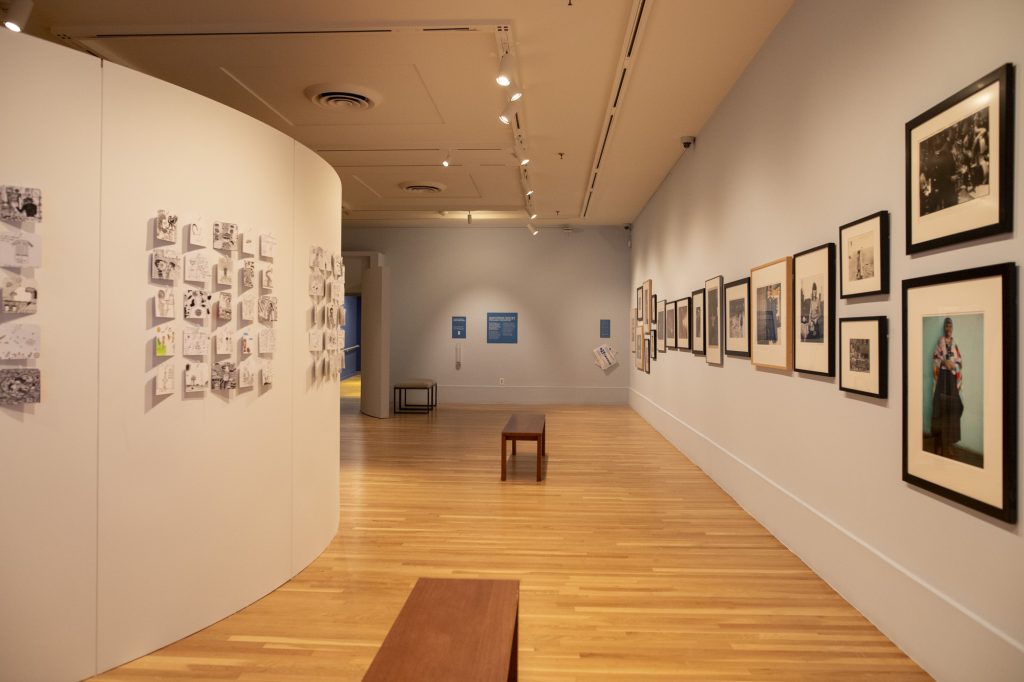
“In shaping Shared Worlds, Andi McKenzie and I asked: how can empathy become visible? How can art surface both individuality and interdependence?” said Knox. “By pairing diverse visual languages, slowing perception, and creating opportunities for dialogue, we invite viewers to experience empathy not as sentimentality, but as a skillful, relational practice that illuminates shared humanity. The student contributions in Youth Voices highlight what young people from thirteen countries value most, allowing visitors to witness compassion as it emerges in developmental stages.”
Ozawa-de Silva explained that Emory’s approach to compassion goes deeper than just an exhibition, a point which is embodied by the University’s pioneering Compassion Center, opened in 2017, which is also known as the Center for Contemplative Science and Compassion-Based Ethics. At the Carlos Museum, Director Henry Kim has a vision to better integrate the museum with the University in terms of academics and research, and so exploring the idea of compassion through art seemed like a perfect fit.
“Compassion is essential to our survival as a human species. If we neglect compassion, what will happen to us? Things will break down and our future – and that of our planet – will be bleak. Compassion is often misunderstood as weakness, sentimentality, or a luxury secondary to more primary needs,” said Ozawa-de Silva.
He went on to explain that compassion can often be seen as weakness, or softness, but that actually compassion is essential to our health and to our humanity. It’s how we relate to one another and how we move forward together into a better and brighter future. Research findings around compassion are not only relevant to the individual – these insights can be applied even when you scale all the way up to the influence on international relations and diplomacy between societies.
“Just like our hearts, which are hidden inside our bodies, compassion is something we can miss if we don’t make it visible,” he continued, and pointed out that interactive elements of this exhibit, such as the stones that visitors are encouraged to collect a stone at the entrance and then leave with the part of the exhibit that moves you the most. This represents a shift away from the invisibility of the audience in a museum setting – you can see that people came before you, that they engaged with the art and that they have been moved by it.
“This exhibition feels especially important at a time when many young people and adults are experiencing increasing levels of anxiety, depression, and loneliness. Despite constant connection, many people feel unseen in their inner lives,” said Knox. “One of the exhibition’s central intentions is to create a space where the viewer’s inner experience matters.”
Compassion: What Moves You? will remain on view through October 25, 2026, and the curators hope that visitors will not only view the work as individual pieces, but move through the entire space as if it’s all part of one ongoing and evolving conversation. In this exhibition, the audience is inspired to consider how we relate to one another and how to share our personal stories, whether it be through pain, pleasure, or the very beating of our own hearts.
“Art brings things out into the world and asks: what do you think? What do you feel? Then we can have a dialogue, and we can learn from each other,” said Ozawa-de Silva.
::

Isadora Pennington is Senior Editor of Art + Design and Dance. An experienced writer and photographer with a deep love for the arts, Isadora founded the Sketchbook newsletter with Rough Draft Atlanta in 2022. She is also President of the Avondale Arts Alliance and Director of the Avondale Arts Center.
STAY UP TO DATE ON ALL THINGS ArtsATL
Subscribe to our free weekly e-newsletter.

PLEASE SUPPORT ARTSATL
Your Gift Sustains the Coverage You Count On!
Related Posts