Atlanta’s classical music and jazz faithful enjoy concerts in religious spaces
It’s no secret that professional classical and jazz ensembles perform secular music in Atlanta churches and synagogues. ArtsATL author Jeff Dingler finds out why.
In early November, a trio of top-notch classically trained musicians took to the stage in front of a full house. With William Ransom accompanying on piano, tenor Timothy Miller and soprano Bethany Grace Mamola performed soaring solos and dopamine-inducing duets, tearing through a program of rich operatic and Broadway classics. This wasn’t at Spivey Hall or Cobb Energy Performing Arts Centre. It was part of a performing arts series at Ahavath Achim Synagogue in Buckhead.
Running for more than four decades, the Ahavath Achim Cultural Arts Series has always been free and open to the public and included a broad range from traditional classical music to jazz and even more modern and fusion acts like the local jazzy Bonaventure Quartet. “I want to provide a mosaic of concerts,” said Ivan Millender, who manages the Cultural Arts Series. “It’s not all just Mozart to Rachmaninoff.”

“There was a need for it and an interest in it,” said Millender about the temple’s series. It was founded in 1980 by the late Dr. Herbert and Hazel Karp, Sam and Harriett Draluck, and the late Sidney Kaplan. The Dralucks ran the program from its inception through 2004, when Millender took over.
With a history degree from Atlanta’s Emory University, Millender has been passionate about music his whole life, having played piano since childhood. He’s also a longtime active congregant at Ahavath Achim. Yet he crafts a secular program that doesn’t cross over into the temple’s religious music and cantorial interpretations. So far, his direction of the cultural arts series has been a hit, with packed audiences and a fairly regular flow of donations. One member donated a Steinway piano and another congregant, Marilyn Eckstein, put $1 million into a trust for the series.
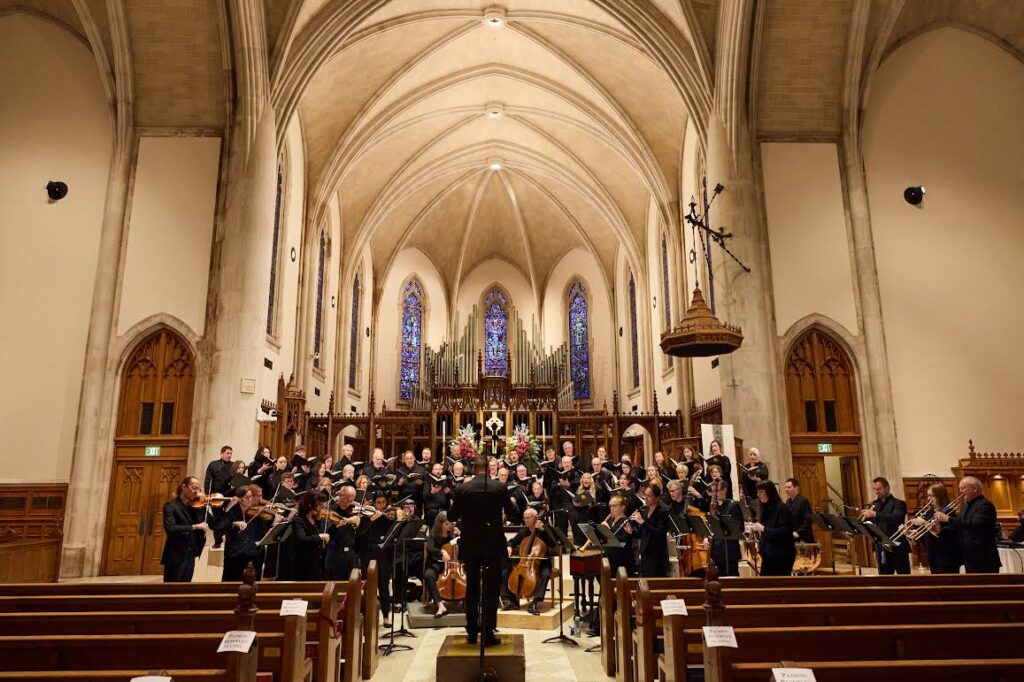
Ahavath’s secular musical offerings are by no means an outlier. A short list of other churches and synagogues in town that present professional musical concerts includes First Presbyterian on Peachtree Road, known for its Friday “Bach’s Lunch” series; The Temple in Midtown; Emory’s Glenn Memorial United Methodist Church; and the Cathedral of St. Philip, known for the Atlanta Gay Men’s Chorus’ annual Christmas concert and performances by its longtime resident ensemble, the Atlanta Baroque Orchestra.
“The beautiful setting does attract many audience members,” said Julie Andrijeski, artistic director and concertmaster of the Atlanta Baroque Orchestra, which performed a nonreligious program there called Dance Fever in November. “Their hospitality toward us, from the Dean to the sextons, has been extremely gracious over the many years we have been in residence, whether we are performing sacred or secular works.” The ABO has also performed at Ahavath Achim Synagogue and earlier this year presented the opera Dido and Aeneas at Glenn Memorial in collaboration with the staibdance contemporary dance company.
On the more intimate side, Roswell’s Unitarian Universalist Metro Atlanta North has its Common Grounds Coffee House, a monthly café experience of live music from local musicians, and just last month All Saints’ Episcopal Church launched a new music series called Jazz at All Saints’. It seems increasingly common these days to catch concerts of chamber and classical music and smaller ensembles not at performing arts centers or prestigious halls but in places of worship. But this begs the question: Why?
Part of the reason is — no surprise — money. Being tax-exempt with large donor bases and congregations, big religious institutions don’t have to depend on exorbitant ticket prices to stay afloat or pay for these shows. All the music programs listed above are either free or offer tickets between $15 and $36. This is in comparison to the national average for popular concert tickets, which hit a new record this year at $127.
But it’s also more financially advantageous for the musicians. “I don’t think that the flourishing chamber music concerts could take place if they were held in a venue where we had to pay commercial rent,” said Millender. “When you go here or to First Presbyterian, the concert promoters don’t have to pay any rent.” In addition to free or low rent, many of these religious institutions also absorb other expenses, such as security, utilities and cleanup.
Ransom, a local Juilliard-trained pianist, performer and professor of music, feels similarly. “You will often pay through the nose if you are presenting a concert and renting a for-profit venue,” he said, “which often will make it financially impossible.”
It’s more than money that keeps a lot of this music in houses of worship, according to Ransom, a regular around town who played piano at that recent show at Ahavath Achim and is a professor of piano at Emory University and the founder and artistic director of the Emory Chamber Music Society. He pointed out that music in religious spaces is nothing new.
“In the Western tradition, this is where music came from,” he said. “J. S. Bach and Handel and all of those early great composers, they were writing either for the church, literally for services, or for the nobility. The idea of a concert hall as a separate entity didn’t emerge until the 18th century with opera houses.”
Although considered canonical to classical music today, Bach was a devout Lutheran. He wrote his cantatas (now part of the art song practice) for church services, and, at the end of many of his compositions signed the initials “SDG,” Latin for Soli Deo Gloria or “Glory to God alone.” The same spiritual sentiments can be said of classical music’s most popular composers from Vivaldi down to Dvorak, both of whom wrote sacred and secular music. Indeed, some composers’ biggest hits, like Mozart’s Requiem or Bach’s Mass in B minor, are steeped in religious traditions. “There’s always the discussion: Is music entertainment, or is it more than that?” said Ransom. “Of course, I think it’s both — but at its best and at its most central, it is a spiritual experience for me.”

As for why it seems more of these classical and secular music programs are popping up in churches and synagogues, Ransom argues that it might be the effect of more musicians. “Big conservatories are pumping out wonderful players every year,” he said. “There are more of us now than any other time in history, and those players need somewhere to work.”
Back at Ahavath, Millender couldn’t agree more. He’s already planning next year’s program and griping about scheduling around football season and the holidays. According to him, it’s a rather simple answer why secular music remains so enduring in sacred spaces. “Churches and synagogues are as much places of community gathering as places of worship,” he said. “And as our current rabbi (Rabbi Laurence Rosenthal) said, ‘All music is spiritual in one sense or another.’”
::

Jeff Dingler is an Atlanta-based author and entertainer. A graduate of Skidmore College with an MFA in creative writing from Hollins University, he’s written for New York Magazine, The Washington Post, The New York Times, Tiny Love, Newsweek, WIRED, Salmagundi and Flash Fiction Magazine. Learn more at jeffdingler.org.
STAY UP TO DATE ON ALL THINGS ArtsATL
Subscribe to our free weekly e-newsletter.

PLEASE SUPPORT ARTSATL
Your Gift Sustains the Coverage You Count On!
Related Posts