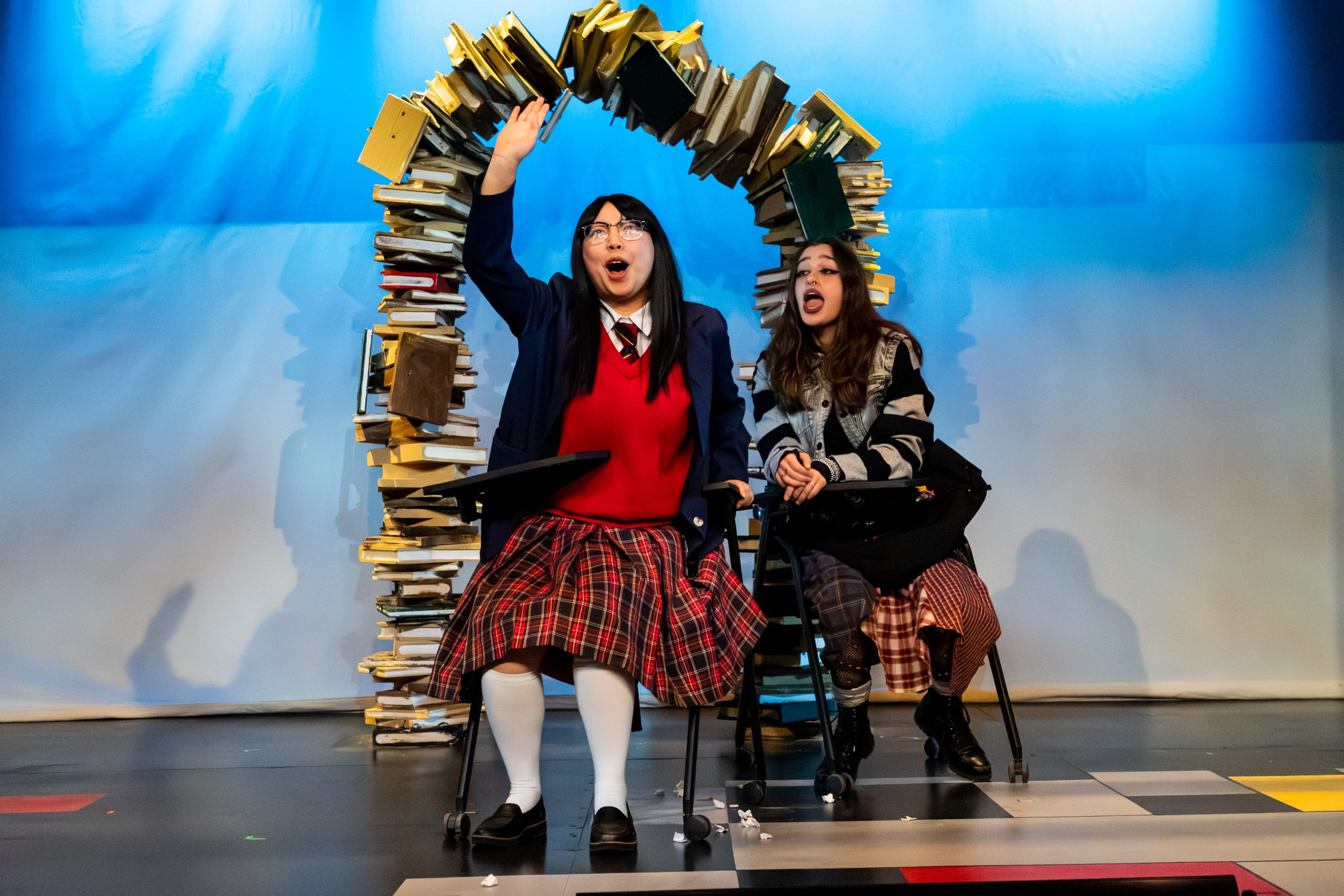
Authenticity tops perfection for director Wanyu Yang and the cast of Theater Emory’s ‘Peerless’
How does competition hinder connection, and how can ambition lead us to turn our back on our own humanity? William Shakespeare was grappling with these questions when he wrote his seminal Macbeth, and, as Peerless by Jiehae Park proves, they are as relevant today as they were in the 1600s. Adapting Shakespeare into a modern academic setting, Peerless explores academic competition, societal pressures and racial identity through the story of twin Asian American sisters vying for admission to the same university. Directed by Wanyu Yang (they/them), Peerless is running at Theater Emory through November 23.
Yang was introduced to Peerless several years ago as an Emory student when they were assigned the play in class and later directed a student-led production. “I was initially really attracted to it because it was about two young Asian American girls, and it was very darkly funny. It kind of stuck with me how haunting it was while simultaneously being about high school.”

Yang was, of course, also embroiled in the pressure cooker of academia at that time. “Everyone likes to say that Emory is the Ivy League of the South,” they pointed out. “So everyone who has been vying for this program is at the top of their game and highly competitive. Right away, [the play] is very relevant to that experience.” This relatability made the play a natural choice for Theater Emory, as it speaks to the experiences of a large portion of their student body — including those in the cast.
“I confess that my most difficult hurdle with the cast,” Yang said, “was this feeling they had of needing constant perfection. Even in this space, where they’re done with classes, they still have this feeling of being clenched tight and needing to perform to absolute perfection.”
Presumably, this drive for success has never driven them to murder, as it does for the characters of Macbeth and Park’s adaptation, but it does provide unique storytelling opportunities and challenges. It allows the actors to more closely identify with the characters, while making it harder for them to remove themselves when necessary.
Part of helping the students let go of their perfectionism was simply giving them the space to experiment and see how far they can comfortably push themselves. As Yang put it, “We provide safety so you can figure out exactly how uncomfortable you want to challenge yourself to be.”
To assist further, Yang also fashioned a ritual to start and end each rehearsal. It starts with what the director described as “word vomit,” in which the students are allowed to express any frustrations, anxieties or disappointments from the day that they might be carrying into the rehearsal room. One of the funniest ways Yang got the students to embrace the spirit of play in rehearsal was to have them circle and yell “Go Rats!” — the animals featured in the play — like a band of merry cheerleaders, allowing the inanity of the cry to make space for levity. Then, at the end of rehearsal, they would shout “Star Og!” — the previous cry spelled backward.
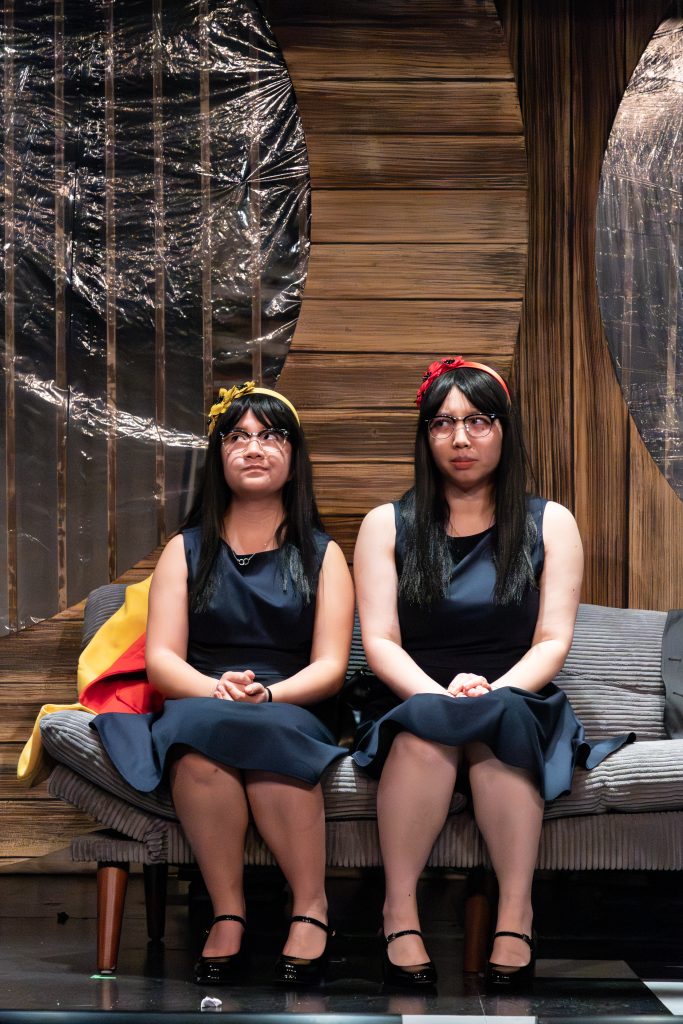
This push and pull between perfection and play is something Yang also had to learn since their first experience directing the play as a student. “I think I was trying to be a little bit more hands off this time, not as perfectionist or controlling. I think as a student director, I had a lot of hangups about letting the actors be the performers they should be rather than bodies on stage that I could control like little mannequins.”
The racial through line of Peerless is central not only to the play itself but to Yang’s directorial approach. When asked about their relationship to the piece, Yang spoke extensively about how modern culture and social media in particular has led to a “flattening and othering of people who we don’t see as our in-group — people who aren’t Asian enough, who haven’t been through enough oppression to be considered a certain identity.”
The way teenagers become willing to cannibalize each other to become part of these in-groups is the play’s clearest thematic parallel with Macbeth.
“It’s an especially troubling thing to see in kids,” Yang opined. “There’s this complete loss of identity or identity building that is genuine, loving or supported, and that reflects on how they treat their peers. They become peerless.”
It is this death of empathy and competition-motivated cruelty that Yang hopes audiences will rebuke. “I didn’t [direct] this whole thing to make people feel good,” the director said. “I don’t want it to simply be a cathartic experience that they can exit the space and forget about. I really want to make sure that they leave shaken or awakened. I hope it touches people in ways that make them act and makes them realize the responsibility they have to each other.”
Where & When
Peerless is at Theater Emory November 19 through November 23 at the Mary Gray Munroe Theater. Tickets are $20 for adults.
1700 North Decatur Road.
::

Luke Evans is an Atlanta-based writer, critic and dramaturg. He covers theater for ArtsATL and Broadway World Atlanta and has worked with theaters such as the Alliance, Actor’s Express, Out Front Theatre and Woodstock Arts. He’s a graduate of Oglethorpe University, where he earned his bachelor’s degree, and the University of Houston, where he earned his master’s.
STAY UP TO DATE ON ALL THINGS ArtsATL
Subscribe to our free weekly e-newsletter.

PLEASE SUPPORT ARTSATL
Your Gift Sustains the Coverage You Count On!
Related Posts