
Atlanta ensembles come together to celebrate a landmark of contemporary classical music
Bent Frequency — along with the Atlanta Contemporary Music Collective, Chamber Cartel, ensemble vim and smol ensemble — concludes its season with an ambitious performance of Steve Reich’s Music for 18 Musicians and three new works.
::
Steve Reich’s Music for 18 Musicians is one of the most important classical music compositions of the 20th century. Written by Reich over three years, the hour-long flux of canonical melodies, cyclical harmonies and densely fluid percussion premiered on April 24, 1976, at Town Hall in Manhattan after more than a year of weekly rehearsals.
Two years later, ECM released a studio recording of Music for 18 Musicians, which quickly and surprisingly became a best-seller for the German record label, which was primarily known for its jazz and world music catalog. In 1998, Nonesuch Records released a new recording of the work, which won a Grammy for Best Small Ensemble Performance.
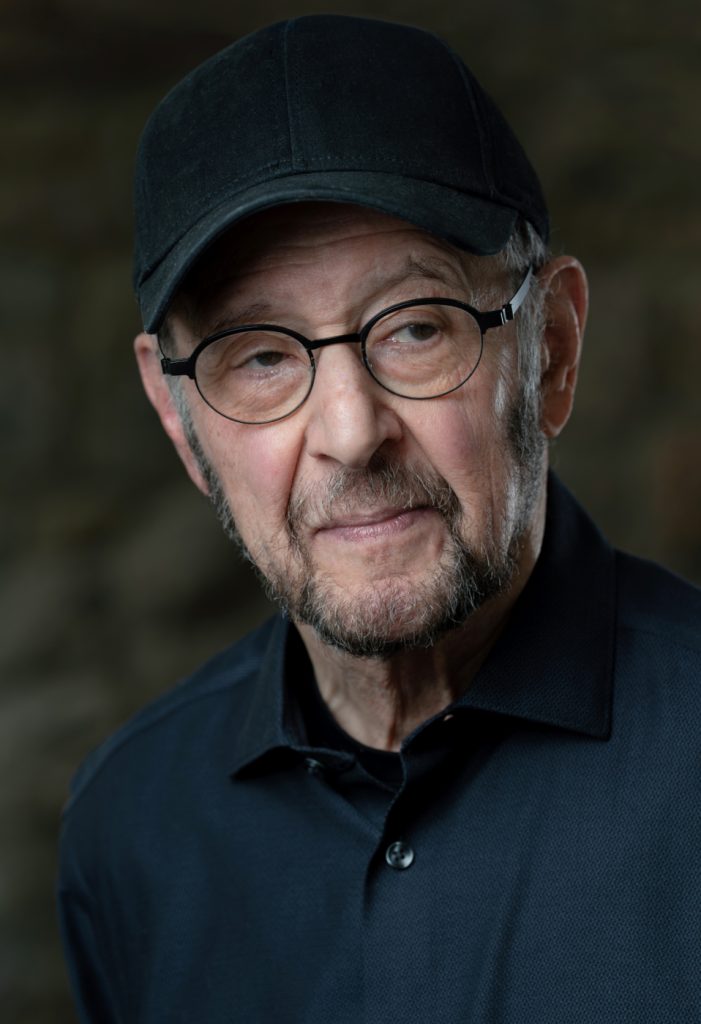
2026 marks the 50th anniversary of the premiere of Music for 18 Musicians, as well as the 90th birth year of Steve Reich. In celebration, performances of Reich’s seminal tour de force — which has influenced generations of musicians from the realms of rock, pop, jazz, jam band, electronic dance music and other genres — along with other compositions from his extensive catalog, such as Drumming, Violin Phase and Different Trains, are scheduled around the globe.
In Atlanta, contemporary classical specialists Bent Frequency is concluding their 2025-26 season with a special free concert on May 3 at Kopleff Recital Hall on the Georgia State University (GSU) campus. The Sunday afternoon (2 p.m.) program includes Music for 18 Musicians performed by a coalition of the city’s talent-rich new music community, as well as recitals of the three winning entries to Underscore_a call for scores, an annual open invitation to submit compositions organized by Bent Frequency.
“We designed Underscore to be truly open to anyone,” said Jan Berry Baker who, along with Stuart Gerber, founded Bent Frequency at GSU in 2003 as an ensemble-in-residence and project incubator. “It does not require an application fee and is reviewed anonymously by our external panel of judges. We wanted it to be as inclusive as possible without any social or economic barriers.”
The musical criteria for the 2026 Underscore competition specified a focus on improvised frameworks, open instrumentation, graphic scores, text-based pieces and other experimental or hybrid notation. The winning entries — João Pedro Oliveira’s Improvisation on a Poem by Augusto de Campos; Ella Kaale’s perfect lovers; and Ilana Waniuk’s Arcana Minor — reflect the impact of that mandate in wonderfully eclectic ways.
“We’ve been lucky to have the Georgia Council for the Arts (GCA) contribute the most significant portion of money for Underscore through their program grant,” said Gerber. “Unfortunately, given recent challenges nationwide regarding grant funding, the GCA grant for individual projects like Underscore was cut by about 40%.”
Consequently, Bent Frequency scaled back the Underscore competition by reducing the number of winners from six to three and assembling a panel of two, rather than three, independent judges. Likewise, the concert performance of the winning entries was effectively cut in half. The upside: The shorter Underscore program created space for doing something special that Bent Frequency had discussed when planning the season.
“We knew Music for 18 Musicians would make a great season-ending program,” Gerber said. “We also knew it would be a long shot for us to do it on our own, financially speaking, so we reached out to the other ensembles who would need to be involved in such a large production.”
The last time Music for 18 Musicians was performed in Atlanta was in 2011 as the grand finale of SONICpalooza, a day-long marathon of contemporary chamber and electro-acoustical music staged in the lobby of the Woodruff Arts Center. The midnight concert, organized by Tom Sherwood, then lead percussionist for the Atlanta Symphony Orchestra, and his wife, flutist Jessica Peek, was a deeply enthralling experience both for the audience and the musicians.
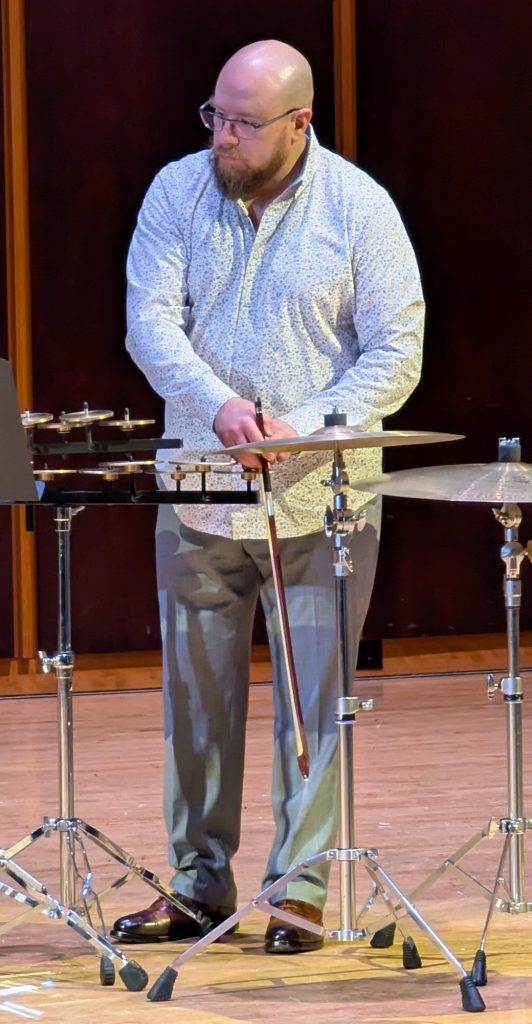
Performing 18 Musicians calls for sustained, repetitive and dexterous physical movement, as well as nearly telepathic cognition of its subtle structural changes. Finding musicians keen and talented enough to tackle the work is no easy task.
“The muscles will burn,” said Baker. “And the brain, the brain will burn trying to keep track of the many repetitions. Whether it’s [Philip] Glass or Reich or whatever, it’s mind over matter, getting your body to keep repeating the cycle without tripping up.”
This time around, Reich’s signature composition will be played by 20 musicians from four local groups — the Atlanta Contemporary Music Collective, Chamber Cartel, ensemble vim and smol ensemble — plus Bent Frequency. These groups perform on a regular basis in the metro area in arts venues such as The Supermarket ATL and eyedrum and in churches, planetariums, homes and recital/theater spaces at GSU and Emory University.
“Having five major contemporary ensembles come together and collaborate on a major project is a feat in itself, which should be celebrated,” said Caleb Herron, founder of Chamber Cartel and xylophonist for the upcoming performance of 18 Musicians. “The musicians involved in each of these ensembles are dear colleagues and friends, some of whom I’ve played with for nearly 20 years.”
The instrumentation for 18 Musicians is an uncommon mix of percussion, strings, reeds and voices. Reich’s score calls for a violin, cello, two clarinets doubling on bass clarinet, four female voices, four grand pianos, three marimbas, two xylophones and a non-motorized vibraphone. Wrangling such an assemblage is its own mean feat.
“We’re lucky to be partnering with GSU on this event, so we get the space for three days,” Gerber said. “We can get everything mic’d and everything sounding really good. But, yeah, finding and moving four grand pianos around is something else.”
The extraordinarily seductive appeal of Music for 18 Musicians stems from an alchemical melding of elements from Western orchestral and chamber music, improvisational jazz and swing and non-Western traditions that predate those musics by multiple millennia. The resulting product sounds as imaginatively fresh, invigorating — even euphoric — today as it did a half century ago.

“Sit back and take it for a wild ride,” said Olivia Kieffer, a composer, educator and percussionist who will play xylophone and maracas in the 18 Musicians performance at GSU. “The music is busy and groovy, both slow and fast at the same time. What should make it most compelling to a non-musician is the sheer scale — the grandness of it.”
For a lot of listeners and musicians in the 1970s, from David Bowie and Brian Eno to Iggy Pop and Bill Bruford (King Crimson, Yes), Music for 18 Musicians was a gateway to minimalism and the contemporary classical genre at large. At the same time, Reich freely admits to drawing on ideas and techniques from traditional folk music, which he heard during his far-flung world travels, and from ancient composers, particularly Pérotin, a French composer known for advancing the principles of polyphony in the late 12th and early 13th centuries.
“Steve Reich travelled to Ghana in the early ’70s,” noted Bryan Wysocki, artistic director of the Atlanta Contemporary Music Collective, who will be playing one of the marimbas on May 3. “When you listen to Clapping Music, Piano Phase, Drumming, Nagoya Marimbas and particularly Music for 18 Musicians, the influence of West African drumming is clearly evident.”
The score of Music for 18 Musicians does not include a conductor to help guide the performers. The music is divided into 11 “pulses” or sections. According to Reich’s instructions, “Changes from one section to the next, as well as changes within each section, are cued by the vibraphone, whose patterns are played once only to call for movements to the next bar, much as in a Balinese Gamelan [in which] a drummer will audibly call for changes of pattern or as the master drummer will call for changes of pattern in West African music.”
Fifty years on and counting, Steve Reich’s Music for 18 Musicians stands as a landmark in the history of Western classical music. To hear it performed live by a troupe of gifted musicians (from Atlanta to boot!) in a space designed for acoustical excellence is a rare enough opportunity. Pairing Reich’s masterpiece with a trio of new works by a younger generation of composers puts Bent Frequency’s presentation of Music for 18 Musicians/Underscore_a call for scores in a very special category.
Where & when
Music for 18 Musicians and the winning compositions from Underscore_a call for scores will be performed at 2 p.m. on May 3 at Georgia State University’s Kopleff Recital Hall.
::

An Atlanta native, Doug DeLoach has been covering music, performing and static arts in his hometown and beyond for five decades. Doug is a regular contributor to Songlines, a world music magazine based in London, and his ruminations on arts and culture have appeared in publications such as Creative Loafing, Georgia Music, ArtsGeorgia, The Atlanta-Journal Constitution, High Performance and Art Papers.
STAY UP TO DATE ON ALL THINGS ArtsATL
Subscribe to our free weekly e-newsletter.

PLEASE SUPPORT ARTSATL
Your Gift Sustains the Coverage You Count On!
Related Posts