At three Atlanta museums, Black women present marvelous solo exhibitions
This fall, three standout Black women artists are highlighted at museums across Atlanta. The late Nancy Elizabeth Prophet’s works are presented in I Will Not Bend an Inch at the Spelman College Museum of Fine Art; Ayana Ross opened her Working Artist Project exhibition Saving Our Sacred Selves at MOCA GA; and Shanequa Gay presents her exhibition Ancestral Mirrors at the Clark Atlanta University Art Museum. It is perhaps no surprise to see such a strong representation of Black women in our museums this autumn, given that Atlanta remains a predominantly Black city. But it still feels inspiring and awesome to see these women, especially ones with such strong ties to Atlanta, own their space and really show up and show out. I truly love to see it.
The Spelman College Museum of Fine Art opened I Will Not Bend an Inch on September 5, and it continues until December 6. Prophet, who gained notoriety as the first woman of color to graduate from the Rhode Island School of Design and later attended L’Ecole des Beaux-Arts in Paris during the early 1920s, is a sculptor who led a nontraditional life that took her from Rhode Island to Paris and later to Atlanta, where she taught at College. The exhibition begins with a timeline documenting major moments in the artist’s life, including a span of three years in which she had to move three times to find more affordable housing. How relatable.
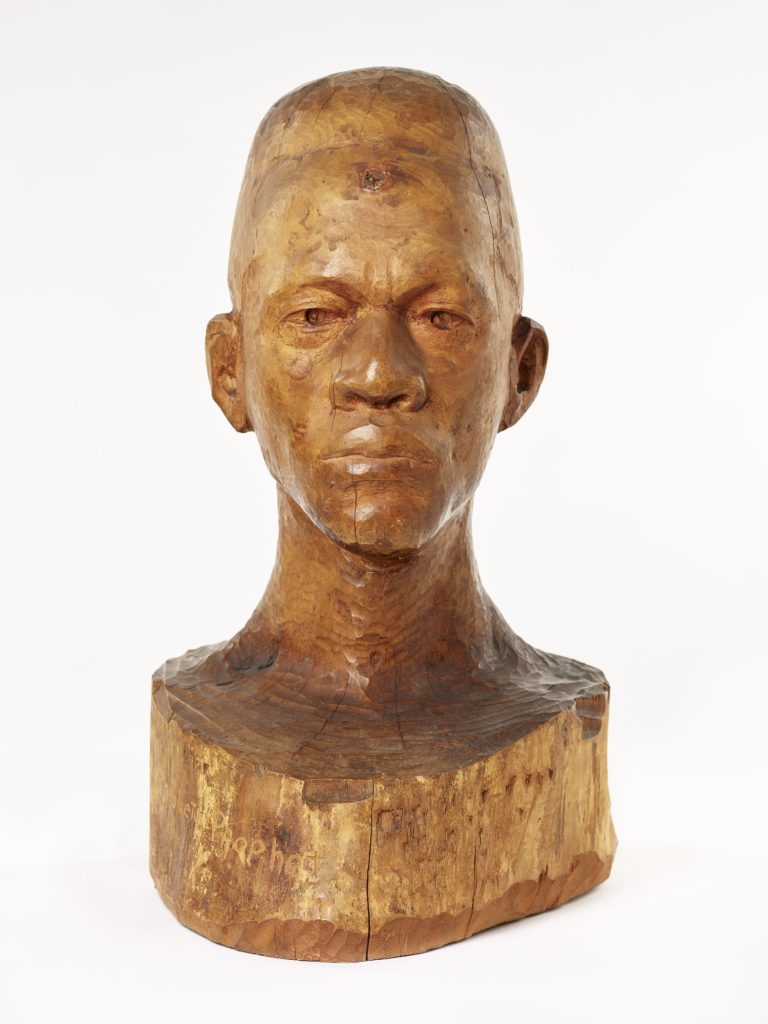
The exhibition is dominated by sculpture but provides some two-dimensional artworks as well — a few watercolors and process sketches. The sculptures, nearly all of which are busts, are created varyingly from bronze and wood. One particularly fantastic artwork is Negro Head (ca. 1924). A log of cherry wood stands vertically, its top carved into a person’s visage. With a surface polished so smoothly as to resemble real human skin, the artwork shows Prophet’s mastery of skill with chisels. However, it is the smaller details that make this artwork sing. The bottom of the cherry wood preserves its bark, making it seem as if this portrait has emerged from the wood rather than being mined from it.
Gift of Miss Eleanor B. Green. RISD Museum, Providence, Rhode Island
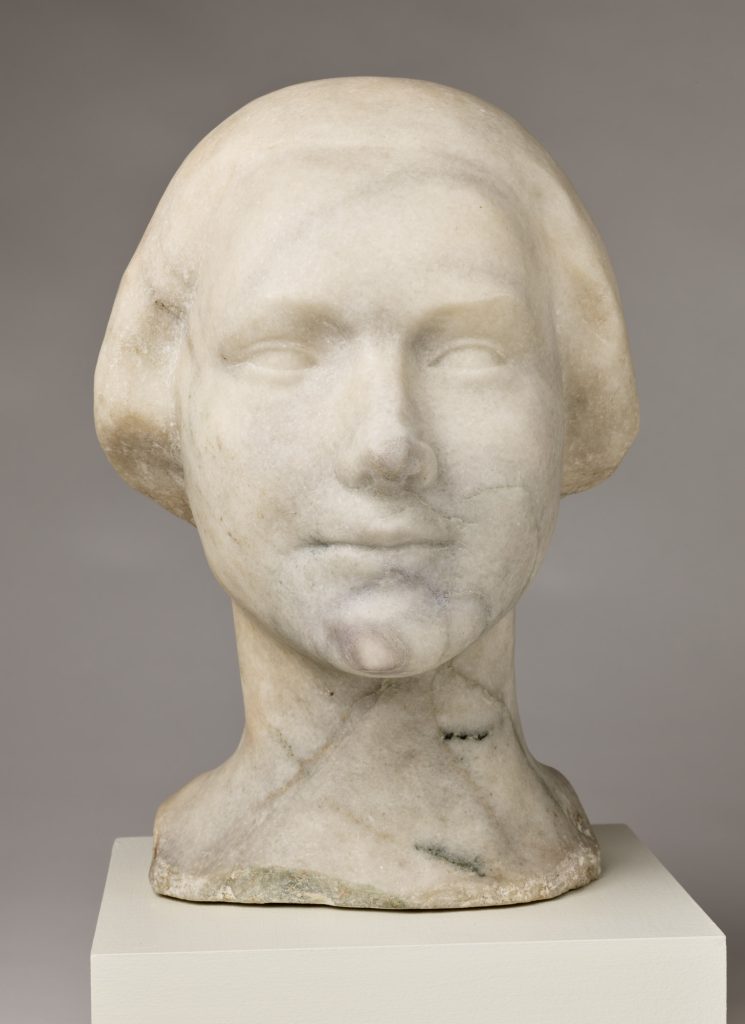

While portraits have long been the subject of sculpture, it is timeliness and skill that make this exhibition most powerful. Sculpture in the United States during the 20th century was dominated by White men, and Prophet’s exhibition here expands the canon, showing clearly that Black women are just as capable of the same artistic feats as their White male counterparts. While during her life she was often rejected and dismissed as an artist due to her race, Prophet’s enduring legacy of artistic prowess proves there is always more to history than meets the eye.
At MOCA GA, Ayana Ross presents her solo exhibition Saving Our Sacred Selves through October 25. I found this exhibition to be truly resplendent. As per the exhibition text, “This exhibition offers large-scale narrative paintings, tonal portraits, landscapes and domestic objects that emerge to present a visual and spatial introspection of daily life and the translation of those moments to the larger narrative of cultural exploration.”
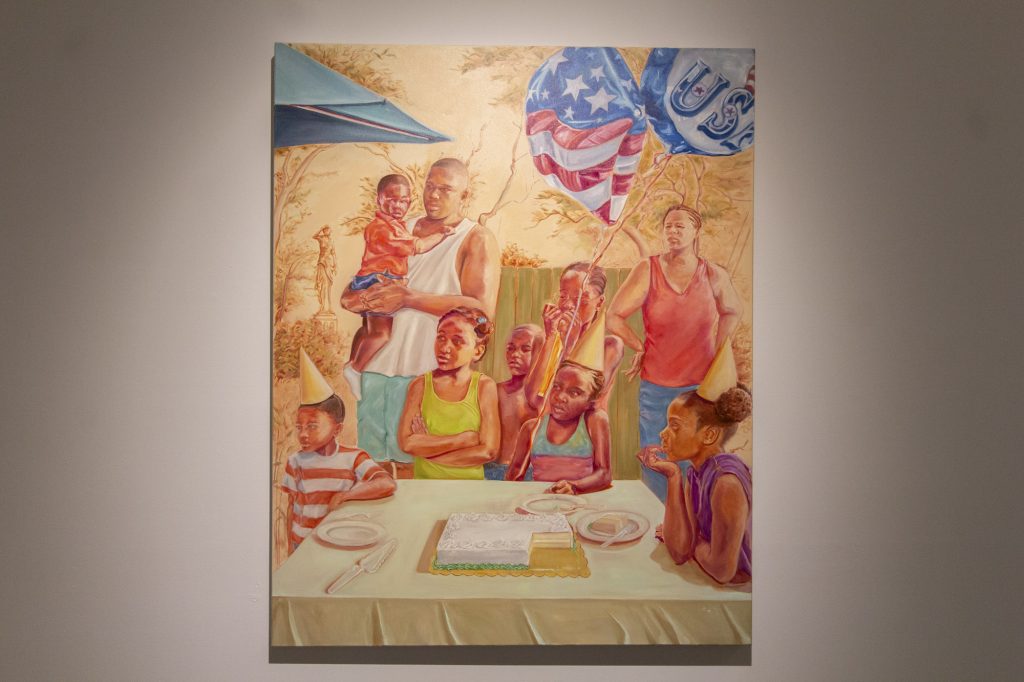

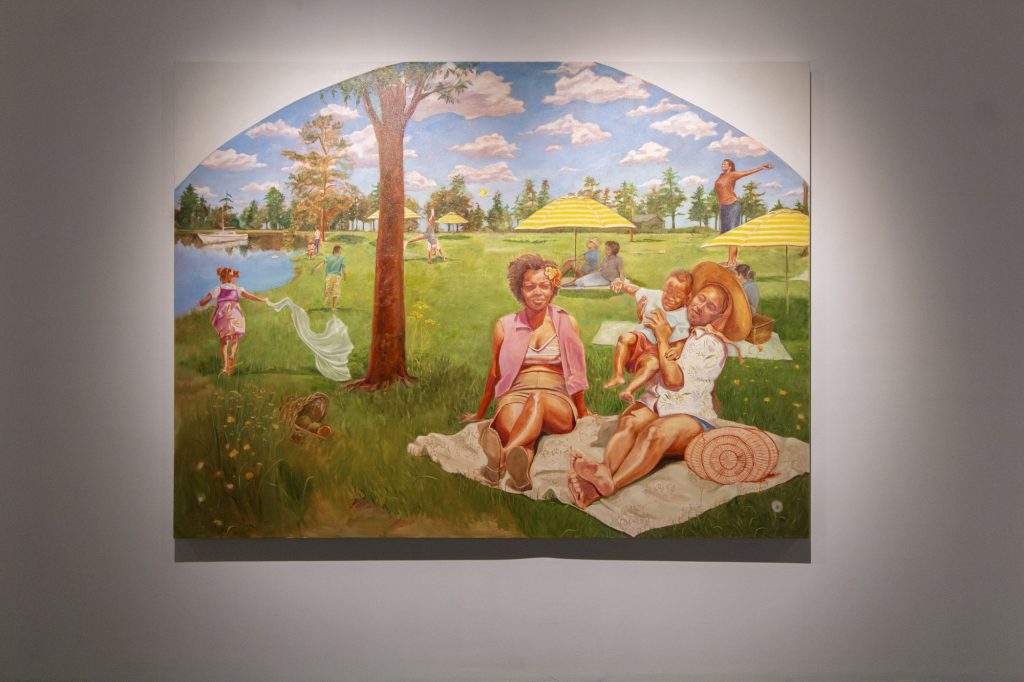


If I could summarize this exhibition in two words, they would be “burnt sienna.” The color, which Ross uses in every painting on view, serves as a throughline for the exhibition. Perhaps it is flesh and blood, perhaps the human spirit or perhaps it is simply a warm, comforting color. Regardless, its continual use throughout the exhibition places each painting within the same universe, as if each painting is a different scene of the same story. At the same time a woman lounges in a field in Woman in the Garden (2025), another woman experiences spiritual transcendence in When She is Lifted (2025).
The beauty of this exhibition, beyond the simply wonderful use of color and paint, is the simplicity of it all. While the scenes represent slices of everyday life, here they seem to radiate with energy, exalting the everyday subjects within. Walking through this exhibition is nothing short of a religious experience — a feeling reinforced by the paintings of praying hands, such as Hands of Praise (2025). Ross shows that we need look no further than our daily lives to find solace; everything we need for a beautiful life is already with us.
At the Clark Atlanta University Art Museum, Shanequa Gay’s solo exhibition Ancestral Mirrors, on view through December 6, continues the exploration of the immaterial world. Haint blue is a color Southerners know well. According to tradition, the color is painted on the ceiling of entry ways, serving as a portal to the sky through which evil spirits may escape and thus protecting the household from misfortune. Blue, especially in the South, is a most spiritual color. It should be no surprise then that Gay’s exhibition, which is a metaphysical exploration of intergenerational exchange, is replete with shades of blue.


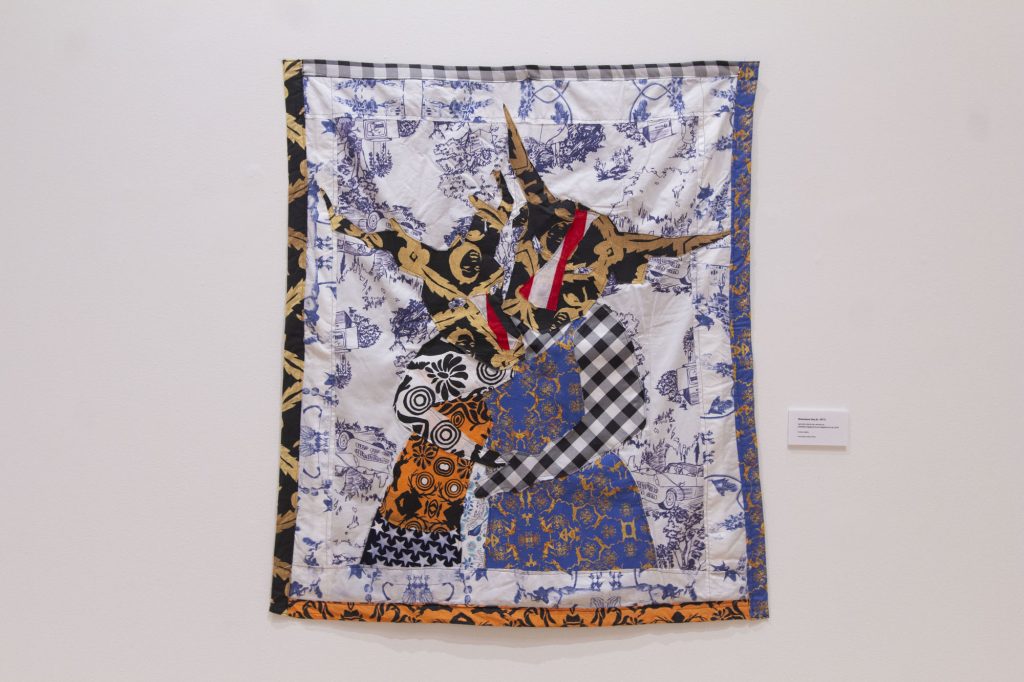
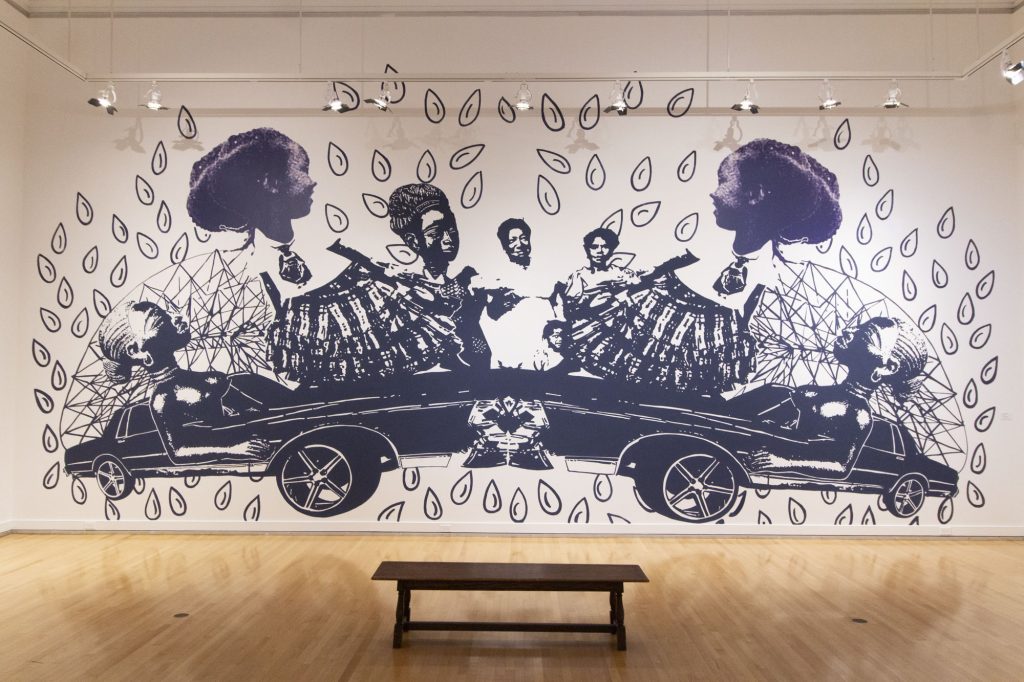

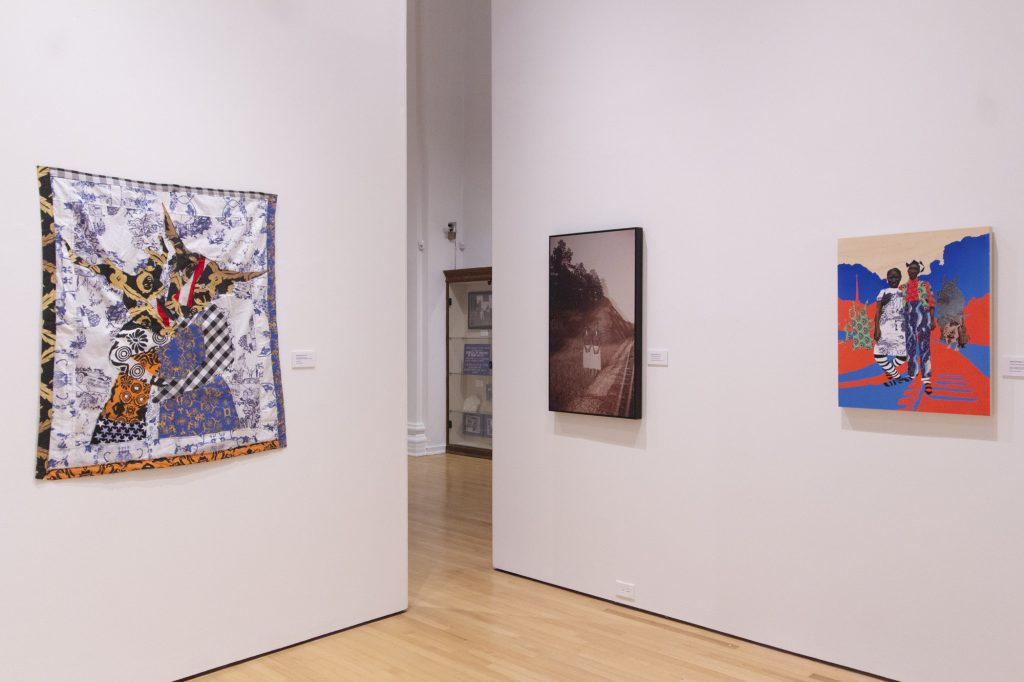

This exhibition serves as a sort of retrospective for Gay, with artworks ranging from multiple years and various mediums — textiles, painting, video and photography all make appearances. But rather than merely serving as a survey of Gay’s work, this exhibition speaks to the occult. Gay is known for her chimera-like figures — part-human, part-animal hybrids which frequently sport masks, occluding their faces. Throughout this exhibition, these creatures dance with Black women, sometimes literally as seen in Healing Circle (2019). Their appearances, regardless of the medium, interconnect every piece, as if each artwork is a talisman used to summon their appearance. As these spirits permeate the artworks, they serve as important reminders that we are never truly alone. Each one of us is part of a family line and that lineage lives inside us. Relinquishing ourselves to matrilineage actualizes us. The title of one of Gay’s artworks puts it best — “I am she, she is me, we are us … whatever happens to you happens to me.”
::

Leia Genis is a trans artist and writer currently based in Atlanta. Her writing has been published in Hyperallergic, Frieze, Burnaway, Art Papers and Number: Inc. magazine. Genis is a graduate of the Savannah College of Art and Design and is also an avid cyclist with a competition history at the national level.
STAY UP TO DATE ON ALL THINGS ArtsATL
Subscribe to our free weekly e-newsletter.

PLEASE SUPPORT ARTSATL
Your Gift Sustains the Coverage You Count On!
Related Posts