After more than a century, the Atlanta Writers Club has new stories to tell
What’s older than The New Yorker, the Iowa Writers’ Workshop and even the Pulitzer Prizes? It’s right here in town, a kind of well-known secret among Atlanta’s aspiring and established scribblers: the Atlanta Writers Club.
“Every year we get more people who come to us and say, ‘I’ve lived here forever and never heard of you.’ Thank goodness for Google,” said George Weinstein, the Atlanta Writers Club’s executive director since 2020 and currently longest-serving member.
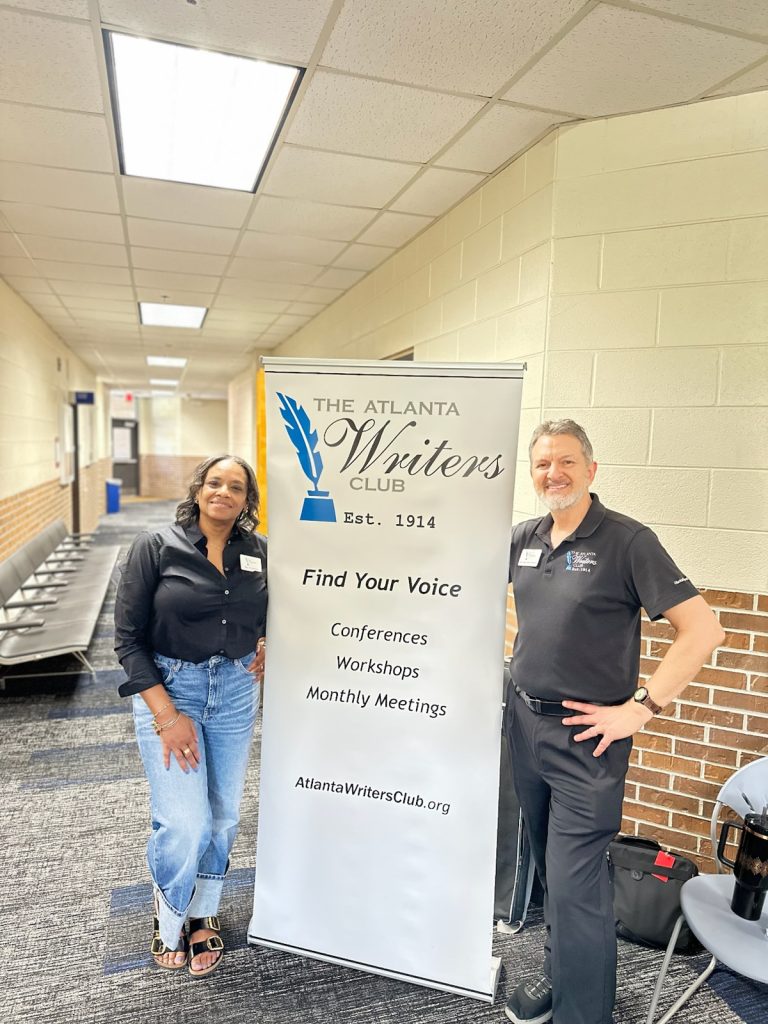
Established in 1914 and in operation ever since, the Atlanta Writers Club is a clearinghouse for all things writing and storytelling related in the Atlanta area and beyond. It offers online writing workshops, book groups, biannual writers conferences, a self-publishing conference, retreats to St. Simons Island and, perhaps most popular, monthly in-person meetings.
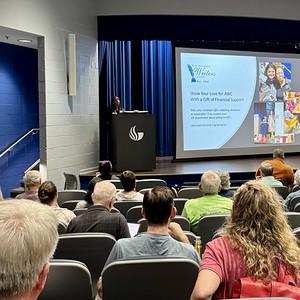
At the meetings, roughly 100 local aspiring and professional wordsmiths congregate at Georgia State Perimeter College (or the Lilburn public library in the summer) with Styrofoam cups of coffee and sugary snacks, clamoring about character arcs, plot twists and alternate endings that could have been. The local literary nonprofit is also the steward of Georgia’s prestigious Townsend Prize, awarded every two years to a seminal work of literary fiction by a Georgia author.
At 111 years, the Atlanta Writers Club is likely the third-oldest such group in the country. Only the California Writers Club, started in 1912, and the Boston Authors Club, founded in 1899, are older. In the Southeast, however, it’s easily the oldest and most active writing organization, naming its 60th president back in August. Dr. Tisha Carter, often known as Dr. T, is the first Black woman to hold the position.
“Fifty-nine other presidents — that’s a little daunting, a little intimidating, but inspiring at the same time,” said Carter, a published author who worked in Cleveland until moving to Atlanta two years ago. “I was a huge part of the literary community in Cleveland, doing programs, events and partnering with the local library and public school systems. I wanted to bring that same energy and experience to Georgia.”
While Carter heads the Club and its board, Weinstein is responsible for almost all of its programming. Executive director is the only paid position at the small literary nonprofit, so he’s been sending scores of emails preparing for the club’s biggest event: the biannual Writers Conference, which draws writers, agents and editors from across the country.
This year’s conference at Westin Atlanta Airport Hotel on October 24 and October 25 will feature agent/editor critiques, pitch meetings, a workshop on AI and publishing, Q&A panels and talks. So far, more than 60 authors have been published through the conference, including young adult superstar Becky Albertalli, who penned the 2015 debut Simon vs. the Homo Sapiens Agenda, later made into the popular film Love, Simon.

“She launched her career through the Atlanta Writers Club about 10 years ago,” said Weinstein. “She got her agent through the conference, and then the agent got her a book and a movie deal. And the rest is history for her.”
But the conference isn’t just the biggest offering and logistical lift every spring and fall — it helped save the club almost 20 years ago when membership hit an all-time low. “I was there in the bad old days,” said Weinstein, who joined back in 2001. “When I assumed the presidency in 2004, we had 48 paying members, and we were lucky to get 10 people at a meeting.”
It was a far cry from the organization’s prestigious beginnings as an elite, invitation-only group reserved for published writers. Created by Mary Peters and Lollie Belle Wylie (a composer, poet and Georgia’s first paid woman journalist), the club counted among its early members editors of The Atlanta Journal and The Atlanta Constitution, the first Georgia Poet Laureate Frank Lebby Stanton, an array of established novelists, journalists, poets and playwrights and even Georgia literati such as Flannery O’Connor and Erskine Caldwell, who were invited speakers or honorary members.
Starting in 1923, the Club met regularly at the château-esque Wimbish House (also home to the Atlanta Woman’s Club), and, for decades, members dressed up in tuxedos and dresses to mingle and discuss the business of wordsmithing. Then, in 1990, a fire destroyed part of the property, and the Writers Club had to meet elsewhere.
“We were like the wandering Israelites from the Bible, going from encampment to encampment,” recalled Weinstein. He added that, at the time, the club was meeting in church basements and retirement homes. It wasn’t just the displacement, however. They’d been losing members for years, despite previous presidents’ efforts to relax publication requirements and other exclusionary rules.
So Weinstein made a few simple yet game-changing adjustments. He moved the monthly meetings from Thursdays to Saturdays and the location from Midtown to somewhere along the perimeter, making the club more accessible to a new writing class that worked during the week and lived mostly on the fringes of the city. These changes turned the Atlanta Writers Club around. By 2008, when Weinstein launched the Atlanta Writers Conference, it had expanded to include several hundred members from all walks of writing life.
However, change didn’t come without pushback, especially from some of the club’s prior presidents. “I would get angry letters from previous presidents in the ’80s, telling me I was ruining the club and how dare I,” recalled Weinstein. “Looking back, it’s laughable just how wrong they were.”
While it was struggling for survival two decades ago, today, the Atlanta Writers Club boasts 1,500 members. “We could branch into different markets to bring in younger members,” said Carter. “I’ve worked in higher education. I’m hoping to collaborate and partner with a lot of Georgia Colleges and get more of those young folks in here.”
As for Weinstein, although Perimeter College has become a new nucleus for the Atlanta Writers Club, he has ambitions of finding a new permanent home. “All my best friends are people I’ve met through the club,” he said. “My wife is someone who joined my critique group in 2008. We’d been friends for a decade before we got together. I owe this club everything, and I guess that’s why I give it everything. I don’t know where I’d be without it.”
Where & When
The Atlanta Writers Club Conference will take place October 24 and October 25 at the Westin Atlanta Airport Hotel. Tickets depend on individual events.
4736 Best Road.
::

Jeff Dingler is an Atlanta-based author and entertainer. A graduate of Skidmore College with an MFA in creative writing from Hollins University, he’s written for New York Magazine, The Washington Post, The New York Times, Tiny Love, Newsweek, WIRED, Salmagundi and Flash Fiction Magazine. More information at jeffdingler.org.
STAY UP TO DATE ON ALL THINGS ArtsATL
Subscribe to our free weekly e-newsletter.

PLEASE SUPPORT ARTSATL
Your Gift Sustains the Coverage You Count On!
Related Posts