Preparing future professional musicians both for life and career
William Pu Music Academy aims to begin a lifetime educational process as early as possible.
::
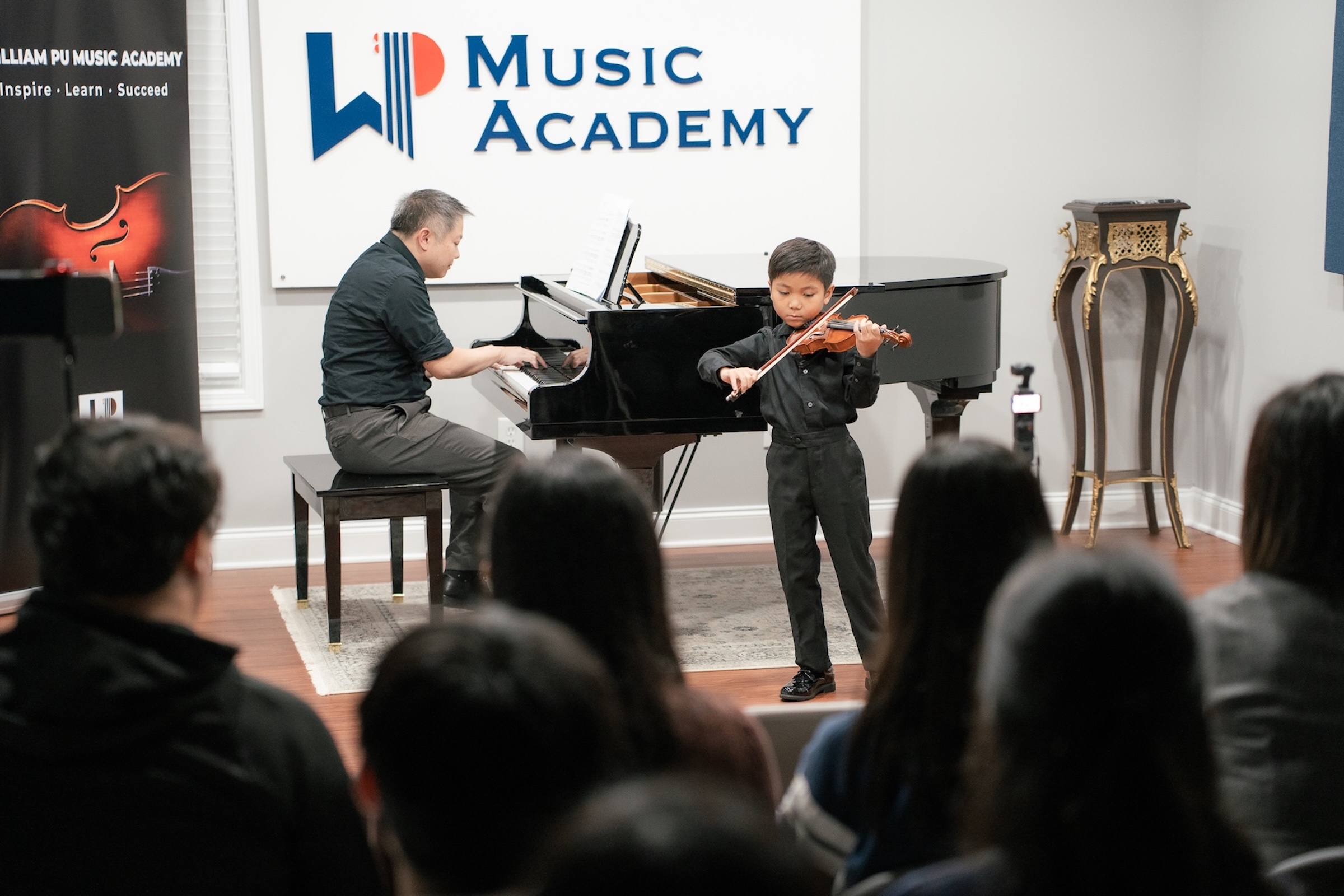
There’s an almost monastic quality to the William Pu Music Academy, a classical music program with locations in Alpharetta and Buford. The chamber where we meet is an unadorned room hidden among other units in an unassuming office park. That serene, humble nature is reflected in the aura of founder William Pu, who has maintained the facility since 2014. Now in its 12th year, the academy is broadening its horizons to offer WMPA Pre-College, a new conservatory track preparatory program for its most committed students.
“Education takes years — and a back-and-forth. It’s not always a growing trajectory,” says Pu of the educational process, which he sees reflected as much in the instructor as in the student. “Throughout starting the Academy to now, 12 years later, is also a process of evolution. To be a better teacher.”

To that end, Pu found himself approached time and again by parents of students, wondering whether their children should pursue a college major in music. For Pu, the question was daunting — first because he knew all too well how difficult it was to succeed in a music career and second because so many of his students were excelling in their other academics, and he worried about turning them away from other opportunities.
The WPMA Pre-College program became his definitive answer. With a curriculum spanning August through May, accepted students will receive instruction that runs the gamut of music theory, ear training, private lessons and ensemble performance.
“I don’t push them until the student tells me to push them,” explains Pu of his academy’s high but accommodating standards. “I tell them, ‘I can push you as hard as you want me to push you.’” That confidence in his own abilities as a teacher developed over time as Pu observed his efforts coming to fruition in the Academy’s earliest students.
Pu laughs when I tell him that one of my best guitar students — one who could reasonably be considered a prodigy — is now a dentist. It’s a narrative he’s seen play out all too many times: Talent alone is not enough to justify a lifelong commitment to music. Still, we concurred that music education serves an important purpose as a building block in personal development.
“They’re learning skills they can use in their life,” Pu affirms. “Like work ethic, perseverance, patience and working out details.” He goes on to point out that the most important skills cultivated by music education are the confidence and communication skills learned in the performance environment. “That was my initial focus. They’re not going for the music major, but they can learn these lessons.”
Now the Pre-College program emerges as an elite course of education for WPMA students who feel called to a lifetime commitment to music. Pu is quick to emphasize that “pre-college” doesn’t just refer to the immediate years leading up to secondary education. It’s a lifetime process that, he feels, should begin as early as possible.
“The only way to do this is to make them start younger,” he says, emphasizing the final word. To that end, the Pre-College program is meant to identify the students who have that potential at an early age. It’s a rigorous undertaking, but he also points out that starting young gives his faculty an opportunity to employ their teaching skills to the fullest possible degree. “By the time they reach high school, they will feel a lot more confident.”
Unique to the Pre-College students will be access to an ongoing series of high-profile visiting artists. “We are very fortunate to have first-class musicians in town,” he continues. He goes on to mention Atlanta Symphony Orchestra concertmaster David Coucheron — an old colleague of Pu, who is also an ASO alum — as a prominent example. He also cites University of Georgia cello professor James Kim as another visiting artist and points out that the WPMA will be calling on its numerous connections to arrange additional visiting lecturers from major conservatories.
Enrollment in Pre-College will be by audition only. “We put up requirements for certain scales, arpeggios, etudes and solo pieces. We’ll have an application process and then a live audition.”
Early interest has been robust and enthusiastic with parents and students alike. “They’re just screaming, ‘Finally you’re offering this! We’ve been waiting for that,’” Pu chuckles. His good cheer is infectious, but there’s a serious undercurrent of learned commitment to it. As Pu’s rich, melodious laugh fills the serene chamber, there is, for an instant, a preview of what the space will sound like when filled with all those passionate young players.
::

Jordan Owen began writing about music professionally at the age of 16 in Oxford, Mississippi. A 2006 graduate of the Berklee College of Music, he is a professional guitarist, bandleader and composer. He is currently the lead guitarist for the jazz group Other Strangers, the power metal band Axis of Empires and the melodic death/thrash metal band Century Spawn.
STAY UP TO DATE ON ALL THINGS ArtsATL
Subscribe to our free weekly e-newsletter.

PLEASE SUPPORT ARTSATL
Your Gift Sustains the Coverage You Count On!
Related Posts