
In the studio: Ato Ribeiro’s loud soundtrack and quiet revolution
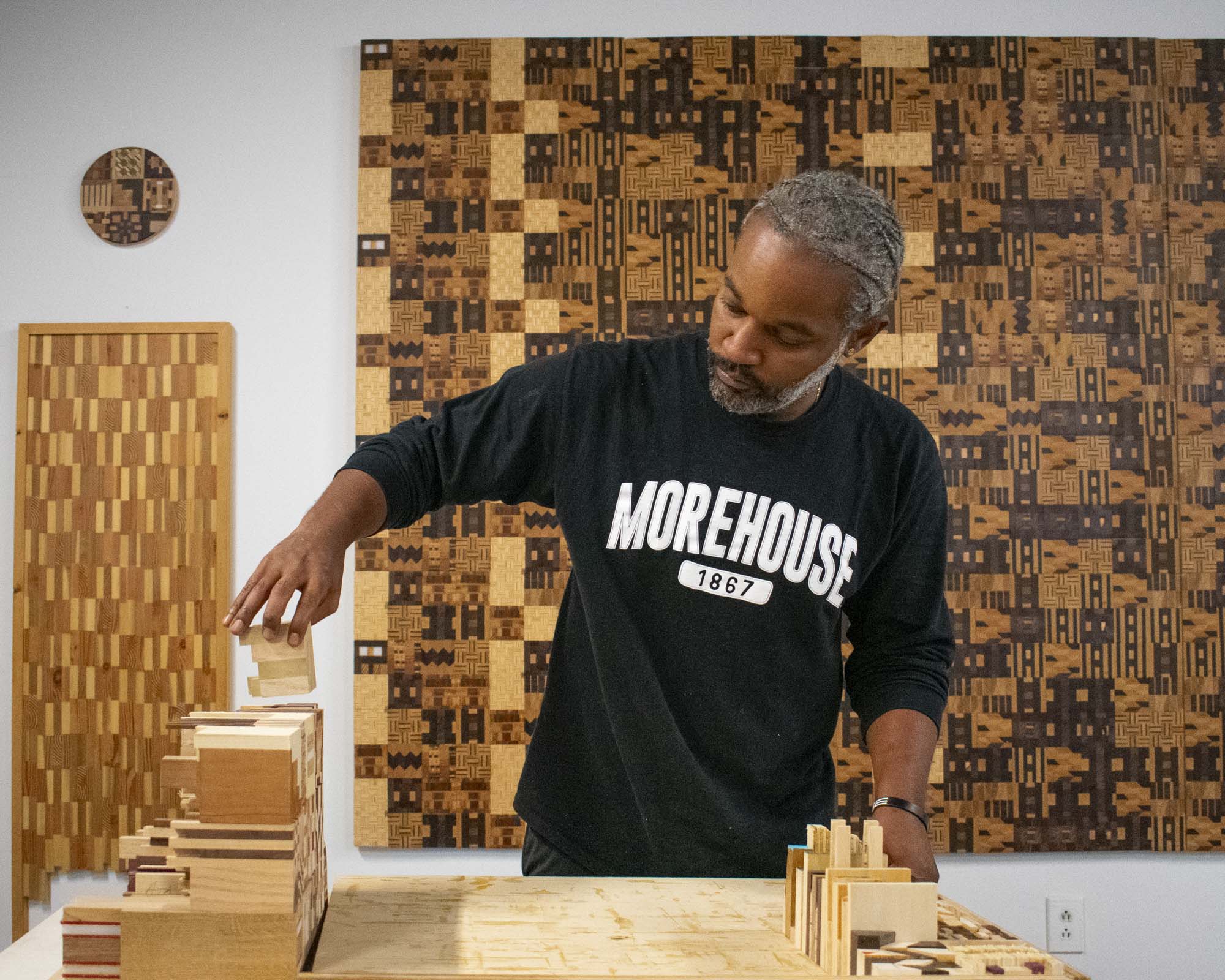
Music rumbled the walls of Ato Ribeiro’s freshly cleaned studio at Atlanta Contemporary as he moved through the space with a water bottle, tending to the plants that had survived his recent trip to Ghana. Ribeiro paused his maintenance task for a moment to share a newly viral social media post from his high school friend — acclaimed jazz pianist Joe Alterman — who posted about the wave of artists canceling performances at the Kennedy Center following its recent and controversial renaming by the current federal administration.
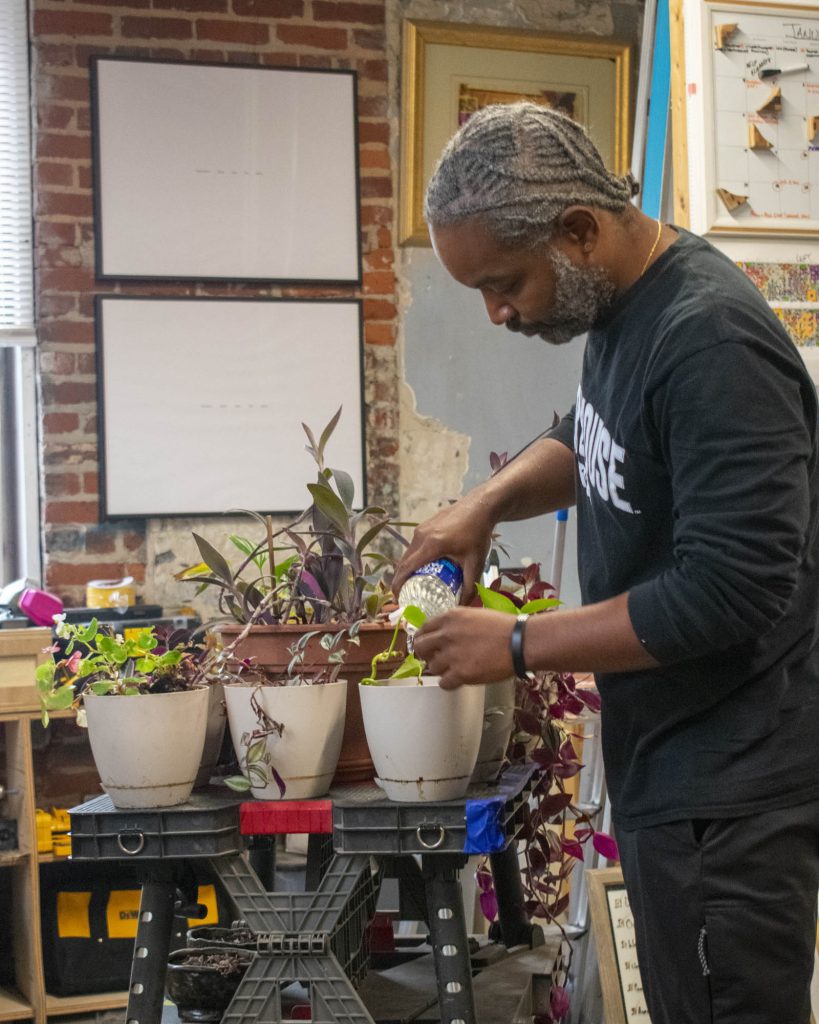
Crowding around his phone, Ribeiro recited the sentiment that had resonated so deeply with him: “When artists step away from institutions being reshaped into political symbols, they aren’t punishing fans. They’re refusing to legitimize power. Stepping away isn’t punishment; it’s protection.”
It is easy to imagine why this sentiment might resonate with Ribeiro. His work was recently accessioned by the Smithsonian Institution, a significant career milestone that places his practice within a federal arts infrastructure that is increasingly hostile to artists of color, especially those addressing themes of racial justice.
Ribeiro’s practice is materially and thematically informed by his cross-cultural background, having spent formative years of his life both in Accra, Ghana, and in Atlanta, before earning a B.A. from Morehouse College and an M.F.A. in print media from the prestigious Cranbrook Academy of Art in Bloomfield Hills, Michigan.
Now based in Atlanta, Ribeiro is best known for his wooden Kente quilts. In these works, “quilt blocks” are fabricated by assembling lengths of diverse woods — much of it engineered, treated as an exoticized alternative — into logs which are cut into thin cross sections and arranged into patterns that reference African and African American textiles.
Rather than retreating in a moment when artistic expression celebrating the African diaspora is being villainized, Ribeiro perceives these difficulties as “directly tied” to the discursive value of his practice. “It’s just like chiseling away at different histories that were neglected,” he shared, “finding ways to celebrate these people that have for so long just been ignored, not seen as contributors to art, culture, to technology, to labor, to the building of the country.”
The continued necessity of his work is a source of both validation and fatigue for Ribeiro. He expressed a complex gratitude that he has “prepared a body of work that is ready for these moments to come back up again,” acknowledging that they are cyclical and, unfortunately, familiar. “We’ve been having these conversations,” he emphasized. “There are generations of people that have been doing it. [And] we did it because we needed to.”
Asked about balancing between participation and refusal — both valid forms of resistance in the right context — Ribeiro noted this question is not unique to this political moment, nor is it limited to federal institutions. He mentioned other arts hubs where histories of controversy frequently force artists to weigh the impact of their presence against the ethics of the venue.
For some artists, past exploitations necessitate a hard line of withdrawal; for others, the goal is to enter these spaces when they possess the “wherewithal” to confront them. It is, as Ribeiro described, a complex ecosystem where “everybody is dealing with it from different angles.”
In contrast to his studio soundtrack, Ribeiro’s personal approach to resistance is remarkably quiet. “I think the reforming part happens in the studio for me personally,” he said. “The conversations I’m having, the themes I’m working with, the titles I’m giving it, the people I’m hoping the works are in conversation with when they are in a group show or an exhibition or in an institution.”
Ribeiro desires for his quilts to signal safety to other Black artists who might feel isolated in hostile spaces. “How can I make a piece that can be like, ‘I see you in this same room. We’re not here permanently, but we’re here together and we’ll hold hands.’ I think that’s such a big part of the daily meditating.”


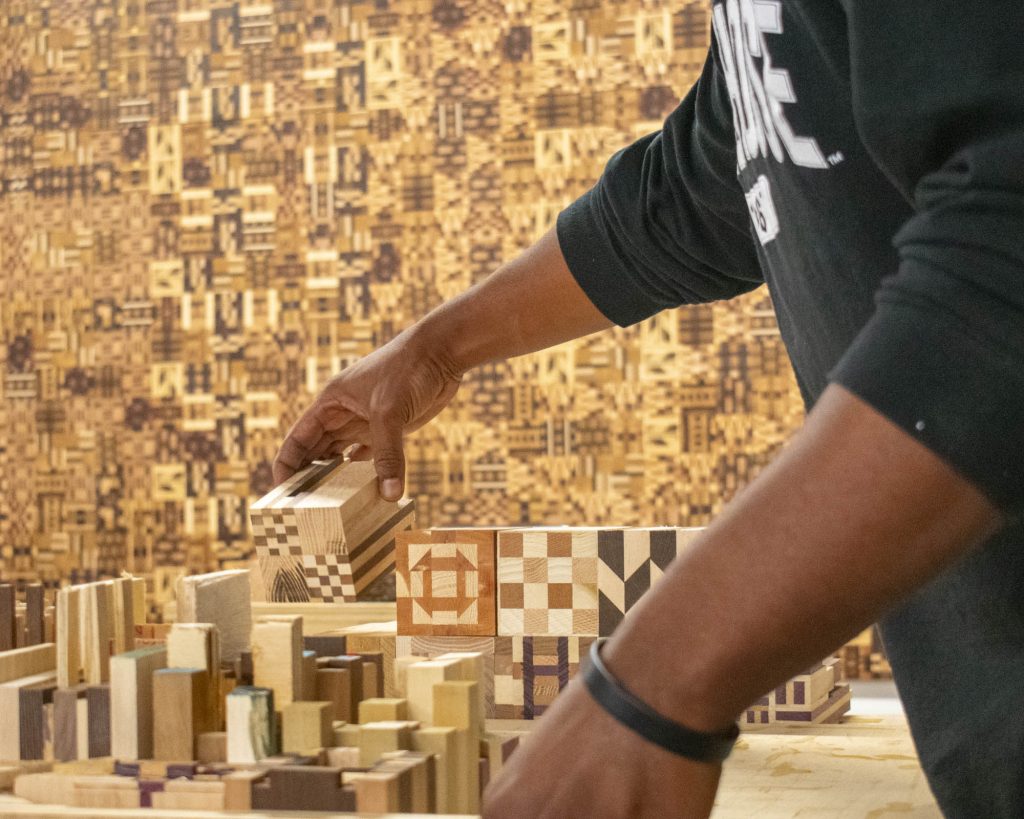

This quiet signaling also serves as a subversive strategy for infiltration within institutions that have historically excluded or exploited Black identity. By creating work that operates below the radar of overt confrontation, Ribeiro’s practice has skillfully established footholds in environments that have been unwelcoming of similar messages. “If I could quietly be in there and create a space that people will walk right past, but somehow it will seep into their subconscious and psyche and they will feel more connected and familiar and open to entering that conversation. I feel like that is exactly where that piece needed to be,” he explained.
Lest one assume Ribeiro feels irritated when viewers fail to engage with his message, he clarified succinctly: “I prefer that.”
Ribeiro’s strategic opacity places his practice in the direct lineage of African American quilters. Just as those artisans encoded messages into textiles to aid navigation along the Underground Railroad, Ribeiro creates work that operates on a dual frequency — “hiding in plain sight” while keeping the deeper meaning obscured and accessible only to those ready to receive its significance.
For Ribeiro, adopting this method is an explicit homage to the ingenuity of Black women, celebrating a sophisticated technology of communication that allowed vital conversations to exist in the most violent spaces.
Ribeiro initially developed this body of work as an MFA student at Cranbrook Academy of Art, an institution with a shockingly small number of Black alums. Asked about how this work was received in that context, Ribeiro reflected on the fact that the cultural references were often illegible to his peers.
He recalled critiques where classmates would occupy the room with irrelevant comments, for example, discussing cutting boards made by their grandfathers, projecting domestic nostalgia onto objects engaging with dark colonial histories.

In probing these examples, it became clear that the success of Ato Ribeiro’s career is not only built upon deep technical skill, sophisticated taste and intellectual rigor — it also rests on a foundation of palpable personal integrity and strength.
Working in the language of hidden messages and buried histories opens opportunities for routine misinterpretation of traumatic topics. Yet, in recounting events that could easily be described as angering, Ribeiro’s assessment of others’ motives and intentions is consistently generous and remarkably kind. Resilience and empathy are unnamed ingredients in his practice.
Ultimately, Ribeiro acknowledges that some viewers may feel the work is “not for them,” but he declines to view this as a conflict. “I’m not going to fight you,” he said. “Some people are not there to have those conversations and that’s fine.”
Instead, he views the work as an exercise in widening one’s gaze — a practice he applies to himself as much as to his audience. It is about “practicing getting better at seeing people,” he explained. “Learning more about my queer friends, learning more about my trans friends, learning more about my Jewish friends, learning more about all of my friends . . . And becoming more aware so that I’m not constantly walking right in front of their ‘quilts’ and not seeing anything. Right?”
In closing his studio, Ribeiro engaged in a final ritual of maintenance, applying a mixture of shea butter and coconut oil to his hands. The blend itself is a map of his existence — shea butter from West Africa, coconut oil from the Americas. “It’s a little hybrid thing,” he noted.“Part of my daily practice of just saying thank you to my hands.”
This act of self-preservation, insuring the tools of his trade against the friction of the work, returns to the sentiment that opened the conversation. For Ribeiro, the ultimate resistance is not always found in the public square or the institutional critique but often in the private refusal to be consumed by them, simply “stepping away and giving yourself space to just listen to your body and make sure you’re OK before you come back to the battle.”
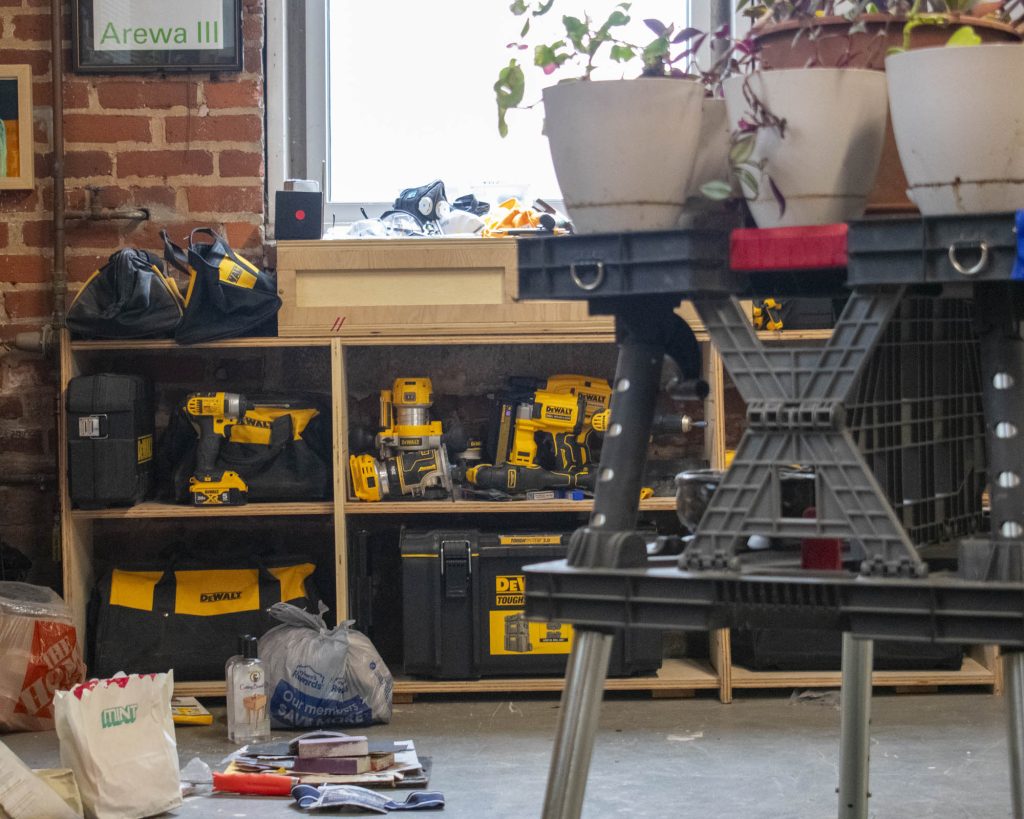
“Sometimes silence is very loud,” he added. “You can just come in and water the plants and go, and it was a successful studio day.”
::

Dr. Kevin M. Storer is a multidisciplinary computing researcher living, working and collecting art in Atlanta. His approach to art criticism and collecting prioritizes the discursive power of artistic practice over purely aesthetic qualities. This perspective is informed by his internationally-awarded scholarship on the complex relationships between people and the objects we create — especially as they shape our identities and social realities. Kevin earned his Ph.D. in informatics from the University of California, Irvine.
STAY UP TO DATE ON ALL THINGS ArtsATL
Subscribe to our free weekly e-newsletter.

