
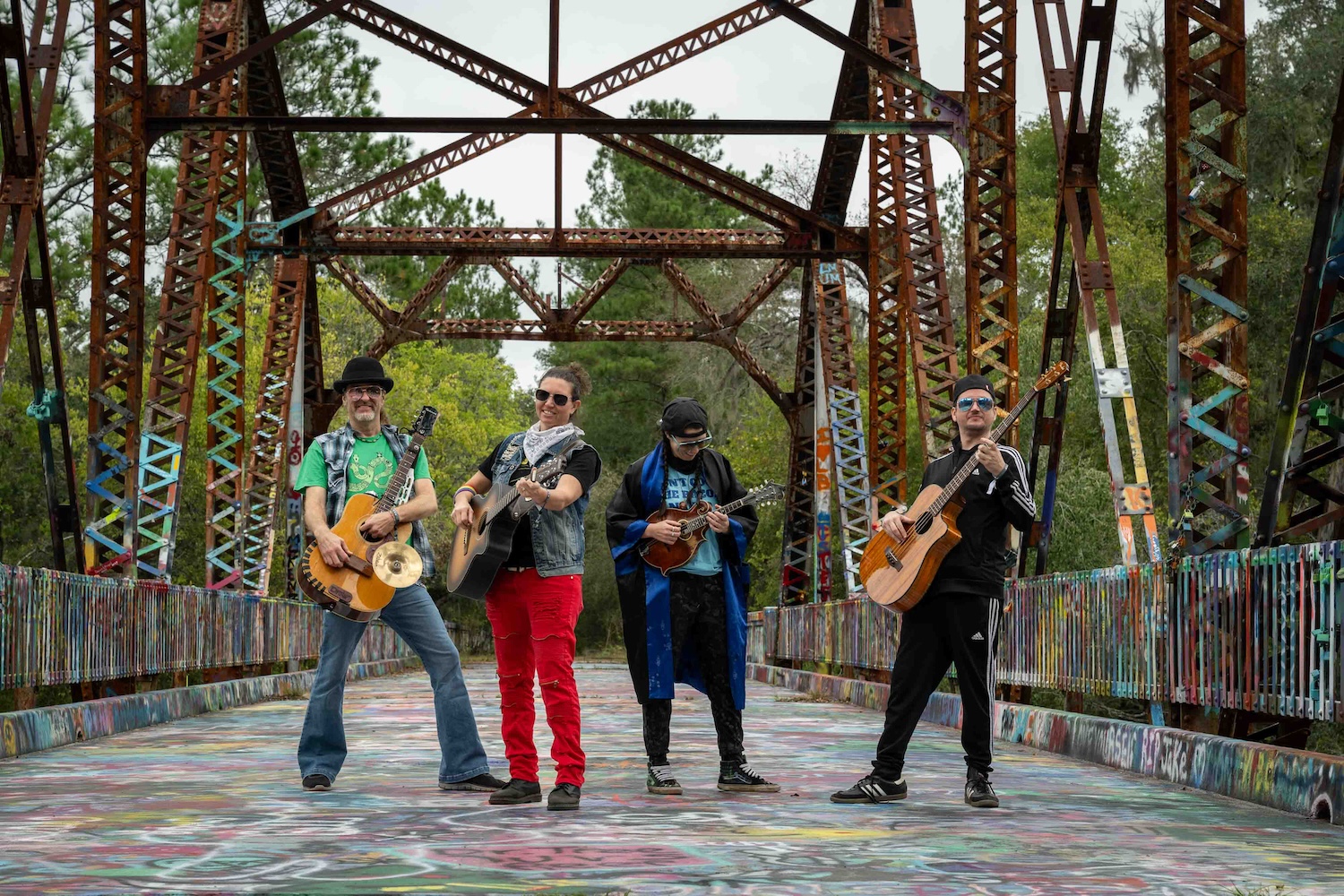
The Ain’t Sisters are here to rock your folk and spread some love
The folk sounds, harmonies and socially conscious lyrics of the The Ain’t Sisters — songwriters, vocalists and guitarists Barb Moose Carbon and Arrie Bozeman (who also plays mandolin), drummer Richie Jones and bassist Justin Boudreau — might remind you of the Indigo Girls, but only if you can imagine that iconic Georgia band stopping mid-set to slam triple espressos, stick on clown noses and sacrifice their sweet melody maidens to the rock ‘n’ roll guitar gods, all before returning to business as usual.
The Ain’t Sisters’ eclectic folk rock toggles between tranquil and spirited, earnest and irreverent, head nodding and head banging. It’s music with complexity and divergence that retains the activist spirit of the ’60s but mirrors today’s more complicated sociocultural milieu. Despite their music being a little “out there,” or perhaps because of that, it clearly resonates with their rapidly growing audience. Shows are more like festivals than performances as fans, many clad in “Shake Your Taint” T-shirts, dance and sing along to songs they know by heart.
Their latest album, Atomic (Dragonsong Productions), is a similar pastiche balancing social critiques with dark humor, plaintive contemplations with bug-squashing rage and relationship sorrows with frenzied debauchery — all threaded together with tongue-in-cheek theatrics. “We wear our hearts on our sleeves,” says Bozeman. “There’s a lot of emotionality in our songs. There’s a lot of humor, and some of it’s dark and some of it’s weird, and I think that the fact that we allow ourselves to just be exactly who we are — sometimes completely stupid, sometimes really deep, sometimes introspective, sometimes angry and sometimes just broken or scared — gives people permission to broach those subjects or emotions as well.”
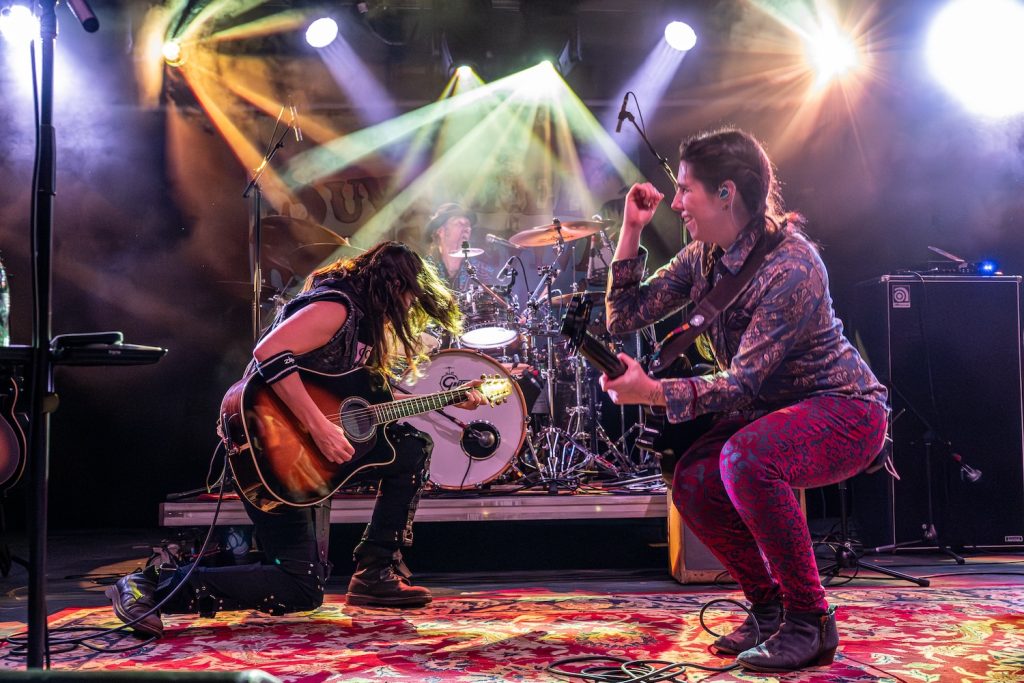
With that kind of emotive range, genre experimentation is the rule both between and within tracks. The unorthodox combinations not only highlight the band members’ individual talents but also amplify each song’s lyrical message. “New American Dream,” for example, satirizes suburbanite virtue signaling by bracketing cheery pop with military drums and distorted national-anthem licks. “Gringo Tourista” hammers home the urgency of addressing environmental issues with heavy metal intensity and Dylan-worthy, just-look-at-yourself sneer. “Marching Orders” incorporates speakeasy jazz sounds to capture the confusion of wanting to do something but not knowing where to start.
Lest it all get too heavy, “C’est La Vie (The Ballad of Isabelle Dinoire)” is a guilty pleasure that injects White Album psychedelia into Ramones punk energy in the same disconcerting way that tragedy can beget dark humor. “Shake Your Taint” begins slow, builds to a K.C. and the Sunshine Band groove and breaks loose into a Widespread Panic-like jam. The result is pure fun (with important cooking advice added in). Carbon claims that the album’s theme is Armageddon, but the tone seems jollier — like a write-your-own-ending Ziggy Stardust story where, instead of self-destructing in the finale, he reads The Power of Positive Thinking and takes it to heart.
But there’s an inverse relationship between out-of-the-box songwriting and listener accessibility. While that approach can yield a following of loyal insiders — think Frank Zappa or Col. Bruce Hampton fans — the resistance to genre archetype may alienate Joe and Josephine Average. Two songs on the album provide gateways for those listeners. “Chest Pains” is an indie-folk love letter that highlights Carbon and Bozeman’s warm harmonies and could double as a longing to heal the world. “Birds,” the album’s opening track, is a catchy, feel-good tune with Southern-rock flourishes that capitalizes on Jones and Boudreau’s driving rhythms and Bozeman’s power guitar crescendos to elevate Carbon’s vocals into a rousing call for freedom, strength and joy.
As a whole, the album adopts a Janus-like scope — balancing an unflinching view of the gritty realities of being human with an existential leap of faith that we’ll somehow figure it out. “We try to thread the positive in with really hard subject matter,” explains Carbon. “I think that a lot of people can relate to that, because it’s like, what can I do right now to make things better for everyone? What can I touch in my immediate community? How do I create positive change during this time?”
Bozeman and Carbon believe that the most impactful songwriting comes from being open to inspiration beyond themselves. “More often than not, the words, or some line, will come to me and not leave me alone. It’s like the idea is out here and it’s ethereal, and it needs some sort of conduit,” says Bozeman. Carbon agrees: “To be creative and build something, you let the collective consciousness flow through you without thinking about how you’ll be perceived or if a million people want to buy it. The same person can write one song with little impact, and then they can write something from the heart where you can feel this person’s soul bending under its weight. It depends on how tapped in you are.”
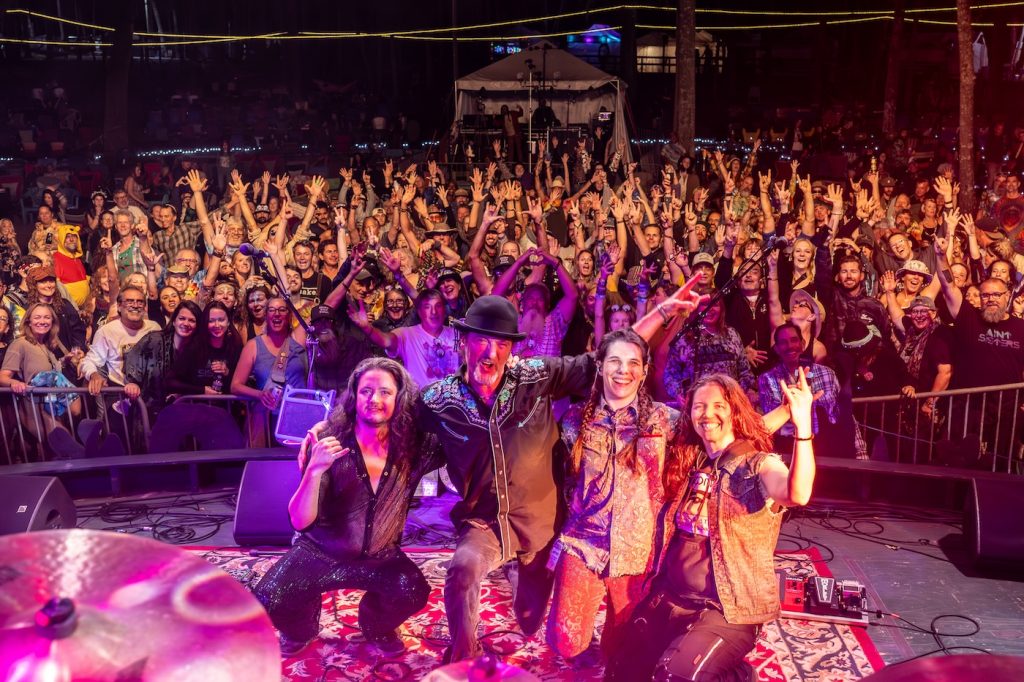
The idea of being “tapped in” extends to live performances as well. “If you do it right, you can change people at a cellular level with the actual music part. And I believe that, because I have felt it in my own body. It’s a spiritual thing. It’s not a mystery why music and religion are so intertwined,” she says. Accordingly, the band prepares for shows, plans their set lists and plays for the audience with purpose. “We circle up before each show,” explains Carbon, “and Richie reminds us of peaks and valleys — that we’re taking the audience on a journey. We don’t play the same set list every night, and we don’t play the songs the exact same way every night. We’re thinking about who we’re playing to and the venue we’re playing at and creating an overarching story with that soundscape.”
That approach comes from how they view their audience and their purpose. “We consider them part of the family and our friends. It’s like our little church where we want everyone to feel welcome and not judged,” explains Bozeman. Carbon agrees. “It’s just such a huge honor and so incredible for us to be able to share songs and have them sing along. People are hugging, and it’s like a family reunion. It’s because they all get this message and they reflect that same spirit onto one another. They allow themselves to see each other.”
The Ain’t Sisters serve as a reminder that when the world’s problems seem formidable, the best place to start might simply be in the here and now with one another. Speak truth, seek hope, spread love and just be your goofball self. That’s the message that brings fans back show after show.
“Everybody deserves peace and love,” says Carbon. “It’s not even a question. It’s just how things ought to be. And so, if there’s a movement behind us, I hope it could stand for that — inclusiveness, connectivity, kindness. All of that.”
“It’s just a really beautiful thing to look out and see,” says Bozeman.
Where & when
The Ain’t Sisters play the Avon Theater at 8 p.m. November 15. 104 N. Avondale Road, Avondale Estates.
::

Shannon Marie Tovey is a freelance music journalist and educator who covers the jazz, blues and rock scene.
STAY UP TO DATE ON ALL THINGS ArtsATL
Subscribe to our free weekly e-newsletter.

