Review: Atlanta Opera’s ‘Macbeth’ — riveting sound and fury
The Atlanta Opera’s staging of Verdi’s Macbeth is a riveting work of operatic theater, magnificently sung and vividly acted.
This new production, which opened March 1 at the Cobb Energy Performing Arts Centre, is often strikingly violent as it relates the story, based on Shakespeare, of the destructive power of ruthless ambition.
Michael Mayes leads the cast as Macbeth, the Scottish general who becomes king after murdering the reigning monarch. Mayes is a villain with a velvet-smooth baritone — his big Act IV aria was mellifluously sung on opening night — yet he’s also capable of singing with commanding menace.
Mayes’ voice is ample, but I particularly enjoyed the dynamic singing and acting range he brings to the role. As the guilt-ridden Macbeth descends into hallucinatory madness, Mayes takes on an array of nervous tics. Driven insane by guilt, he has no fight in him by the end of the opera and welcomes his fate with an unhinged laugh at a life full of sound and fury but signifying nothing.
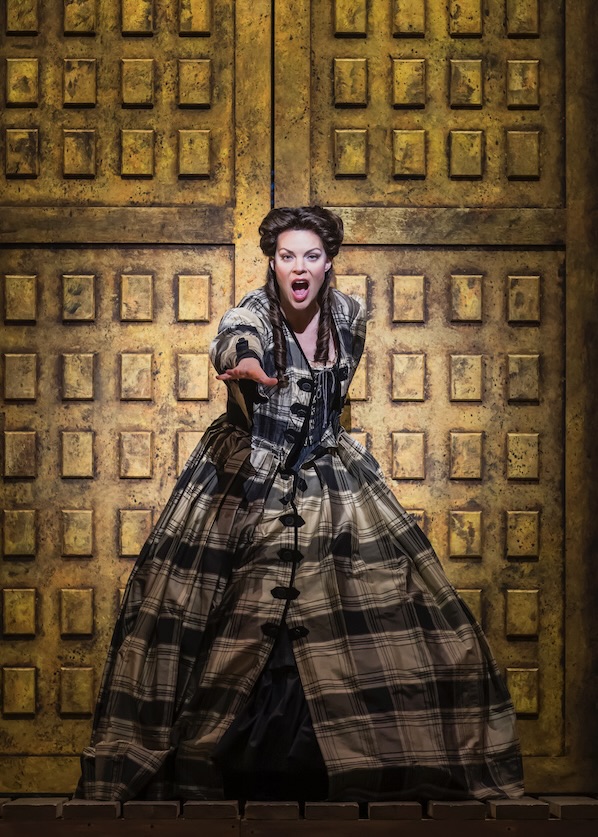
Soprano Sara Gartland reminds a listener why the opera could be called Lady Macbeth. Gartland dominates any scene she’s in — and she’s in a lot. Verdi knew exactly what he wanted in a Lady Macbeth. He wrote that her voice should be “hard, stifled and dark,” the voice of “the devil.”
Gartland, with her gleaming top notes, sings more like an angel than the devil, and it makes for a compelling performance. Her middle and low range is perhaps not as strong as a listener might prefer in this role, one of the most challenging in the operatic repertoire, but the pianissimo high notes she sang in her final scene on opening night were stunning.
Mayes and Gartland offer tour-de-force performances as both singers and actors.
If Macbeth is a villain with a modicum of conscience, Lady Macbeth comes closer to pure evil. Yet Stage Director Gregory Luis Boyle and Production Director Tomer Zvulun provide an intriguing explanation for Lady Macbeth’s machinations. Without spoiling too much, suffice it to say it involves the loss of children.
The overall staging by Boyle, Zvulun and Live Action Director Ran Arthur Braun is detailed and dynamic — opera as theatrical music drama, a far cry from the old stand-and-sing style of opera. It is, at times, a brutal vision, with some typically offstage violence (such as the Macbeth/McDuff sword fight) played out on center stage.
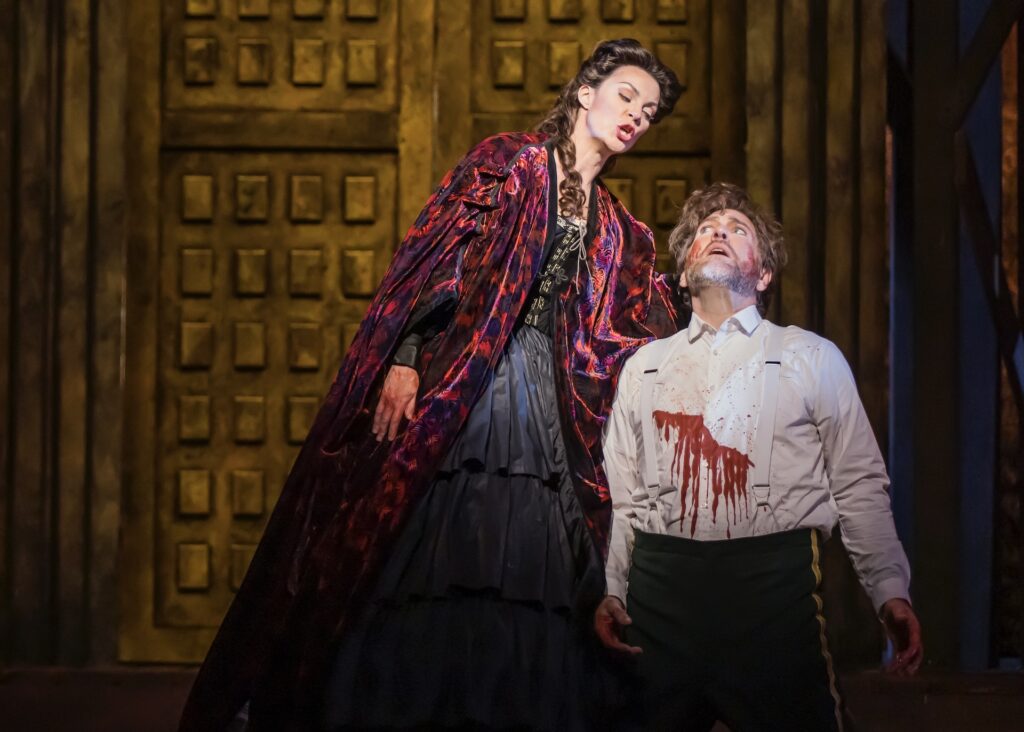
The wooden scaffold set design by Steven C. Kemp places the action in the 11th century — when the historical Macbeth ruled — as does Shakespeare’s play. But Robert Israel’s appealing costume designs are a mix of styles, perhaps attesting to the timelessness of the story.
“The road to power is paved with ill deeds,” Lady Macbeth says early in the opera. Indeed, after one murder, the couple finds that several others are necessary to maintain power. These are driven primarily by Lady Macbeth, who sees her husband’s hesitations and remorse as mere weakness.
Tyrants are so intent on self-preservation, Verdi and Shakespeare suggest, that they fail to notice how their actions can destroy not only those around them but an entire nation.
In one of the opera’s most memorable scenes, a chorus of refugees laments the losses they’ve suffered under the tyrants. This was poignantly rendered by the Atlanta Opera Chorus.
Indeed, Macbeth is a big opera for chorus. Under the direction of Rolando Salazar, the superb chorus fills the theater with a glorious sound. On opening night, the ensemble also negotiated the tricky up-tempo numbers with marvelous clarity and precision.
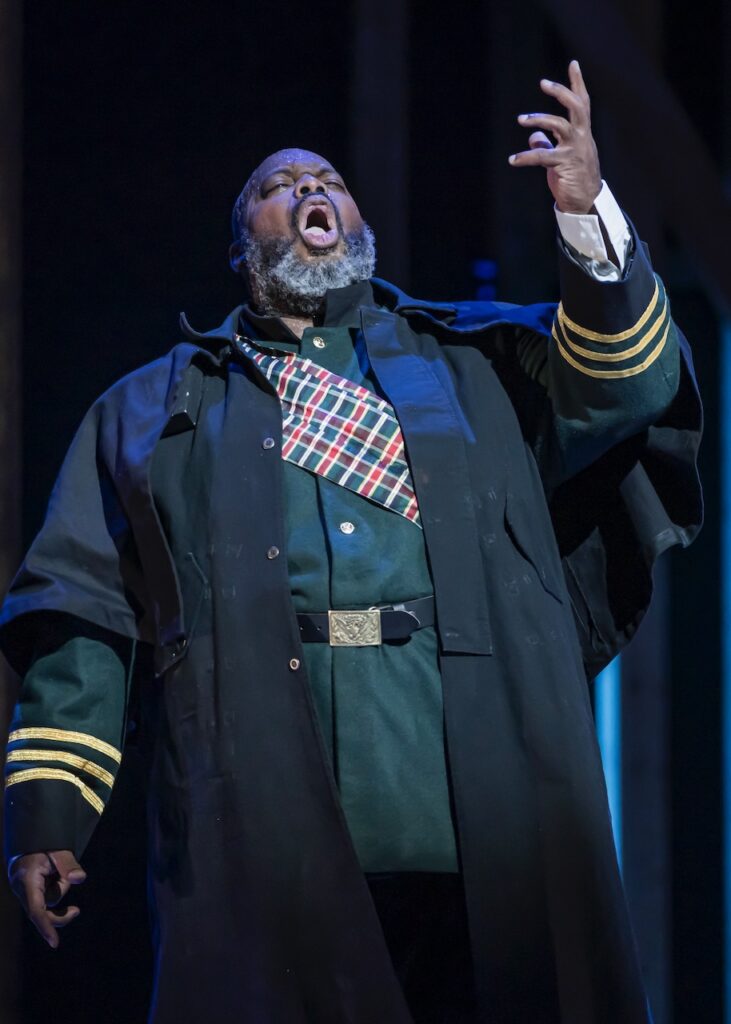
Morris Robinson plays Banquo with dignity and a stentorian, resonant bass. Won Whi Choi brings a bright, silken tenor to the role of McDuff. Demetrious Sampson Jr. plays the role of Malcolm with a lyrical tenor.
Ivan Lopez-Reynoso conducted a taut and polished performance by the Atlanta Opera Orchestra on opening night. He drew lovely playing from the strings and pleasingly vigorous exclamations from the brass in the big chorus numbers.
The lighting, projection and filmed media designers (Driscoll Otto, Andrei Borges, Andrew Garvis and Felipe Barral, director of the Opera’s film studio) offered an integral contribution to the robust atmosphere of the opera.
I missed two elements sometimes included in the opera: Macbeth’s final aria, “Mal per me che m’affidai,” and the very appealing ballet music Verdi wrote. But these are often excluded from productions of the opera.
Two more performances, March 7 and March 9, remain of Atlanta Opera’s gripping production of Verdi’s Macbeth. This bold staging is sure to captivate both the opera aficionado and fans of classic drama.
::

Paul Hyde is a longtime arts journalist and English instructor in Upstate South Carolina. He writes frequently for the Greenville Journal, South Carolina Daily Gazette and Classical Voice North America.
STAY UP TO DATE ON ALL THINGS ArtsATL
Subscribe to our free weekly e-newsletter.

PLEASE SUPPORT ARTSATL
Your Gift Sustains the Coverage You Count On!
Related Posts