Review: Atlanta Ballet’s ‘Rite of Spring’ isn’t beautiful. It’s sublime.
With Rite of Spring, a new dance choreographed to Igor Stravinsky’s masterwork, the Atlanta Ballet dancers and Choreographer in Residence Claudia Schreier took a rare gamble in ballet: They left beautiful on the table in order to grasp the sublime. The ballet is a spectacular, timely, dire warning about climate disaster and the ugly consequences of scapegoating. The performance on opening night was virtuosic, accompanied live by the Atlanta Ballet Orchestra under the baton of Jonathan McPhee conducting his own renowned arrangement of the score. Brilliantly crafted but filled with unforgettable images of crisis, desperation, cruelty and despair, the work was far from pretty. It was awe-inspiring nonetheless.
Schreier’s choreography was as provocative and surprising as Stravinsky’s rhythms and harmonics were in 1913 when the Rite of Spring’s premiere caused a riot in Paris, just over a year before World War I tore Europe apart. Schreier explained that, while she included “Easter eggs” referencing previous choreographic interpretations for those in the know, her Rite of Spring is first and foremost an exploration of Stravinsky’s composition.
“From the opening note, you’re listening to how Stravinsky is pulling sounds out of the oboe, the bassoon, forcing them into the highest and lowest registers, in what were, at the time, really unnatural ways,” she said. “The music is telling you that something isn’t quite right. It’s simultaneously elegant and off-putting.”
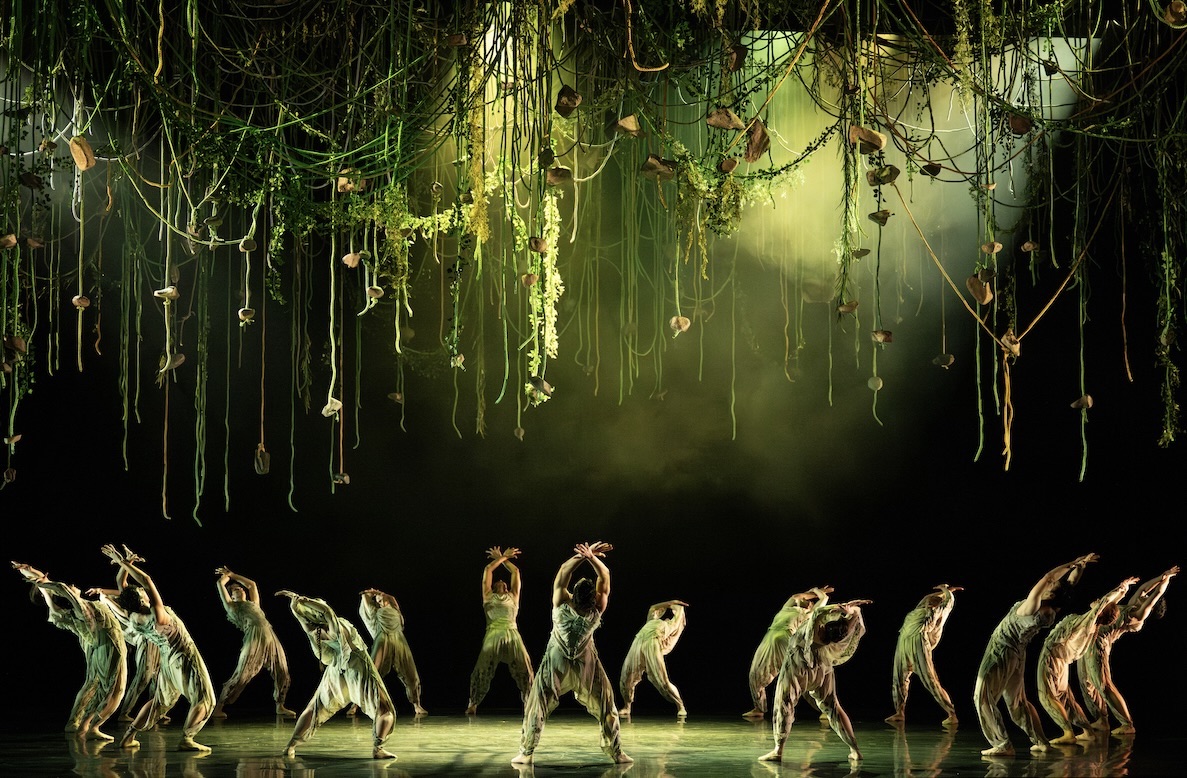
To create a similarly uncanny visual aesthetic, Schreier relied heavily on her design collaborators. The curtain went up on a stage decked in what at first glance appeared to be lush vines and foliage suspended above a bare floor. The lighting, by Ben Rawson, tinted the set, by Jason Ardizzone-West, in vibrant shades of green, with subtle hints of pink and purple. Abigail Dupree-Polston costumed all of the dancers in filmy georgette pants tapered at the ankle and tight-fitting doublets with subtle ruffles of chiffon at the chest, waist and shoulders. The women had “winglets” of chiffon, running like webbing between arms and waist.
As the dance began, Schreier’s bespoke vocabulary embedded the dancers within the natural setting suggested by the stage design. No imagined pagans of a bygone era or prancing forest sprites, the ensemble in this rendition embodied the idea of humanity as an inextricable part of nature. Pointed feet, turned out hips and occasionally recognizable arabesque lines were drawn from neoclassical ballet, but angular elbows, heads tilted at odd and unconventional angles and grasping hands formed to resemble extra mouths, snapping teeth or pinching claws lent an insectile quality to the dancers’ precisely-timed steps and gestures.
Schreier said she wanted to explore and foreground the “profoundly twisted” irony of taking life in a vain effort at renewal. “You start in this verdant world, but even from the very first notes, the first steps, you can tell that everything is beginning to decay and die off.”
Throughout the first half, “Adoration of the Earth,” the dancers resembled a swarm of locusts — leaping, striving, mating and dying, only to pick themselves up and begin the cycle anew. Their slashed and laced doublets recalled segmented carapaces, the textures of the chiffon the delicate tissue of wings and chitinous extremities. Driven by Stravinsky’s unmistakable ostinatos, seemingly lost in an unsustainable orgy of consumption, the dancers continued until their only option was collapse.
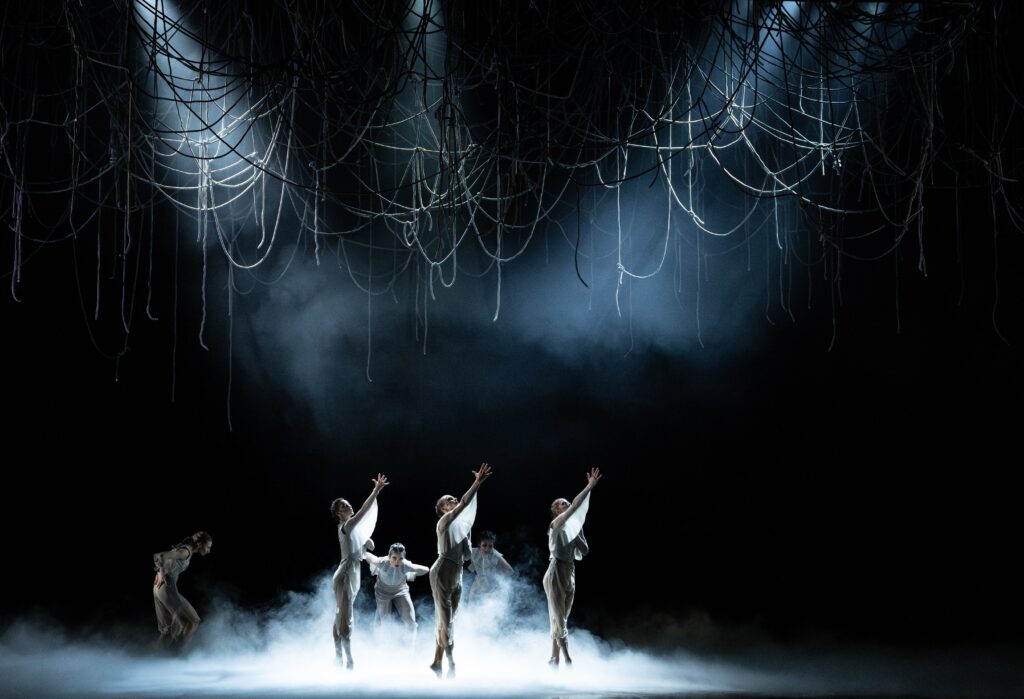
After a pause behind a dropped scrim for a set and costume change, the somber melodies that opened the second half, “The Sacrifice,” were calm before the storm. The lighting accelerated what throughout had been an almost imperceptible shift into a more muted palette. The hanging scenery descended claustrophobically. Color leached from the scene, a transformation reflected in the dancers’ bodies. Their torsos caved inward. Their arms hung limply from shoulder sockets and their feet shuffled. They became undead monstrosities stumbling around a drowned bayou cluttered with litter — or sluggish underwater denizens of a flotsam-clotted patch of seagrass.
In this context, the infamous “Mystic Circles of Young Girls” took on a double significance. Joining hands to form a whirling, tilted torus, the women enacting an arcane ritual of supplication and the shifting tempos and melodies evoked the sound and fury of the maelstrom — a tornado, a hurricane, a wildfire. The sacrifice, danced on opening night by Brooke Gilliam, was doomed when she fell outside the circle.

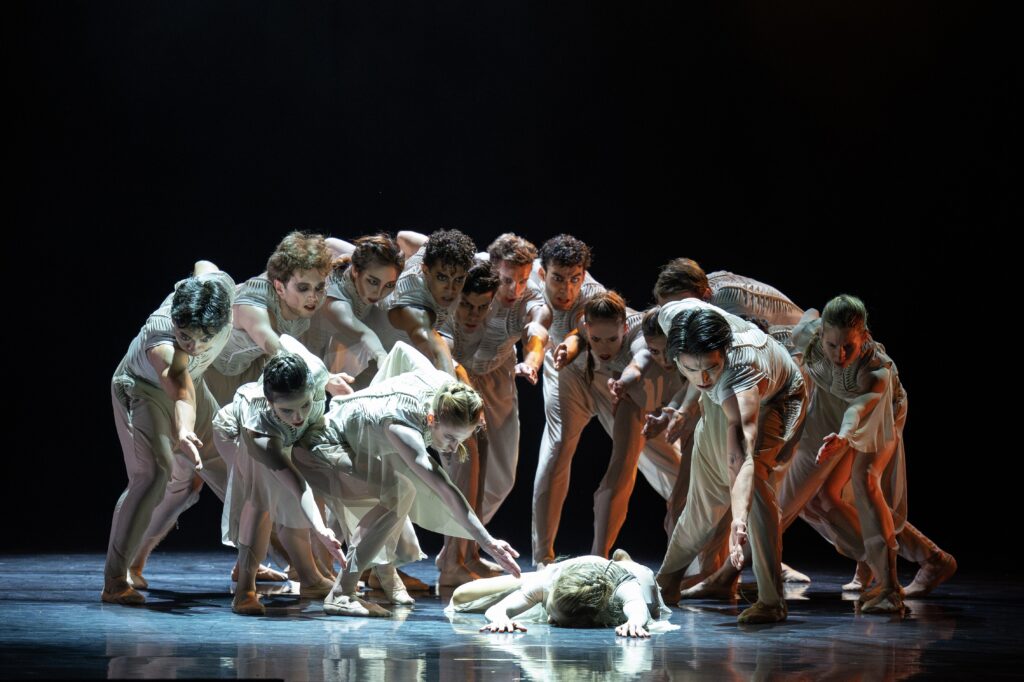
Gilliam struggled to her feet and rejoined her peers, only to be called out by a formidable Darian Kane. Climate refugee, weakest of the herd, dissident or simply a nonconformist, Gilliam became a target of blame and ire from the rest of the ensemble.
By the time the mob grabbed Gilliam, stripped off her costume (she was wearing a flesh-colored unitard underneath) and left her standing denuded at center stage before retreating to squat around her in a circle, all color had drained from set and costumes alike. Gilliam’s “Sacrificial Dance” took place in a bleached-bone wasteland, the post-apocalyptic landscape of Mad Max or Cormac McCarthy’s The Road.
Under Gennadi Nedvigin’s direction, the company has sometimes performed unevenly in more contemporary work. During Rite of Spring, however, the entire ensemble was cohesive, grounded, moving with confidence and without affectation. The dancers gave themselves over to the movement. Gilliam’s performance was impassioned, gut-wrenching and heartbreaking.
This is Schreier’s fifth season with Atlanta Ballet, and Gilliam said she began the process for Rite of Spring with something familiar, asking the dancers, as she has many times now, to learn some movement phrases first before trying to put them to music. Schreier then taught them to hear Rite of Spring as she hears it.
“McPhee’s arrangement contains the vibrancy and intentionality of the original score, but there’s a crispness and clarity to the instrumentation that’s particularly helpful for dance because there’s a lot to grab onto,” Schreier explained. “It centers us in a really concentrated environment, like we are sitting on top of this big ball of energy,” emanating from the orchestra pit.
Gilliam said that, having been through the process for Nighthawks with Schreier last season and learning with her to navigate the complexity of Wynton Marsalis’ The Jungle, the company “trusted Claudia to bring us through to the other side” of Stravinsky’s musical labyrinth. Gilliam described one rehearsal where Schreier asked the company to listen and take notes while she counted a few minutes from “The Ritual of Abduction” in “The Sacrifice.” In other rehearsals, McPhee joined them to practice conducting to the recording Schreier was using in the studio.
Schreier and the dancers have built a level of trust that enabled Schreier to create movement that looked awkward and sometimes even violent without doing violence to the dancers’ bodies. “I was always asking them, ‘is this OK?,’ and I could trust them to be honest,” she said. At one point, while creating what she described as a “behemoth of a solo” for the sacrifice, Schreier recalled, “There’s a stationary pose that everyone else is doing, and it’s so contorted, so gawky and awkward — it looks uncomfortable but isn’t physically so — that I said, ‘you guys OK doing this?’, and one dancer gave this beautiful, confident, ‘oh sure,’ because they understood why it was necessary.”
In the “behemoth” sacrifice solo, Gilliam moved as if her mind was attempting to control her steps, but her body refused to comply. She gazed out into the audience while her limbs and torso twisted and writhed, her head and neck an oddly still point at the center. Slowly, her look of horrified desperation fell into one of despondent resignation. Her performance was a tour de force of emotion, technique and energy.
In the end, though, no matter how the mob threatened, beat and tortured their sacrifice, instead of the longed-for return of fecundity, all they got was a dead body. The music ended and the lights faded to black as Gilliam went still.

To create a full-length program, Nedvigin paired Rite of Spring with Helgi Tomasson’s 7 for Eight, a lovely and technically challenging neoclassical ballet set to four Bach keyboard concertos. Although Rite of Spring may have stolen the show, the dancers who opened the program in 7 for Eight played a crucial role in setting the stage.
Emily Carrico and Denys Nedak led a strong ensemble with an outstanding performance. Carrico’s technique was flawless, and she danced as if the difficult partnering and pointe work in the opening pas de deux were only a little more physically demanding than a delightful stroll through the park. Nedak impressed with his astonishing skill as an adagio partner. He never missed a grip in turns or lifts, and, in his own placement, he complemented and extended Carrico’s lines with grace and seeming ease.
::

Robin Wharton studied dance at the School of American Ballet and the Pacific Northwest Ballet School. As an undergraduate at Tulane University in New Orleans, she was a member of the Newcomb Dance Company. In addition to a bachelor of arts in English from Tulane, Robin holds a law degree and a Ph.D. in English, both from the University of Georgia.
STAY UP TO DATE ON ALL THINGS ArtsATL
Subscribe to our free weekly e-newsletter.

PLEASE SUPPORT ARTSATL
Your Gift Sustains the Coverage You Count On!
Related Posts