
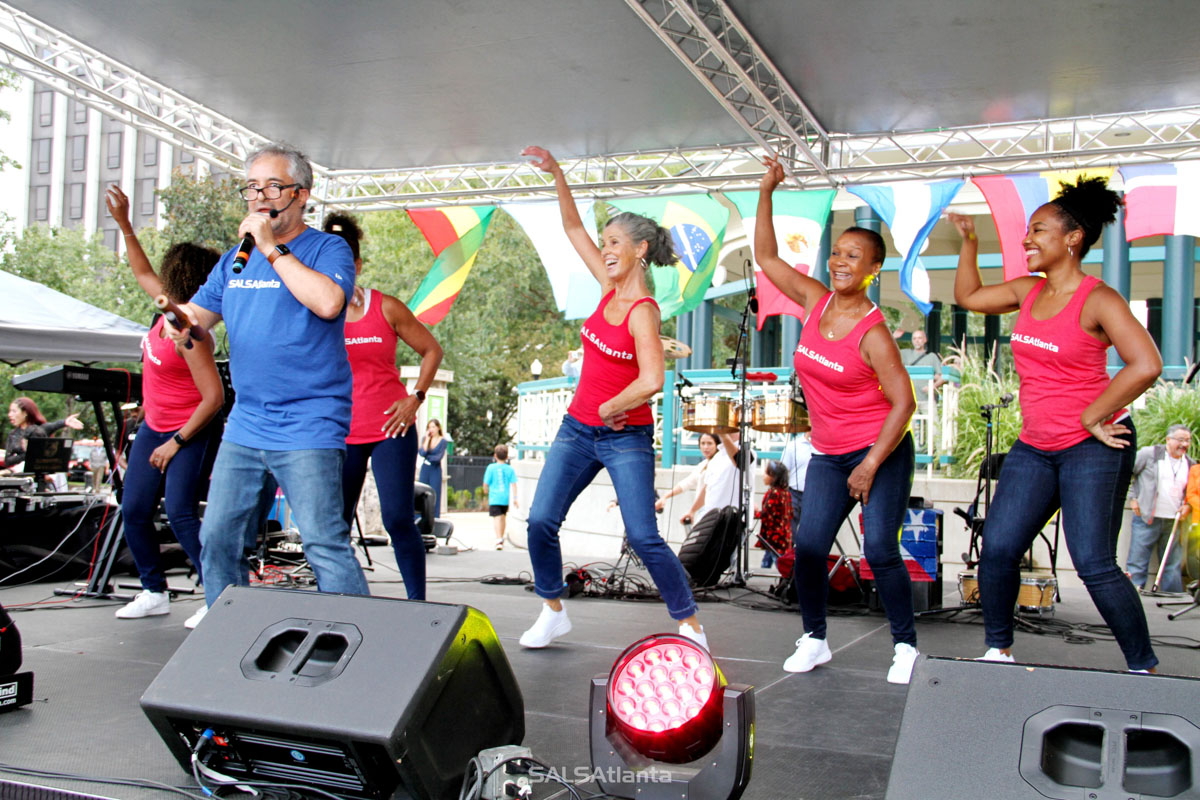
Julian Mejia introduced Atlanta to casino in ’99 and has been teaching it ever since
Julian Mejia, the founder and director of SALSAtlanta, did not move to Atlanta in 1999 to become a dance instructor. When George Morales, the owner of a ballroom studio in Sandy Springs, saw Mejia dancing at a nightclub, however, Morales was immediately struck by Mejia’s unique style.
At the time, Atlanta was home to plenty of clubs playing Latin music where people could dance.
“But there was no one dancing casino,” Mejia explained. “In the United States, this music we call ‘salsa,’ that comes from Cuban music … But the dance styles that were popular here when I moved to Atlanta were not in the Cuban style.”
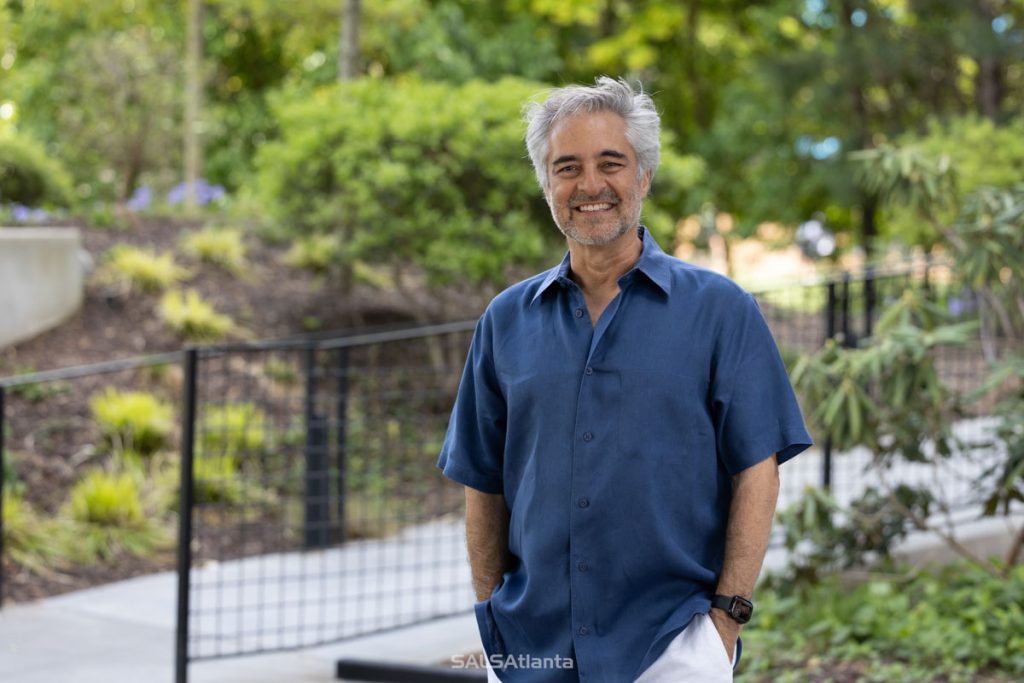
Morales invited Mejia to teach one class a week at the studio in Sandy Springs.
“It was on Monday evenings, which was less busy,” Mejia recalled. “The first night, I had four students.”
The following week, each student brought another, bringing the total to eight. The next week, there were 16. The crowd continued to grow exponentially, and the studio gave him additional classes on Wednesdays and Sundays.
As his students learned the rhythms and steps of casino, Mejia learned how to be an instructor.
In order to teach both partners, he had to teach himself how to dance the follower’s part. He was used to leading, and he also realized he had to do more than just demonstrate the steps. He worked on understanding which muscles directed the movement and how the steps felt in his body so he could explain casino in more detail to his students.
Soon he taught other Atlanta dance instructors, and, as casino’s popularity spread, Mejia sought to learn more about the history behind the dance and its accompanying Cuban music.
He first encountered casino — also known as Rueda de Casino, Cuban salsa or salsa casino — in Miami, where he had been living for three years before moving to Atlanta. Mejia grew up in Colombia, where he said dancing at parties was just part of the culture.
The movement of casino was very different from the social dancing he had grown up with, though. “There was such a connection between the dancers, and the movement was so elegant,” Mejia recalled.
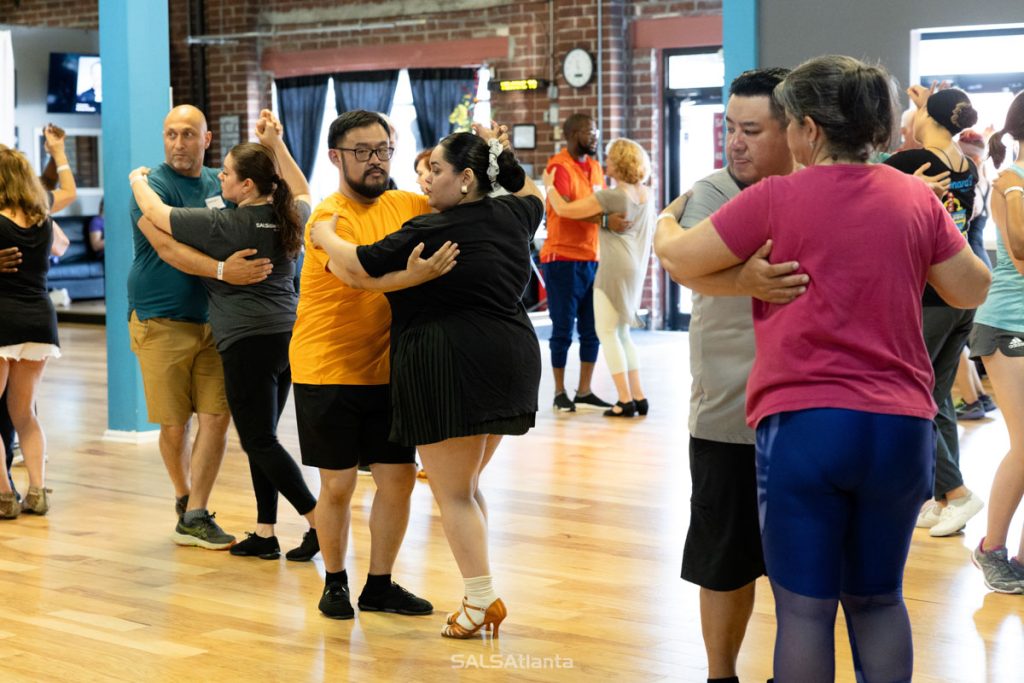
While his friends on the dance floor in Miami taught him casino’s moves, they were less knowledgeable about the culture, history and folklore behind the dance form, so he started on a journey to learn everything he could, Mejia said.
He connected with Ricardo Hayes, an Atlanta-based expert in danzón, a form that dates to the 19th century and is generally known as the national dance of Cuba. He also studied with Roberto Borrell, a Cuban music and dance historian from San Francisco. Through Borrell’s connections, Mejia found more teachers.
Along with the movement, Mejia tries to pass on some of casino’s history to his students. He explains the differences between the casino he was teaching and the Americanized forms like the mambo — or Los Angeles and New York salsa.
“I explain to my students that it’s like how I learned English in Boston,” he said. “Then I came to Atlanta, and the English that they taught in Boston didn’t work here. It wasn’t that it was a different language. It’s that I wasn’t trained to understand the different accent. When we dance to this music called salsa, each form uses the same timing with different accents.”
Even in Cuba, there are myriad variations of casino, and, as a teacher, Mejia wants students to experience some of that depth and richness.
Mejia also tries to preserve the Cuban accent by using music performed and recorded by Cuban artists.

Before it was popularized by U.S.-based Fania Records in the ’70s, Cuban music and the movement of salsa had been part of Cuban culture for many years.
“But when that all started to be commercialized in the 1980s, the Cubans had no voice,” Mejia explained. “There was an embargo.”
Contemporary music from Cuba that falls into the broad category of “tropical music” or “salsa” is generally called “timba.”
Timba, Mejia explained, is sometimes used as a catch-all category to include earlier branches in the evolution of son cubano before, during and after the Cold War, from 19th-century changüí to songo, which was popularized by bandleaders in the 1970s.
Timba and classic salsa share the same roots in son cubano, but, after the revolution of the 1950s, their paths diverged. Outside of Cuba, son cubano became salsa, with a steady rhythm and a blend of Afro-Cuban and big band jazz harmonies. Within Cuba, it mutated into timba, which often combines multiple complex rhythms within a single song and layers traditional Afro-Cuban and post-revolutionary Cuban jazz influences with funk, hip-hop and rock.
“I use timba,” said Mejia. “I never say there’s anything wrong with classic salsa, but timba is beautiful and complex, and a lot of artists who play that kind of music haven’t gotten the recognition they deserve.”

Ultimately, Mejia knows that most first-time students show up in his studio not because they want to learn the complexities of salsa’s various forms or its history.
“They come for multiple reasons. Maybe it’s a New Year’s resolution, it’s an easy way to stay physically active or they want to learn to dance or have a new hobby,” he said. “Mostly, it’s that they want to meet other people.”
At SALSAtlanta, Mejia said students from teens to seniors have been fulfilling all those goals for almost 30 years.
“I’ve seen people who come to class for the first time, and they can’t look you in the eye; they’re shy introverts,” he said. “And I’ve seen those same people meeting somebody and starting a family with that person they met in class.”
If you go
SALSAtlanta has classes Sundays at 5 p.m. at Academy Ballroom, 800 Miami Circle, and Wednesdays at Callanwolde, 980 Briarcliff Road NE, both in Atlanta. Single classes are $20. Regular dance events also start with a free lesson. For a full schedule, visit salsacasino.com.
::

Robin Wharton studied dance at the School of American Ballet and the Pacific Northwest Ballet School. As an undergraduate at Tulane University in New Orleans, she was a member of the Newcomb Dance Company. In addition to a bachelor of arts in English from Tulane, Robin holds a law degree and a Ph.D. in English, both from the University of Georgia.
STAY UP TO DATE ON ALL THINGS ArtsATL
Subscribe to our free weekly e-newsletter.

PLEASE SUPPORT ARTSATL
Your Gift Sustains the Coverage You Count On!
Related Posts

