Steve on TV: Peacock’s ‘Fight Night’ revels in the roots of Black Atlanta
Steve Murray’s monthly musings on TV in Atlanta and beyond.
::

Watching the funky, salty, Blaxploitation flavored Fight Night: The Million Dollar Heist, I never expected I’d find myself thinking about Scarlett O’Hara and Tara. Based loosely on the house-party robbery that took place after Muhammad Ali’s comeback match against Jerry Quarry in 1970, the eight-episode Peacock series is as much about where the events are set as what happens there. And Atlanta and land play as crucial roles in this story as they do in Gone With the Wind.
Starring Samuel L. Jackson, Taraji P. Henson, Don Cheadle and Kevin Hart, Fight Night celebrates the city at a time when the nation’s Civil Rights Movement had been tripped up by the assassinations of MLK, X and RFK. The Black leaders of Atlanta, on both the high and low ends of the criminal and legal echelons, weren’t about to let their local dreams get stalled.
In Fight Night, Sen. Leroy Johnson (RonReaco Lee), the first Black politician at the State Capitol since Jim Crow days, sells Atlanta to investors as “a vibrant, inclusive city that’s open for business.” The real Johnson would later lose his mayoral bid to Maynard Jackson, and Jackson went on to parlay similar words into action. He turned Atlanta into the international city it claimed to be long before reality (an expanded Hartsfield Airport, the winning of the Olympic Games and the explosion of Southern hip-hop) caught up with all the sloganeering.
So we know who the real villain in Fight Night is (I won’t spoil his identity) when he says this about Atlanta: “A day in that godforsaken, country-ass backward town is an eternity.” (If this were a silent film, intertitles would pop up onscreen, prompting the audience to “BOO! and “HISS!”)
A street-level man on the make, Gordon Williams (Hart) is known by that name in the church his wife (Artrece Johnson) fervently attends. Outside those walls, though, he’s Chicken Man, a bookie who gathers daily numbers from small-ante gamblers around the city. He’s aided in the biz by his side piece, Vivian (Henson), a former stripper with a head for numbers.
Gordon leans on his street-level networking skills when he makes a bid to host a big post-fight party he hears about from his friend Silky (Atkins Estimond). Gordon promises to pack the house with the best booze and the best beauties in the city. In exchange, he hopes to get an in with big-time operators who can grease his way toward better opportunities.
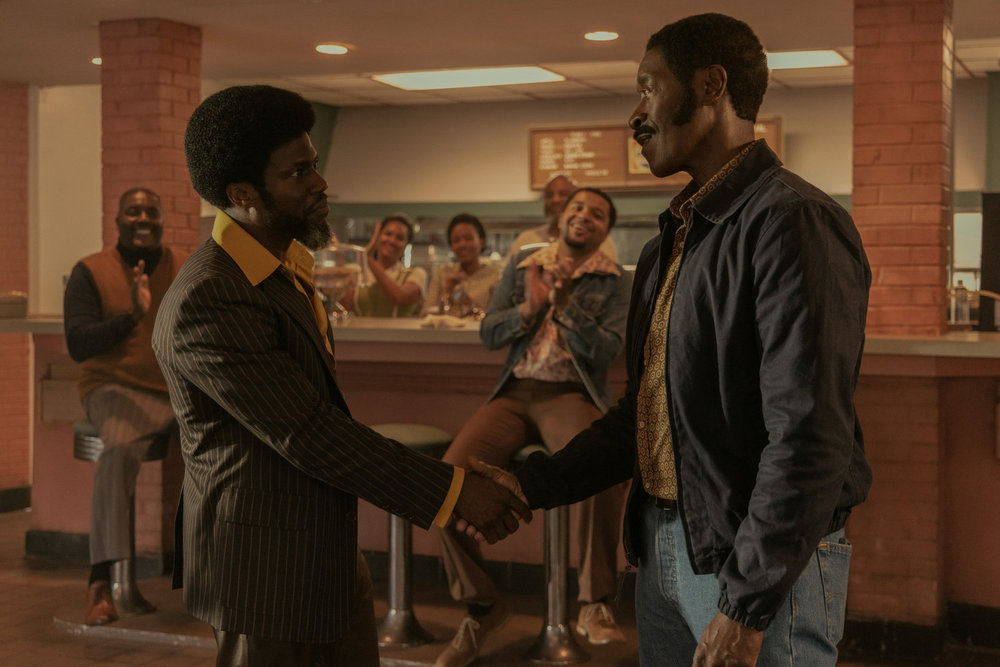
Problem is, the real guests of the party aren’t locals. They’re leaders of the nation’s Black mafia, gathering in Atlanta to watch Ali clobber Quarry. Chief among them is Jackson’s Frank Moten, sporting a stylish silver streak in his hair, and also Terrence Howard as the slow-burning Cadillac Wheeler, sporting a perm that looks like caramel waves crashing on either side of his face. (The people in the wig department had a fun time with this show.)
A former Atlantan who sees the red clay of Georgia as the blood-soaked birthright of the formerly enslaved, Frank has his eye on some westside property he wants to develop. Gordon swears he can pull strings to make the land deal happen. In honored Atlanta tradition, Gordon’s mouth is racing ahead of reality. He’s in over his head even without knowing some key intel about the party he’s about to host: Puppeteered by the unknown, a gang plans to raid the party and strip the guests of their cash and jewelry. That gang is run by Vietnam vet McKinley (Sinqua Walls), violent hothead Willie (Myles Bullock), baby-faced teen Baby Ray (Jalyn Hall) and lothario Andre (Melvin Gregg).
Like Gordon, these guys are also fatally underinformed. They don’t realize the men they’re stealing from are mobsters who won’t think twice about tracking and killing them all. (A lot of people get shot in the head, in case you need that sort of trigger warning.)
The other main player in Fight Night’s crowded cast is Detective J.D. Hudson of the Atlanta P.D., played by Cheadle and introduced first when he’s assigned to bodyguard Ali (Dexter Darden) during the prizefighter’s short time in Gov. Lester Maddox’s cracker-happy Georgia. Seen alternately as (that damning phrase) “a credit to his people” and an Uncle Tom, Hudson works to identify and arrest the house-party thieves, while Frank and his men are on a parallel track to murder them.
Created by Shaye Ogbonna and based on the 2020 fictionalized podcast about the crime, Fight Night benefits from a strong behind-the-camera crew. Half the episodes are directed by Craig Brewer, who made his mark with 2005’s Hustle & Flow. That movie paired Henson and Howard memorably on screen, and they went on to play warring ex-spouses in Empire; Brewer directed 10 episodes of that Lee Daniels series. In other words, the Peacock series is something of an old home week.

In the central role of Gordon/Chicken Man, Hart starts off ideally. After all, the comedian has made his career as a mouthy dynamo, much like his character. But the dividends stop paying off as the series heads toward its final stretch. Hart starts to feel more like a placeholder than the nuanced actor the part calls for; there’s not enough going on behind his eyes to keep you invested in the guy’s fate. Luckily, the rest of the dynamite cast takes up the slack. And there is definitely some slack.
That’s another way Fight Night reminded me a little of Gone With the Wind. It goes on too long — though that’s the default mode of most shows in our more-is-better world of streaming. About halfway through its eight episodes, the series feels like it’s spinning its narrative wheels. Some of that wheel-spinning includes giving Vivian a side hustle, as she looks for ways to expand her own opportunities. I never get tired of Henson’s blend of sultry and smarts, so I was OK with that.
Fight Night depicts Atlanta beautifully as a lived-in background, better than the impersonal, 1990s luxe version displayed in Netflix’s A Man in Full. The series finds poetry in the familiar and the run-down: abandoned clubs, red-brick ranch houses and the occasional trailer parked in the middle of nowhere. Underground Atlanta turns up, and presiding above it all is the revolving, saucer-shaped blue lounge atop the Hyatt Regency — the Polaris. It’s Fight Night’s Black Olympus, where Frank oversees his yes men or negotiates with a scrappy new ally in Vivian. (Jackson and Henson’s scenes are among the show’s liveliest.)
After eight episodes of pungent dialogue, criminal reversals and gunfights that pay fond homage to 1970s shoot-em-ups, Fight Night ends with an onscreen dedication that reads, To Atlanta, with love. That sentiment is all over the screen.
::
Steve Murray is an award-winning journalist and playwright who has covered the arts as a reporter and critic for many years. Catch up to Steve’s previous column here.
STAY UP TO DATE ON ALL THINGS ArtsATL
Subscribe to our free weekly e-newsletter.

PLEASE SUPPORT ARTSATL
Your Gift Sustains the Coverage You Count On!
Related Posts