Local businesses come together to prepare the Tara for its sequel
Like most everyone else, Christopher Escobar — who owns the Plaza Theatre and serves as the executive director of the Atlanta Film Society — reacted to the news of the Tara Theatre’s closure last November with sadness and the assumption that the building would eventually be bulldozed. Then, to his own surprise, he was eventually able to strike a new deal with Halpern Enterprises, owners of the property, to re-open the beloved theater. Escobar made the announcement at the closing night of the recent Atlanta Jewish Film Festival via a recorded message.
Yet the undertaking was hardly overnight. When Escobar initially reached out to gauge plans for the location, it took a while to hear back, and when he did, Halpern officials — themselves surprised at Regal Cinema’s actions to close the Tara and certain other theaters across the nation — mentioned they could not move forward until the property was technically back with them.
By late December, it seemed the two parties had gotten as far as they could with negotiations. Others were interested in the property for reasons that would not have been a movie theater. “Presumably, they would have paid more than a movie theater could justifiably earn, because . . . well, that is not hard,” laughs Escobar.
That’s when Escobar reached out to longtime colleague Kenny Blank, the executive director of the Atlanta Jewish Film Festival. He mentioned if there was a time to interject on his behalf and say something positive to the owners, now would be it. “Apparently [Kenny] did because the next time I talked to Halpern Enterprises they were willing to deal with me and come down on the price,” says Escobar.
According to Jack Halpern, CEO of Halpern Enterprises, Regal filed for Chapter 11 bankruptcy last year. Covid had an adverse impact on the entire industry, so, with the Tara’s revenue down, the closing was not a huge shock. As Halpern Enterprises was contemplating the next life cycle of the facility, they were contacted by a couple of people in the film industry interested in leasing from them, including Escobar. Halpern knew Escobar by name — although the two had never met — and later spoke to Blank, whose family he has been longtime friends with.
“Kenny told me he knew Chris, knew he had expressed interest in taking [the property] over and gave me a positive review of Chris and his dealings,” says Halpern. “He encouraged me to consider him as a candidate [for] the building. Having Kenny’s endorsement checked a good box, and I think that Chris — from what I could tell — had done a good job at the theater he had taken over and appears to be well respected within the arts community. We decided we would take a chance with him.”
Halpern agreed to let Escobar and his team take over and has given them a period of time for free rent and reduced rent until they get the business up and running. The lease is a minimum of six years.

The recently-formed company Tara Theatre LLC will oversee the theater, thus far involving Escobar; Steve Krams of Magna-Tech Electronic, which provides projectors and other services to movie theaters and has an Atlanta location; Michael Spaeth, the Plaza’s booker, and his wife Kris; and some of the management staff from the Plaza, who will branch out and be part owners of the new theater. Their fundraising arm will be Friends of the Tara, which is actively seeking $50,000 in donations to get the theater up and running. Donations can be made at the Tara Atlanta website, and Escobar says 80% of the needed funds have been raised so far.
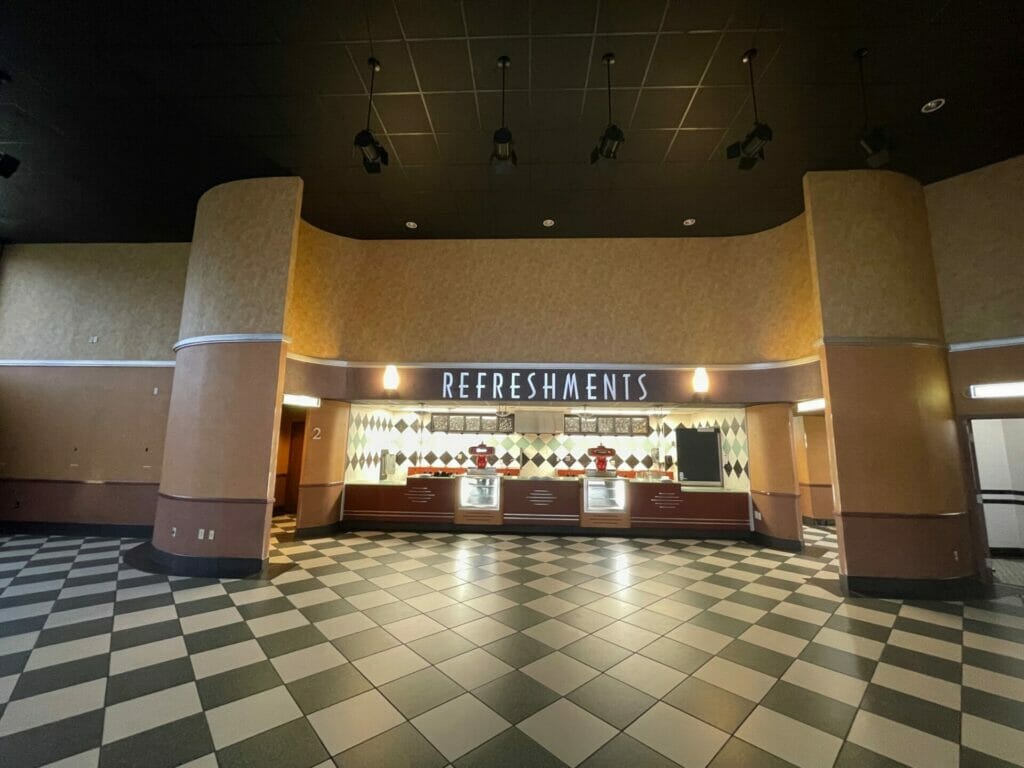
One of the unexpected costs of opening the new Tara will be replacing equipment. When Escobar checked out the property to gauge its condition, he was met with an unpleasant surprise. Regal had taken away every item in the theater, including the projectors, furniture and concession items. Even though the condition of Regal’s lease stipulates they have to leave everything, the movie chain did not. They even took art off the wall and chucked it in a dumpster, according to Escobar. “To me, that shows that the company doesn’t respect film,” he says. “This is trash to them. If they really don’t want it, just leave it there. Put it outside and let people take it. To [put these items] in the garbage is such disdain.”
It will take some time to rebuild the theater. Escobar expects to be done equipping the location by the end of March. As part of the renovation, he wants to lean into the original aesthetic of the theater and erect a new neon sign outside to resemble the original one.
While he admits a large number of permits are needed to officially re-open, the current plan is to launch the new Tara sometime between mid-April and May with some sort of grand re-opening event. Escobar also expects to offer a private event at the Tara as part of the upcoming Atlanta Film Festival.
Deciding what to program is another area the team is sorting out. The audiences and demographics for the Plaza and Tara are different, with the Plaza skewing younger and the Tara older. Escobar wants to find a way to accommodate both crowds and locations. Each will feature arthouse films — a staple of the Tara — and repertory titles, and Escobar wants to make the Tara available to the Atlanta Jewish Film Festival as a venue as well.
With his work at the Plaza and now the Tara, some have likened Escobar to a modern-day George Lefont, who operated a number of arthouse cinemas in the Atlanta area over a four-decade career. Escobar scoffs at any comparison. “That is a little too generous. There is really nothing I am doing that is new. Lefont was innovating, introducing Atlanta to arthouse programming and took [over] theaters that were not arthouses. He had a much harder job because there was not an arthouse audience in Atlanta, and he also did it on a much bigger scale.”
“In some ways, it is bittersweet,” he continues. “If somebody having two arthouse theaters compares you to George Lefont, that shows you how far we have fallen from his heyday when he would have five or six arthouse theaters at once. There’s a bit of mourning going along with thinking about that.”
::
Jim Farmer covers theater and film for ArtsATL. A graduate of the University of Georgia, he has written about the arts for 30-plus years. Jim is the festival director of Out on Film, Atlanta’s LGBTQ film festival. He lives in Avondale Estates with his husband, Craig, and dog, Douglas.
STAY UP TO DATE ON ALL THINGS ArtsATL
Subscribe to our free weekly e-newsletter.

PLEASE SUPPORT ARTSATL
Your Gift Sustains the Coverage You Count On!
Related Posts