Wagner’s “Das Rheingold” defines The Atlanta Opera’s highest aspirations
Has any music ever resonated with such primordial intensity as the opening of Richard Wagner’s Das Rheingold? The initial chord that emanates from the orchestra’s subterranean depths and continues for an astonishing 136 bars seems to spirit us back to the beginning of time itself. Thus begins Wagner’s great magnum opus Der Ring des Nibelungen, or as it is more commonly called, the “Ring” cycle.
Composed of four operas — Rheingold, Die Walküre, Siegfried, and Götterdämmerung — this tetralogy represents one of the greatest musical achievements of Western civilization and an ultimate challenge to the few companies who elect to produce it.
Atlanta audiences can judge for themselves at Cobb Energy Performing Arts Centre beginning Saturday, when The Atlanta Opera presents Das Rheingold in a new production directed by Tomer Zvulun, the opera’s general and artistic director.

The Atlanta production (with Zvulun directing) premiered in February with the Dallas Opera to glowing reviews. It now comes home for a four-performance run through May 7. ArtsATL spoke with Zvulun between rehearsals to discuss the challenges of bringing Wagner’s “Ring” operas to Atlanta.
ArtsATL: Wagner’s “Ring” is open to a myriad of interpretations. Can you clue us in on your own approach to the piece as a director?
Tomer Zvulun: I have been engulfed in the world of Rheingold and the “Ring” for 20 years. On the surface the “Ring” is this incredible mythological story about dwarves and dragons and gods and a golden ring that rules them all. But underneath, it is about family — fathers and daughters, fathers and sons, brothers and sisters, husbands and wives. Wagner was obsessed with Greek culture. In English we have one word for love. In Greek, there are eight words for love. The “Ring” is about those different facets of love, those relationships.
But it is also about power and the fear of dying because we are so petrified of death. Wotan and Alberich are concerned about being in control, but there is no way to avoid death. It is a fact of nature. When men try to change fate and outwit nature, nature always wins. So, the “Ring” is about that struggle between man’s desire to be immortal and the reality that we are mortal.
ArtsATL: The “Ring” is a monumental undertaking for even the largest opera companies. What are its challenges for a medium-sized company like The Atlanta Opera?
Zvulun: I think it has to do with ethos and aspiration — the recognition that this is a masterpiece that will catapult the organization into a different metabolism. It’s a little bit like an athlete who is told that they will be competing in the Olympics. The minute you say that to that athlete, their metabolism changes. Everything about their life changes so that they can work toward that goal. They become stronger and more accomplished.
When I came here a decade ago, the idea of a “Ring” opera was not a possibility. But as we stabilized the company, I began to put this out as a goal, and I think it changed our ethos. It changed the way the board and donors and staff think about themselves. It created competencies.
When you do a “Ring” opera, your Traviatas and your Carmens are better for that, because your infrastructure gets bigger, your technical knowledge is higher. The capital investment that you make in an LED wall or turntable or projection devices, heightens your possibilities. You grow more muscles as a company, especially if you do it in a thoughtful way over some years.
ArtsATL: Tell us a bit about the production. What will we be seeing onstage?
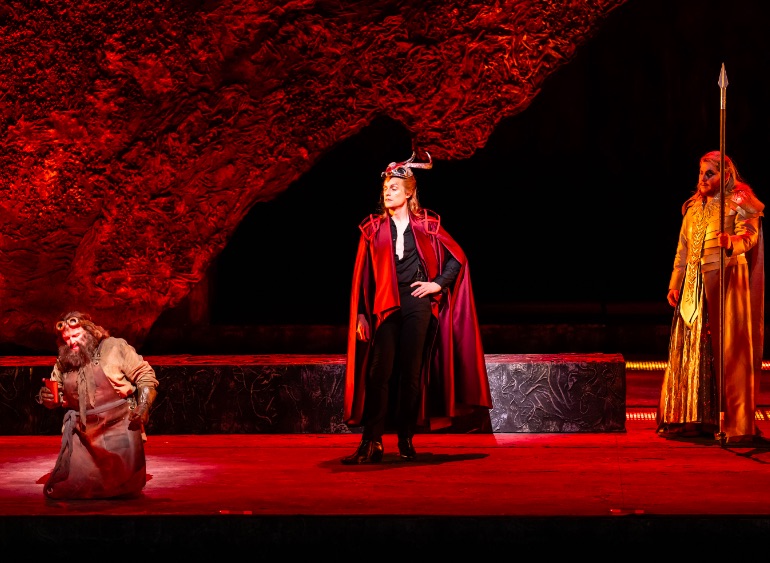
Zvulun: I am working with my favorite team — the designers Erhard Rom, who has done 90 percent of my shows and is my dear friend, and Robert Wierzel. They did our Salome, they did our Onegin and Butterfly. When we did things like Salome and Semele, the world we created was a timeless, mythological world. I am obsessed with mythology because mythology tells us things about humanity that transcend our understanding.
The world we have created for Rheingold is timeless. We don’t want the audience to be thrown into something like the world of the Great Gatsby in 1925, or JFK in 1963, or a strip club in Vegas. That tendency to update something into a time period that robs the story of its timelessness and mythological meaning is something we wanted to avoid. Mythology surrounds us. Look at the Marvel universe, or the Lord of the Rings. When I began studying the “Ring” twenty years ago that was less the case, but now things like Game of Thrones and Star Wars are all around us.
ArtsATL: You have assembled an amazing cast for this, including Greer Grimsley, who is one of the most sought-after interpreters of Wotan in the world today.
Zvulun: It has been an absolute joy to work with this cast; they are true collaborators. I have known Greer for 20 years; he was the go-to baritone during my formative years at Seattle Opera. To bring him here is a gift — and back to your question about what a “Ring” can do for a company, I don’t know that he would come here for Tosca, but he came for Rheingold. It’s a terrific cast all around. Directing is 90 percent about casting. When you cast the right people, you can bring an idea and they will take it and run with it.
ArtsATL: You are also mounting Die Walküre next season. Dare we hope for a complete “Ring” in Atlanta?

Zvulun: My answer is: Ask Atlanta. I would love to do a “Ring,” but I won’t do it if Atlanta doesn’t want it. My strategy was to do Rheingold and Walküre, which can stand on their own, and decide. Had you asked me a year ago if we would go ahead and do the whole thing, I would have said I wasn’t sure. Now, I can tell you that ticket sales are out of the park. It is too soon for me to say, but it’s more likely than it was a year ago.
ArtsATL: Any final thoughts?
Zvulun: There is something I would like to close with, and that is the ambivalence I feel toward the phenomenon of Wagner. I feel this even more so as a proud Israeli. The influence of Wagner changed the course of art forever. Most devastatingly, it changed history.
We may want to bury our heads in the sand, but there is no question that while Wagner was not a Nazi (he died 50 years before) he inspired the Nazis. He created an ethos of a blond, perfect German character that deserved to take over the world. I have a deep problem with that. At the same time, when I listen to the incredible music, I cannot help but think about Leonard Bernstein, who said “I hate Wagner . . . on my knees.” That is absolutely true. What a myopic person Wagner was. But what a genius of monumental proportion.
I cut my teeth on Wagner during my years as an assistant director in Seattle. Speight Jenkins, my mentor there, always said that anyone who does a “Ring” will have their lives changed; they will not be the same person coming out of this adventure as going in. I was young and thought that was a little dramatic. But you know what? He was right. It changes you. I don’t know if it’s because of the challenge of the piece, or the spiritual depth it conveys, but it’s true.
::
Mark Thomas Ketterson is a Chicago-based arts critic and writer. He is the Chicago correspondent for Opera News, and has also written for Playbill, the Chicago Tribune and other publications.
STAY UP TO DATE ON ALL THINGS ArtsATL
Subscribe to our free weekly e-newsletter.

PLEASE SUPPORT ARTSATL
Your Gift Sustains the Coverage You Count On!
Related Posts