Transmutation of utility with W. Chester Old
In a mid-century former church in the Lake Claire neighborhood, artist W. Chester Old presents a retrospective of his career. Spanning five decades, the works on display exhibit elegance paired with a particularly American irony that feels right on time given the nation’s current challenges and difficulties.
Inside, a wall-sized grid of photographs depict the artist interacting with a tree branch framed by large, dried leaves from a potted fig tree. Referencing the historic use of fig leaves to hide the sexual parts of Adam and Eve for more than five centuries, Old presents these leaves as fragile and glorious objects as well as barriers that frame his self-portraits. This dialectical relationship between revelation and concealment is manifest in many of Old’s artworks on view in this exhibition.
Irony is present in all of Old’s objects but particularly in his series of burnt books. Erasing culture through burning books is a tactic that was used in Nazi Germany and recently mirrored as many states have banned texts addressing racial politics and subjects pertaining to the LGBTQ+ community.
Applying this same tactic to the pages of blank sketchbooks, Old transforms the act of erasure into one of beauty. The series of books Old charred with a blow torch is exhibited with their pages open, like flowers revealing their centers. The pages of these sketchbooks are layered, each sculpted by blackened char.
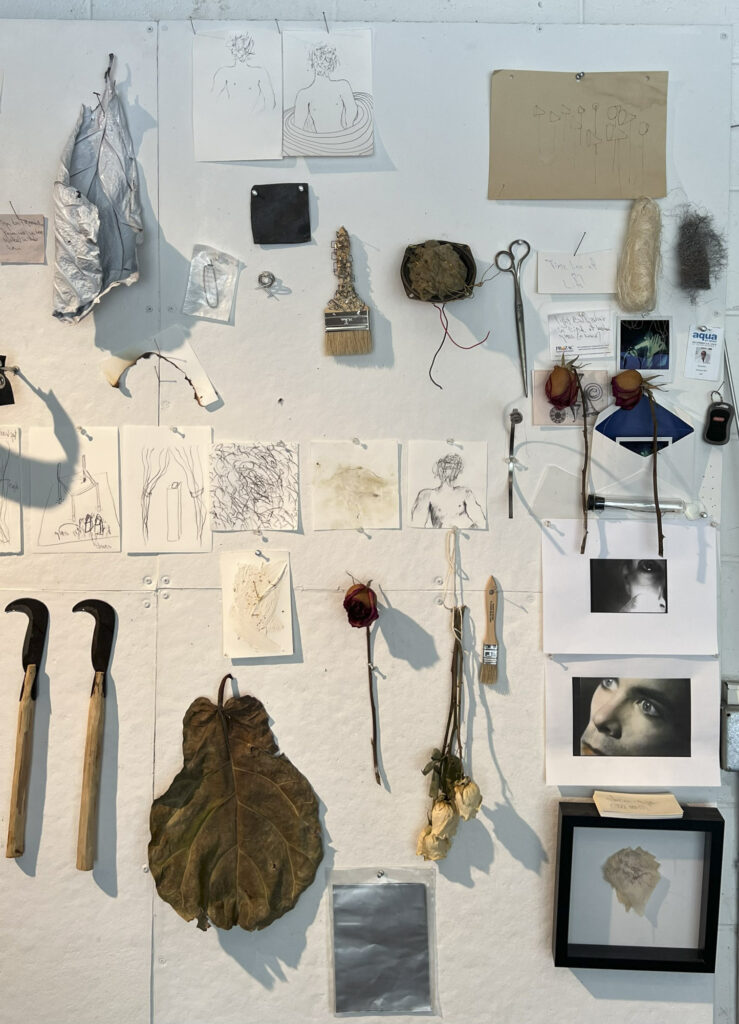
The primacy of the object has been part of Old’s artistic language from the beginning. Old attended Penland School of Craft in the Blue Ridge Mountains of North Carolina and later worked as a production potter crafting exquisite functional porcelain slab vessels which are now proudly displayed on the shelves of his office. A wall in his studio displays his tools, objects, photographs and small drawings in a style that recalls Joseph Cornell’s shadow boxes and constitutes a codex to Old’s art.
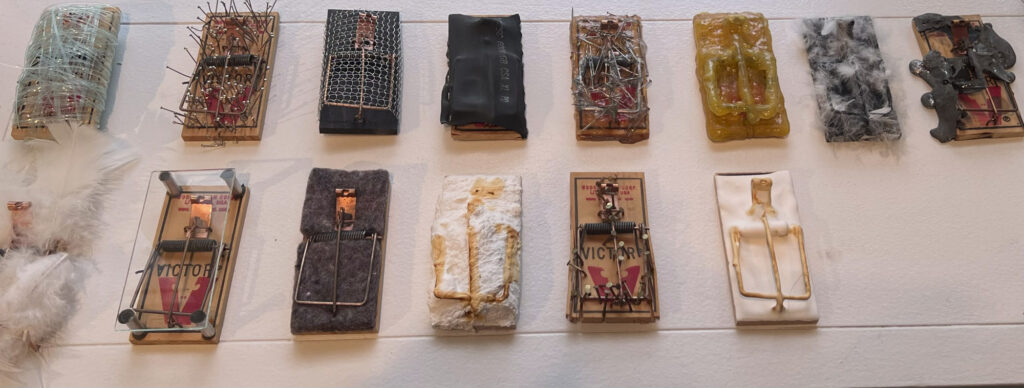
Other early works on view in the studio include a series of altered mousetraps which relate to his Dysfunctional Objects series of wrapped shovels that were shown at Mason Murer Fine Art in 2006. Hammers embellished with string, feathers, wax and metal are encased in domed vitrines, thereby transforming the tools into sculptural objects of contemplation. The wrapped surfaces recall surrealism and suggest religious icons such as shrouded crosses.
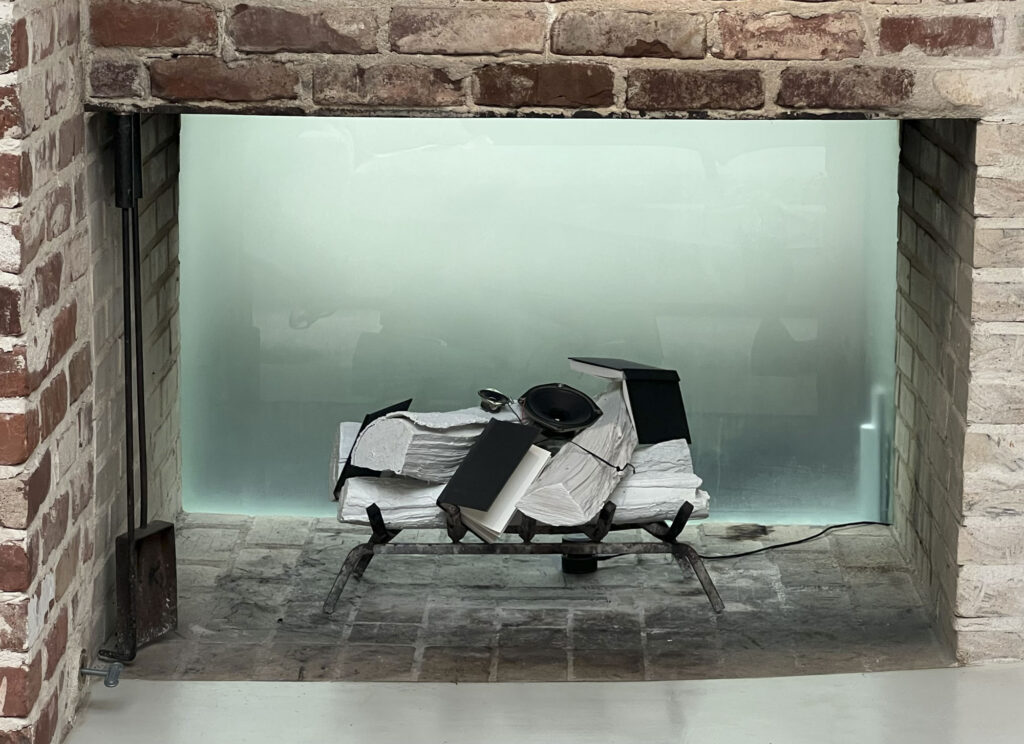
Old’s entire home is an art installation. In the fireplace, burned books are accompanied by audio of pages burning. Many of Old’s objects feature deconstructed speaker parts, including the one perched atop a stack of burned books.
The home and hearth are central to Old’s artistry. He reminisced about making exquisite Christmas decorations with his great aunt Christine as a child. In his kitchen is a selection of silver plated trays and platters that he has painted black; the largest and most impressive in the collection was once one of the same aunt’s most treasured possessions.
Inviting the viewer to consider the origins of his present works, he displays a series of sketchbooks from a class he took with Professor Marcia Cohen at the Atlanta College of Art (ACA). These burnt, tied, sewn and metal-wrapped books contain many of the seeds of the current works.
While at ACA (BFA 1983), Old produced videos, sculptures and performances that he has since revisited in recent works. One sculpture he made as a student has been re-created, accompanied by a photo of its original iteration. In the piece, a chair has been rebuilt with a pane of glass as a seat, no back and four tubular lights serving as the legs, embodying Old’s play with disutility in his later works.
The exhibition also includes a series of self-portraits made by the artist performing behind a scrim, in which shadows of his silhouette are captured mid-motion, then digitally modified and printed on paper. Old immerses the prints in beeswax and buffs them to create a patina, turning two-dimensional works into three-dimensional objects that cast shadows within their frames. In this way, Old crafts an archival physical remnant of his performance.
The intimacy of viewing the artist’s work within his home studio where it originated and framed by the context of the artist’s history is poignant. The experience offers insight into Old’s extensive career spanning 50 years of exploring art processes, new materials and the conveyance of ideas through transmutation of everyday objects.
Old’s retrospective exhibition will remain on view at 1933 McLendon Ave. from May 1 through May 17. For more information, visit the artist’s website.
::

Deanna Sirlin is an artist and writer. She is known internationally for large-scale installations that have covered the sides of buildings from Atlanta to Venice, Italy. Her book, She’s Got What It Takes: American Women Artists in Dialogue, (2013) is a critical yet intimate look at the lives and work of nine noted American women artists who have been personally important to Sirlin, based on conversations with each one.
STAY UP TO DATE ON ALL THINGS ArtsATL
Subscribe to our free weekly e-newsletter.

PLEASE SUPPORT ARTSATL
Your Gift Sustains the Coverage You Count On!
Related Posts