

The life of an unsung folk music activist documented in ‘Singing for Justice’
From the Great Depression until she died in 2013, Faith Petric showed up for equality and freedom. The film premieres at the Tara on April 19.
::
Folk singer Faith Petric might not be a household name, but filmmaker Christie Herring and Atlanta musician John McCutcheon are doing their best to change that. The two worked together for more than five years on the film Singing for Justice, a documentary (directed and produced by Herring and Estelle Freedman, with McCutcheon the composer and musical director) on the subject making its theatrical debut April 19 at the Tara Atlanta movie theater.

Known not just as a musician but as a longtime activist and the leader of the San Francisco Folk Music Club, Petric passed away at the age of 98 in 2013. Throughout her life, she helped Great Depression-era migrant workers in California, marched for justice in Selma, Alabama, and in her ’80s protested war as a Raging Granny. McCutcheon — known himself for his folk music — called her a constant presence in the greater folk music world. He subscribed to Sing Out! magazine early in his life and regularly read her columns.

When he started touring the West Coast in 1980, one of the first places he played was the Plowshares Coffeehouse, run by the San Francisco Folk Music Club. Petric was in the front row of his first gig and came up to talk to him. “I felt like I had just met God,” McCutcheon recalls. “Here was this person who had no business coming to see someone like me, deigning to see someone like me and gave me advice and encouragement.” She would attend other performances as well, and the two wound up working together in different capacities, such as helping union workers in the American Federation of Musicians and playing all kinds of benefit concerts together.
McCutcheon, who moved to Atlanta in 2006, recalls one time when Petric had broken her hip at the age of 89 and begged her rehab caretakers to allow her to come see him perform. They would not, so the next day he visited her instead.
“She was a living embodiment of what it meant to be a dedicated activist and an artist your entire life,” says McCutcheon. “When I was asked to be part (of the film), I was honored.”

Herring was working on her marriage equality documentary The Campaign when she met Petric. A colleague had connected her to Freedman, a feminist historian at Stanford who knew the musician and saw her story as a life unfolding in terms of activism on the left for almost a century. “This connection of social movement and history and a folk singer spoke to me,” says Herring. Over 13 years, she and Freedman worked on the project, conducting as many interviews as they could with their subject.
The directors had a lot to choose from in charting her life, including archival footage and additional interviews with family members and colleagues. Herring worked with a historian to be thorough. “We looked at her personal life and what was going on politically and in the industry,” she says. “She was intentionally on sight and location when things were happening.”
Petric attended Whitman College, which Herring says was rare at the time for a woman, and organized her first political demonstration there in her 20s. Her activism persisted for decades. While marching at Selma, she was arrested but not processed. She joined with others present to sing freedom songs all night.
At the April 19 screening, PBS’ Virginia Prescott will lead a post-film conversation with Herring and McCutcheon. At an April 18 event at Eddie’s Attic the night before, titled Songs My Mother Taught Me, Herring’s musician sister Caroline Herring will sing some of Petric’s favorite songs. McCutcheon wrote a song about Petric for the documentary called “You Got to Have a Little Faith,” but it ultimately was not used.
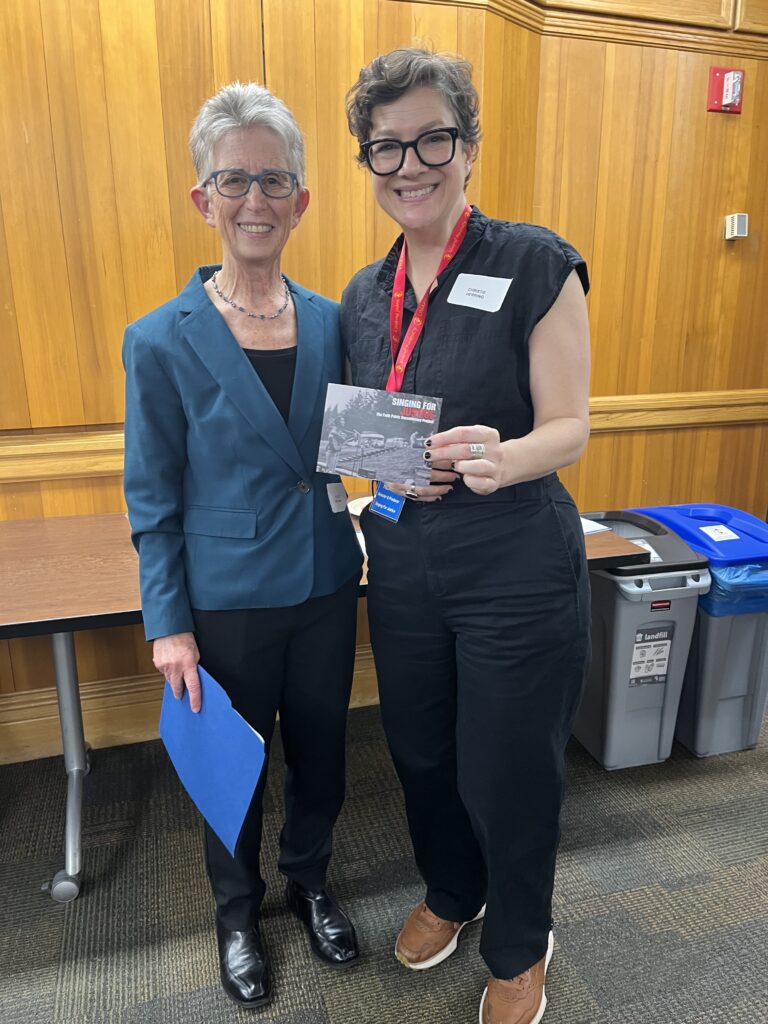
Singing for Justice is now available to view on PBS stations.
When Herring pictures Petric, she thinks of perseverance. “She had a lifelong commitment to other people and community and what we can do together and (the fact that) we are stronger doing those things together,” she says. “She wanted to help others to have better lives and reduce suffering and have less discrimination.”
“Tomorrow is important and what we do today is vital. It is our job to pass the torch and keep it going and help each other do that. I appreciate hearing that (from her) and can’t hear it enough.”
As someone who knew her for more than 30 years, McCutcheon was inspired by Petric’s desire to grow. She wanted to be as involved as much as possible every moment. “I’ve been with Faith at different places of the world, and I think it is an inspiration that you can be helpful and do beautiful things your entire life,” he says. “We hit a certain age and we figure — ‘I’m not going to learn anything new. I am not going to do anything new.’ Here was someone who showed up — in every sense of the word.”
Where & When
Singing for Justice makes its theatrical debut on April 19 at the Tara Atlanta movie theater. At the April 19 screening, PBS’ Virginia Prescott will lead a post-film conversation with Herring and McCutcheon. At an April 18 event at Eddie’s Attic the night before, titled Songs My Mother Taught Me, Caroline Herring will sing some of Faith Petric’s favorite songs.
::

Jim Farmer is the recipient of the 2022 National Arts and Entertainment Journalism Award for Best Theatre Feature and a nominee for Online Journalist of the Year. A member of five national critics’ organizations, he covers theater and film for ArtsATL. A graduate of the University of Georgia, he has written about the arts for 30-plus years. Jim is the festival director of Out on Film, Atlanta’s LGBTQ film festival, and lives in Avondale Estates with his husband, Craig.
STAY UP TO DATE ON ALL THINGS ArtsATL
Subscribe to our free weekly e-newsletter.

