
Streaming in July: ‘Stax’ on Max, the truth about Jonestown, life-size puppets, more
MAX: Stax: Soulsville U.S.A.
Two powerful new documentary series’ take deep dives into different kinds of tragedies. Let’s start with Stax: Soulsville U.S.A. on Max. It takes us back more than half a century to a miraculous little music studio that seems blessed and cursed in equal measure. Lasting from 1957 to ’75, the brief musical powerhouse was something so unlikely, it should never have worked in the Jim Crow South. But Stax Records sprang up as an integrated workplace run by people whose shared love of music made each other’s skin color irrelevant, at least within the walls of Stax’s adjoining record store and studio.
Jim Stewart, a self-described “hillbilly from Tennessee that liked country music,” took the train to big-city Memphis, where his older sister, Estelle Axton, was already ensconced, and sought her help in opening up a record shop. (Director Jamila Wignot’s documentary draws on interviews from Estelle, who died in 2004, and Jim, who followed two years ago). Instead of just a place to pick up vinyl, Satellite Records, as it was initially called, became a hangout spot for Black and White kids and musicians. Soon, another kind of music beside country was foremost on Jim Stewart’s mind.
“Gee Whiz,” by teenage Carla Thomas sounded, on the one hand, like a normal, wistful, lovestruck ballad of its time. But the extra soulful something that Carla brought caught the attention of Atlantic Records executives up in New York City. In an aptly ominous detail, Carla recalls having to ride the freight elevator in a Manhattan hotel to meet the label’s execs because Blacks weren’t allowed in the regular one. Soon, the starstruck Stewart siblings signed the first of several bad contracts that doomed Stax nearly from its start.
Al Bell, the eventual Stax co-owner who came on as the studio’s marketing mastermind, recalls working as a kid for politician Winthrop Rockefeller, who explained the big-fish-eat-little-fish nature of the entertainment business. That lesson proves prophetic. But even though we know the four-episode Soulsville will take us on a bummer of an arc, getting there is a funky joy.
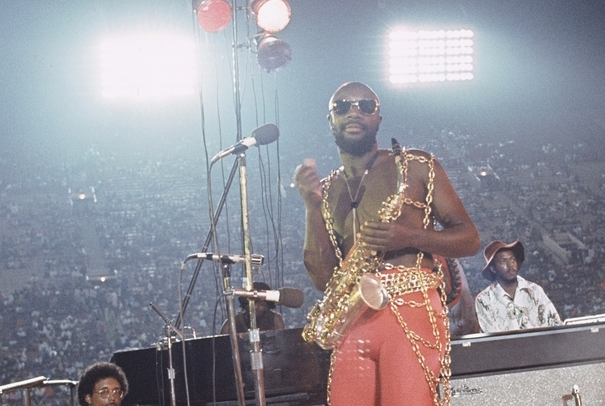
The series resurrects a couple of R&B and rock icons, starting with Macon’s Otis Redding — a soulful, sweaty musical god and spiritual leader of Stax over the course of his too-short career and life. Footage from the Monterey Pop Festival, in particular, captures Redding’s power and charisma as he sings “I’ve Been Loving You Too Long.” His premature death sends Stax into a depression only an artist with a bigger-than-life swagger like Isaac Hayes can remedy, and we get great doses of him as well.
The real story of the studio is best told by the people who did the work that made it work, including Bell; Booker T. Jones, whose group the M.G.’s became Stax’s de facto house band; and Deanie Parker, the studio’s longtime director of publicity. As the series starts, Parker couches her words diplomatically as she plans to recount the rapacious, racist business tactics that destroyed Stax from the outside. “I’ve been quiet about it for a long time,” she begins, then gives up: “Hell, I might as well tell you the whole story.” We all benefit from her candor.
There’s a replica building and a museum where Stax once stood in Memphis, but the studio itself is gone. Recalling a day when she lay on the demolished pile of bricks where she’d once recorded her hit record, Carla Thomas says, “Think of all the music we could have produced to share with the world . . . That’s a sin.” What’s lost is intangible, and a what-might-have-been hangs like a parallel universe alongside the historical facts.
::
HULU: Cult Massacre: One Day in Jonestown
The loss in Hulu’s Cult Massacre: One Day in Jonestown is more quantifiable — 912, the total of Jim Jones followers killed by “suicide” at the People’s Temple in the sweaty depths of the Guyana jungle. Forty-six years after the fact, the basic outline of the Jonestown tragedy is familiar. The three-episode series brings new information by telling its story primarily through footage shot on that day — November 18, 1978 — and in the memories of survivors, including Jones’ son, Stephan; Tim Carter, a Temple member who lost both his wife and baby son; and Jackie Speier, a young legal aide to Leo Ryan, the California congressman whose life would end on a landing strip in the jungle.
Ryan’s visit with Speier and a camera crew are at the scary heart of the second episode. We see how the Jonestown followers clap and cheer a little too long and too manically after the congressman’s speech at the communal dinner. There’s a craziness in the air that becomes more palpable when people start slipping notes to the visitors, asking for rescue from this supposed paradise.
Disaster at the airstrip — and the panic of survivors who dart into the jungle for safety — is followed by even worse footage. One of the saddest clips is a video of a couple fighting over the fate of their son. The mom wants him to go with her to the States, while the dad drags the kid back into the compound. In his present-day interview, Carter recalls holding his wife as she died in his arms, their baby son also poisoned.
Taking a bit of a detour in episode three to explore Stephan Jones’ relationship with his dad, the now-middle-aged son contradicts himself a little, saying the media has done a poor job of showing why people would follow his “dynamic” dad, but later admitting, “He was as nuts as anybody gets.”
Even in the wake of plentiful Jonestown docs and dramatizations, Massacre packs a punch. If it does no other service to the world besides opening up some stubborn, contemporary U.S. citizens’ eyes to how cults work, the series can make you retire the phrase “drink the Kool-Aid” from your vocabulary.
::
NETFLIX: Eric
An overreaching, thoroughly watchable disaster, Eric has a big wad of plot elements and themes that could either blend together in tangy ways or splat against each other. The latter happens.
Created by British writer Abi Morgan (who wrote the worst movie Meryl Streep ever won an Oscar for, The Iron Lady), Eric takes place in mid-1980s New York City and stars Benedict Cumberbatch. No, he’s not Eric. He’s Vincent, a narcissistic, alcoholic puppeteer on a Sesame Street-like kids’ show called Good Day Sunshine, which he co-created with pal Lennie (Dan Fogler).
When he’s not antagonizing his co-workers, at home he argues about sex with wife Cassie (Gaby Hoffman, managing to humanize every fraught scene she’s in) and talks down to his 9-year-old son Edgar (Ivan Morris Howe). Vincent is an egotistical mess, and he only gets worse when Edgar goes missing one morning while walking to school.
In his son’s absence, Vincent decides the only way to get the boy back is to create the human-sized puppet character Edgar had drawn sketches of: Eric. Soon, Vincent is imagining a real version of Eric, who tags along the streets of Brooklyn as Vincent purportedly seeks his son. Mainly, though, Vincent just gets drunker and higher and more toxic to everyone.
Vincent alone makes Eric almost impossible to watch, but there are competing factors. Missing milk carton kids, AIDS, graffiti tagging culture, city hall politics, homelessness, racism, homophobia and child sex trafficking are all plot devices thrown around in the show’s six episodes. It’s as if Morgan wanted to create a wild pastiche of 1980s themes, a la Angels in America, but just can’t juggle all the diverse pieces the way Angels playwright Tony Kushner managed to do — she’s a tourist. (In one example, a news anchor in the show refers to homeless people “sleeping rough,” a British term not really in use in the States.)
Still, actors Hoffman and Fogler survive the chaos. The great Clarke Peters of Treme elevates his few scenes as the super at Vincent’s brownstone. But the show’s true VIP is McKinley Belcher III as Ledroit, a closeted Black cop who investigates Edgar’s disappearance while hiding the fact from his fellow cops that his lover is an older man dying of AIDS. Like I said, the show is a lot — while somehow being not quite enough. Gotta respect the ambition, even if the results are this wonky.
::
Netflix: Hit Man
Also on Netflix, Director Richard Linklater’s Hit Man has been getting a lot of love, and I wish it lived up to the buzz. It’s likable enough, in a film-noir-lite way, but it’s never as thrilling, funny or romantic as it ought to be. Based loosely on a true story published in Texas Monthly, it stars Glen Powell as Gary, a college professor with a side hustle as an electronics surveillance expert. This leads to his subbing for an undercover cop who poses as a killer for hire, then gets the people who want to pay him arrested by colleague cops listening in on the miked conversation.
Linklater is a great humanist filmmaker and has fun as he shows Gary wheeling through various disguises to represent the ideal killer he thinks each client most desires. Things get tricky when, while on duty, Gary meets and falls for Maddy (Adria Arjona), who wants to off her abusive husband. Figuring she has just cause, Gary advises her to just leave the guy and start a new life. They get romantically involved, and things get even trickier when the husband turns up dead anyway.
Hit Man wants to motor along on a sleek, winking amorality, but Powell’s beady-eyed, thin-voiced presence doesn’t sell the character’s would-be depth. (His gym-toned body works hard to compensate for that deficit.) As a possible femme fatale, Arjona is no Jane Greer from Out of the Past or even Body Heat’s Kathleen Turner. She’s a sultry dream object, a third-hand concoction. But the movie earns a pleasant buzz from Sanjay Rao and Retta as two of Gary’s amiable colleagues — and especially from Austin Amelio as a scuzzy cop.
Near the end, when they have a couple of felonies behind them, Gary declares his love for Maddy. Then he adds a caveat: “There’s some factual loose threads we’ll be dealing with.” Those are the words of the screenwriters — Linklater, Powell and Skip Hollandsworth — owning up and calling themselves out for a job not-quite-so-well done.
::
HBO/MAX: The Great Lillian Hall
One of those stealthy, secretly-shot-in-Atlanta films we get a lot of lately, The Great Lillian Hall demonstrates the only things dementia is good for: The disease provides material for writers and trophy opportunities for older actors. Here, it’s Jessica Lange, whose career deserves the “Great” that the title bestows on her character. (Hell, Lange has even livened up the worst of Ryan Murphy’s American Horror Story seasons.)
As a theatrical grand dame returning to the stage in a Broadway revival of The Cherry Orchard, Lange’s Lillian frustrates her director (Jesse Williams), longtime assistant (Kathy Bates) and fellow cast members by forgetting her lines and her blocking during rehearsals. Yeah, you guessed what’s up long before everyone else does. Lily Rabe, a Broadway baby in real life as the daughter of Jill Clayburgh and playwright David Rabe, plays Lillian’s long-neglected daughter. Instead of an interesting study of dementia, Elisabeth Seldes Annacone’s script becomes a showcase for mother-daughter recriminations that seem even older than Chekhov’s play.
::
NETFLIX: Atlas
On the topic of aging divas, Jennifer Lopez also plays the title role in the movie Atlas. She’s a scientist of the future, battling the AI avatar (played by Simu Liu) that crippled Earth’s intelligence grid many years ago. The setup is mainly a chance for Lopez to act all by herself against a lot of CG effects. (Sterling K. Brown, the best thing about the movie, gets sidelined early to cede Lopez full focus.)
Lopez’s character and the movie itself can’t quite decide if AI is a big bad evil thing or our very best buddy. So it decides to say both things in what seems less a philosophical choice and more the most inoffensive and lucrative one. The same could be said about many of Lopez’s career and romantic choices. Let’s just say that JLo is having a moment right now, and it’s not the best.
::
Steve Murray is an award-winning journalist and playwright who has covered the arts as a reporter and critic for many years. Catch up to Steve’s previous Streaming columns here.
STAY UP TO DATE ON ALL THINGS ArtsATL
Subscribe to our free weekly e-newsletter.

