‘Said in Stone’ at Georgia Museum reclaims the storied career of sculptor Edmonia Lewis
When Edmonia Lewis arrived in Italy in 1865, she was determined to forge her own artistic identity. Barely out of her teens, the Black and Anishinaabe sculptor had already weathered racial prejudice, false accusations and the abrupt end of her education at Oberlin College. Rome offered what America could not: a flourishing community of expatriate women sculptors, access to Carrara marble and the opportunity to build an international career.
Now, visitors to the Georgia Museum of Art can experience the full scale of her ambition in Edmonia Lewis: Said in Stone. The exhibition brings together more than 30 sculptures from public and private collections across North America and Europe — many displayed side-by-side for the first time, alongside never-before-seen works, archival photographs and letters.
For Shawnya L. Harris, co-curator of the exhibition, Lewis’ story is about more than overcoming obstacles. For Harris, it’s the story of an artist who deliberately shaped her public image and built a reputation through persistence and creativity.

“She was so resourceful in her ability to network, not just to gain customers for her work but to be known, to be visible,” Harris said. “For people to know that she even existed, to create the works that she did. That was something that we always marveled at while we were researching her.”
Born in 1844 in Greenbush, New York, Lewis was the daughter of a free Black father and a mother of Mississauga Anishinaabe heritage. Orphaned as a child, she was raised in part by members of her mother’s community, where she encountered Indigenous craft traditions including weaving, beadwork and other forms of artistry.
“We believe you can draw parallels from her childhood, where she would have had a sensibility about artistry, to her thinking about more formal training in art,” Harris said.
That journey led Lewis to Oberlin College in Ohio, where she faced discrimination and was falsely accused of poisoning two classmates. Although acquitted, the episode effectively ended her studies and forced her to seek another path. After leaving Oberlin, Lewis moved to Boston, where abolitionist supporters helped launch her career. There she made portrait medallions and busts before sailing to Italy to master neoclassical marble.
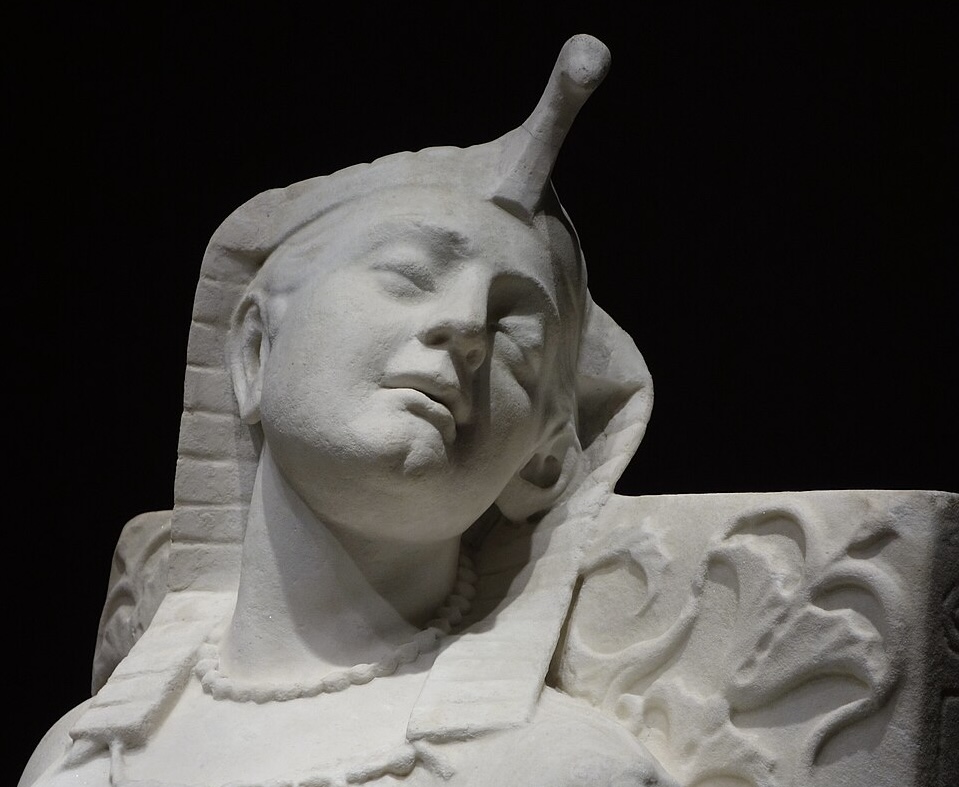
In Rome, Lewis’ studio became a destination. She produced bold works that often directly tackled liberation, heritage and history, most famously Forever Free (1867), a striking celebration of emancipation, and The Death of Cleopatra (1876), a dramatically realistic marble depiction of the Egyptian queen at the moment of her death.
In Lewis’ lifetime, she achieved international recognition, exhibiting her work in the United States and Europe, attracting patrons who admired her technical skill and ambitious subjects. But, after her death in 1907, her reputation faded, and many of her sculptures slipped from public view. Her most famous work, The Death of Cleopatra, suffered one of the most bizarre fates in art history. Celebrated at the 1876 Centennial Exposition in Philadelphia, where it drew attention for its dramatic realism, the monumental marble sculpture later disappeared. It eventually resurfaced in Chicago, where it had been painted and repurposed as a grave marker for a racehorse named Cleopatra before it was rediscovered and restored.
Stepping into Said in Stone, viewers can trace Lewis’ artistic evolution through her work for the first time. Seeing these works reunited reveals subtle details: a head turned slightly further than in an earlier cast; softer folds in marble drapery; evolving anatomical precision; and a signature that grew bolder as her confidence solidified.
“I always felt like she didn’t carve the same way five years later as she did earlier,” Harris said. “Being able to see those nuances by looking at the works in a kind of a progression, rather than simply assuming that they’re all the same, was really important.”
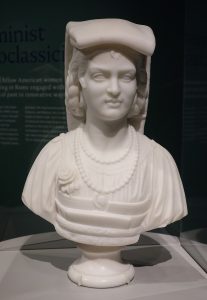
Among the works visitors will see are sculptures that have rarely, if ever, been shown publicly, including Portrait Bust of a Contadina (1872), a detailed depiction of an Italian woman, and a carved pair of clasped hands representing abolitionist Gerrit Smith and his wife.
Beyond her technical skill, the exhibition explores how Lewis strategically commanded her own image. Long before modern personal branding, she posed for sleek studio portraits that projected absolute professionalism, directly challenging 19th-century doubts about whether a Black and Indigenous woman could succeed as a fine artist.
“We talk about headshots nowadays — those were her headshots,” Harris said. “She was very much an agent of creating her own visual identity.”
The exhibit also sheds light on the crucial role played by her older brother, Samuel, whose financial support and correspondence sustained her career alongside abolitionist patrons, re-inforcing the deep family ties behind her success.
As visitors walk through the gallery, curators hope the show will do more than honor history — they hope it might solve a few art world mysteries. Many of Lewis’ works remain missing, and the exhibition could be the key to unlocking them.
“There may be family collections that we’re not aware of,” Harris said. “We’re hoping someone will come along and say, ‘Hey, I think this is an Edmonia Lewis.’”
Ultimately, Said in Stone gives an icon her due — not just as an artist who overcame massive odds but as a master sculptor who reshaped 19th-century art on her own terms.
“She was a pioneer who used sculpture to champion the independence and humanity of Black and Indigenous people at a time when they were often denied both,” Harris said. “By bringing these sculptures together, we aren’t just looking at history: We are rediscovering a legacy of courage and self-determination.”
If you go:
Edmonia Lewis: Said in Stone remains on view at the Georgia Museum of Art through January 3, 2027. The museum’s community open house on August 22 celebrates the exhibition with family activities, marble-carving demonstrations, music by UGA students and a 3:30 p.m. gallery tour with Dr. Shawnya L. Harris, followed by an evening reception. Additional programs throughout the fall include curator tours, lectures, poetry, studio workshops and family events designed to explore Lewis’ art and legacy.
::
Andrew Alexander is an Atlanta-based writer, editor and arts journalist. A longtime contributor and former senior editor at ArtsATL, his work appears regularly in local, regional and national publications, covering theater, visual art, music, film, dance, literature and the artists and institutions shaping Atlanta’s cultural landscape.
STAY UP TO DATE ON ALL THINGS ArtsATL
Subscribe to our free weekly e-newsletter.

PLEASE SUPPORT ARTSATL
Your Gift Sustains the Coverage You Count On!
Related Posts