

Review: Theatrical Outfit’s story of the Lehman Brothers. Yes, those Lehman Brothers.
Anyone up for a three-hour play about investment banking?
Admittedly, with a pitch like that, you might not get many takers. Better to say that the new production of Ben Power’s masterful adaptation of Stefano Massini’s monumental work The Lehman Trilogy at Theatrical Outfit is a knockout. The show is an ever-unfolding box of wonders. Don’t be frightened by the long running time: Under the powerful direction of Artistic Director Matt Torney, the production is not to be missed.
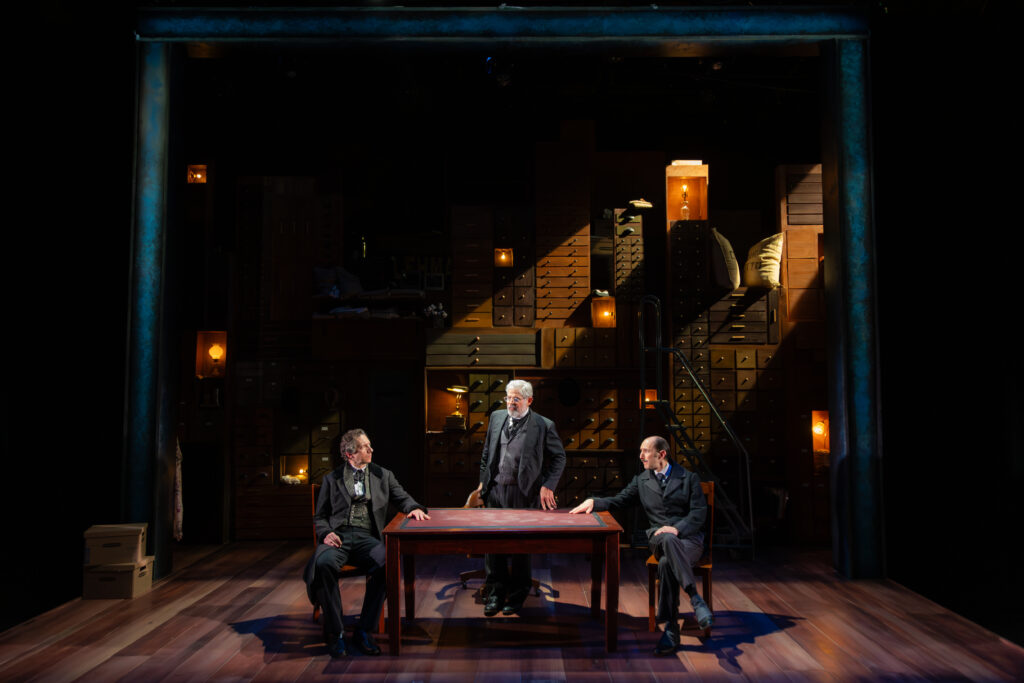
The show contains a lot of extraordinary elements, but it’s best to begin with the three actors — Brian Kurlander, Eric Mendenhall and Andrew Benator. Undoubtedly among the finest in the city, they bring unmatched energy to their roles, embodying multiple characters with ease and conviction. Portraying all the characters with minimal sets and costumes, they tell the multigenerational story of the rise and fall of Lehman Brothers, one of the most influential investment banks in American history. Along the way, we catch glimpses of Lehman descendants as children, young men and powerful business leaders — all of it exquisitely handled by the three leads.
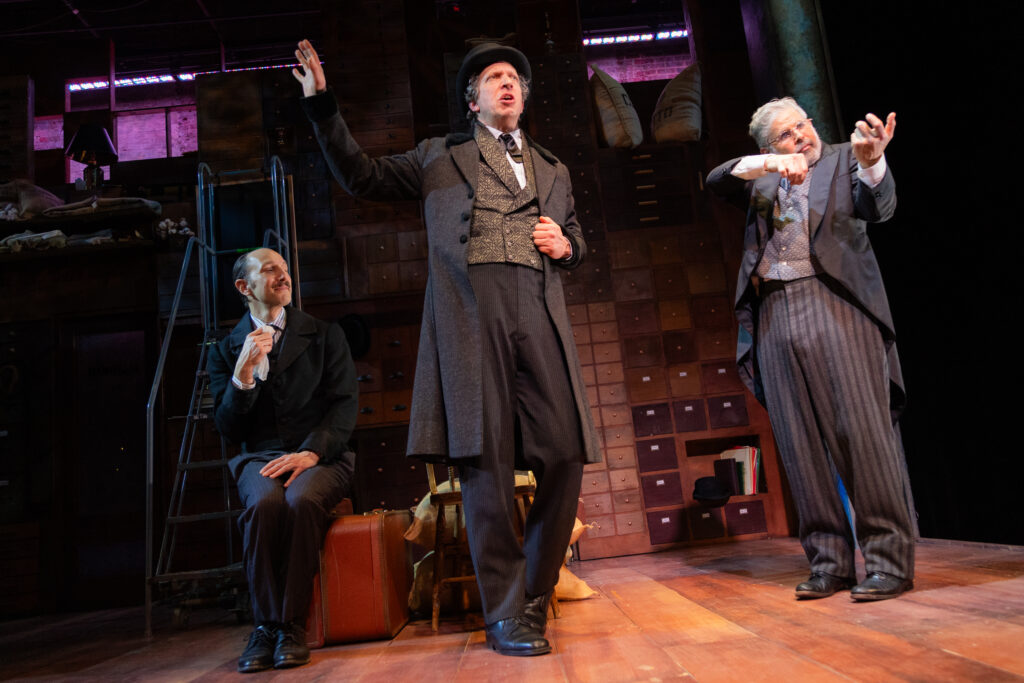
In Act I, we see the hopeful arrival of Henry Lehman (Kurlander), a German-Jewish immigrant, to America, followed soon after by his brothers, Emanuel (Mendenhall) and Mayer (Benator). Kurlander’s nuanced portrayal of Henry, filled with quiet ambition, grounds the story in a personal, intimate space from the beginning, which later contrasts with the sheer scale of the Lehman dynasty’s growth. From their humble start as merchants in Montgomery, Alabama, the three brothers shift to cotton trading, then move to New York to enter the financial sector.
This isn’t a production driven by grand theatrical effects, but the creative team skillfully crafts shifting moods and striking moments through changes in lighting, sound and simple costume pieces. Effectively and dramatically brought to the stage are a devastating fire in Montgomery, the Civil War, the Great Crash and more.
With only three actors portraying generations of Lehmans, it’s easy to lose track of who’s who. Even as an attentive theatergoer, I sometimes found myself momentarily lost. But I soon came to realize that it hardly mattered; we’re meant to understand them as new embodiments (or, in the case of Bobby Lehman, new diversifications) of the original Lehmans’ spirit. It’s a testament to the power of the play that it still works.
I have only one note of true criticism, and it’s about the audience. The story of The Lehman Trilogy is, by nature, a story about men; they are brothers, after all. But the actors do occasionally perform briefly as female characters, primarily Lehman brides and wives. I found myself a little irked by the audience’s laughter each time this storytelling device appeared. Some moments were clearly comedic — such as when a bride was portrayed as homely or haughty — but, at other times, it was simply part of the storytelling, as with the introduction of Ruth Lamar, the outspoken, resolutely modern divorcé who married Bobby Lehman.
Most contemporary American dramas focus on the domestic, the interpersonal, the violent, the erotic or some combination thereof. Elements of all those themes are present here, but the Lehman story is especially compelling for how different it is from what we’ve seen represented on stage before. It’s also striking that this is not a simple morality tale about the destructiveness of greed, as I might have expected. It’s not exactly the death of Old Yeller, but the downfall of the bank in the final scene will likely surprise you with the genuine pathos it evokes — one of the play’s most impressive accomplishments. It’s not just the rise and fall of an investment bank — it’s the rise and fall of a family bound by shared dreams and devastating loss.
In its final moments, The Lehman Trilogy powerfully underscores a truth that’s evident even from the opening. The rise and fall of Lehman Brothers is not just the story of a family or a bank; it’s the story of America itself. This is a sweeping, deeply American tale — one of ambition, expansion, re-invention and, most menacingly, of collapse.
::

Andrew Alexander is an Atlanta-based writer.
STAY UP TO DATE ON ALL THINGS ArtsATL
Subscribe to our free weekly e-newsletter.

