Review: ‘The Lost Family’ confronts isolation and fear, fosters connection
A lifetime can be captured in a quarter of a second.
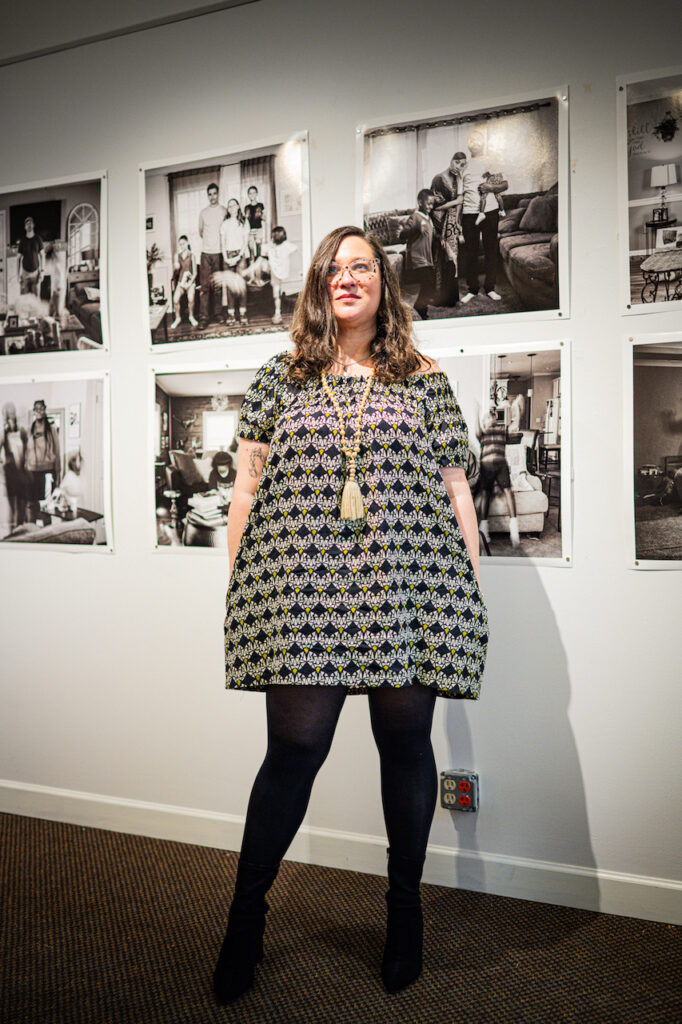
The Lost Family: Summoning the Courage, Making the Cobbler, photographer Stephanie Hanlon’s first solo exhibit, is a paradoxical and intimate glimpse into the lives of more than 20 Atlanta families through long-exposure, black and white photography. It will be on view at Atlanta Photography Group through April 12.
Inspired by her own experiences, research, Carrie Mae Weems’ Kitchen Table Series and Aracelis Girmay’s tender yet dauntless “You Are Who I Love” — the exhibit’s subtitle borrows a line from the poem — Hanlon confronts hyper-individualism, the loss of the village and the challenges of parenting amid the alarming rise of school violence, isolation and self-harm among children and teens.
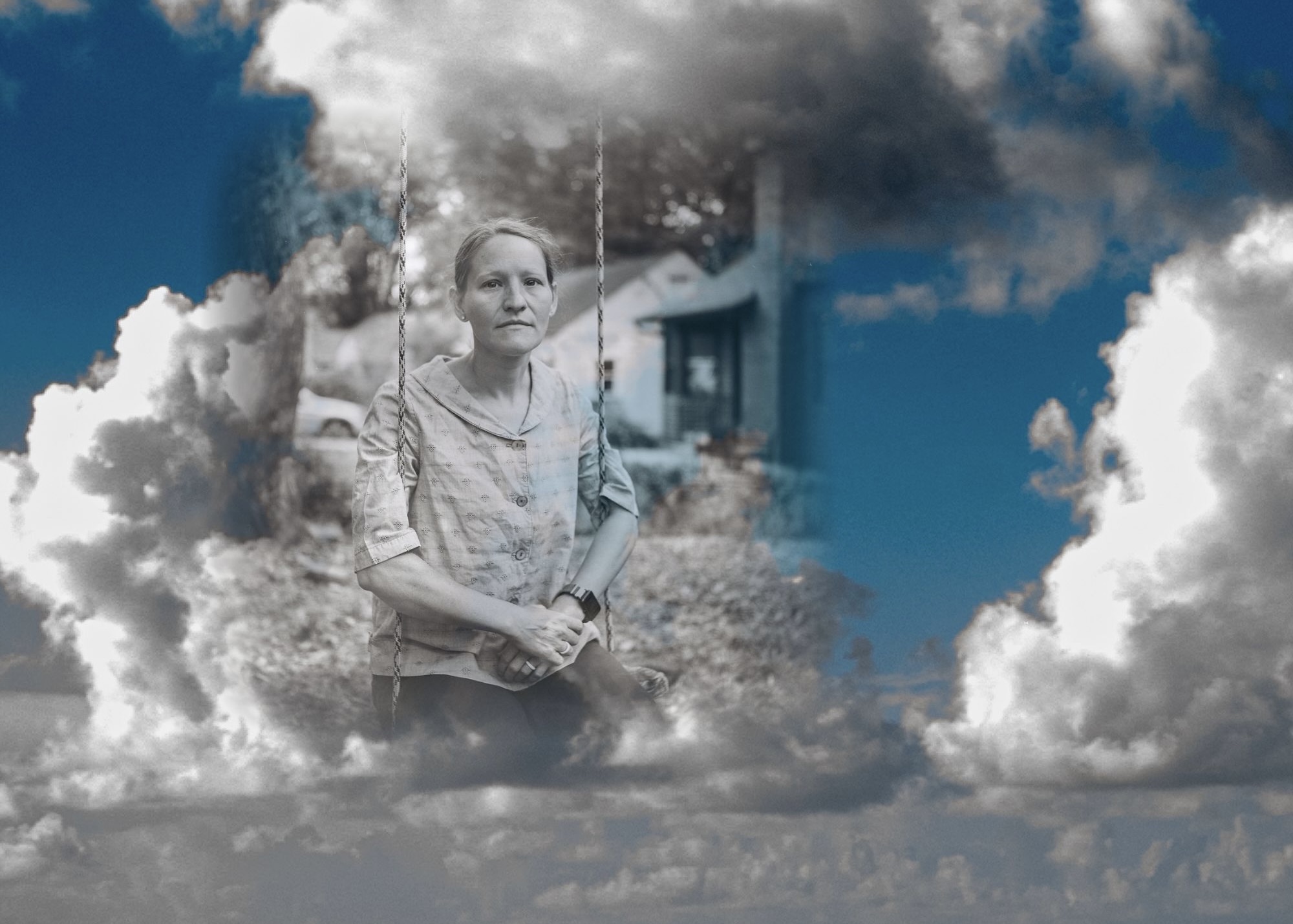
In the exhibit, Weems and Girmay quotes are printed on fabrics bearing Hanlon’s landscape photography and astrophotography (photographs of celestial objects like stars and planets). Composite images blending the families, nature and the stars hang in the center of the gallery. A mirror, with “it takes a village” displayed on it, challenges viewers to remember their role.

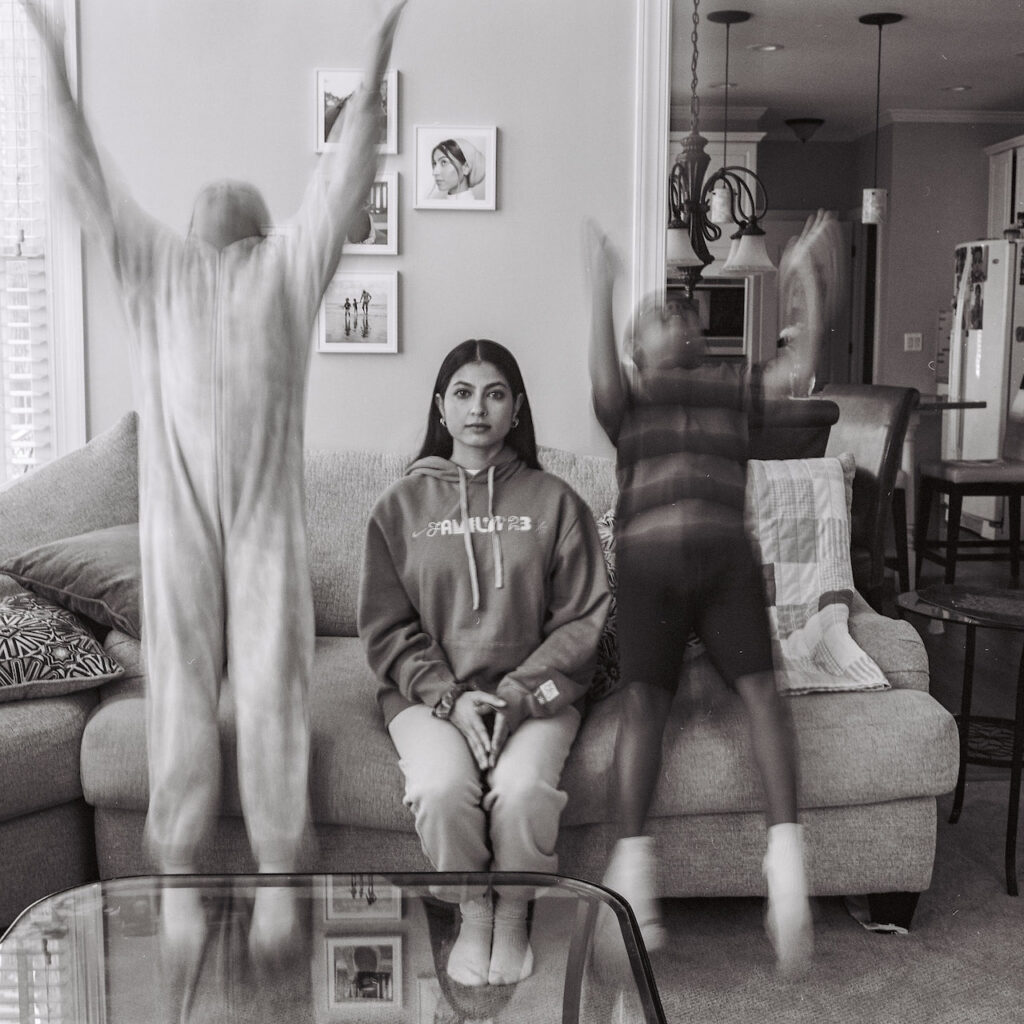
Taken with a Rolleiflex medium-format film camera, a gift from her father, the photos capture the aliveness and curiosity of children — sharing a meal in the kitchen, hitting cartwheels, looking on as their parents work on their laptops — while underlining the stress often quietly felt by parents. In one group of photos, the parents stand or sit stoically as their little ones move around them.
The titles of the photos refer to the long-exposure time and each family’s neighborhood: Quarter of a Second in West End. Quarter of a Second in Edgewood. Quarter of a Second in Sandy Springs.
“This is what a quarter of a second looks like — imagine what the whole day looks like,” Hanlon says. “But it also shows that you can feel both love and pain in the same moment — that there is a storm of chaos and uncertainty and fear (as a parent) around you, but you are still centered in your love and in your strengths.”
Hanlon, a New York native, was a journalist and professor in St. Croix before moving into corporate communications. In 2017, the company she worked for evacuated before a major hurricane devastated the island and sent her to an office in Atlanta.
The first four months in Atlanta, with her daughter, Madeleine, now 13, were borderline traumatic, she explains. “We still thought we were going back. We lost a lot there,” she says. She and her husband, who was still in St. Croix, divorced, but she missed his family and their community.
Even more disheartening was the reminder of American excess and the way people are siloed stateside. “It’s a very American problem, being so rooted in individualism,” she says. “We’ve gone too far in that direction to the point where people think they don’t need other people to survive, and it’s taking a toll on us.”
It’s especially visible in the effects on children, she says, noting that suicide is the leading cause of death for ages 10 to 14 in Georgia.
“People might think, ‘Oh, I don’t have kids; it’s not my issue,’” she says, “No, it’s everyone’s issue. Our future is dependent upon our kids’ future.”
The Lost Family project began with photographs of her own family and friends who opened up their homes to her. One pressing commonality among the parents, she says, is fear.
“I think we all can feel the pressure building, and we can feel that (the current state of society) is not sustainable; it’s so overwhelming that we all just have our heads down trying to get through it and keep our kids safe,” Hanlon says. “These families are working magic to bring moments of joy and love into their lives.”
For one participant, S.M. (who asked that we identify her only with her initials, for safety reasons), the experience brought her more joy than she could have imagined. Shortly before she met Hanlon, the Atlanta native and mother of five sent her oldest four children to live with family in another state while she made a plan to escape her abusive husband with their baby.
Once she pushed through the shock, different friends and family offered their homes for brief periods. Then she saw Hanlon’s ad.
“She took the pictures during a time when I lost my light, my hope. It was a really low period for me, not just as a human but as a mom,” she says.
The photo sessions gave her a chance to be vulnerable and transparent, and it was Hanlon who told her about the Partnership Against Domestic Violence.
“I didn’t have to worry about nobody choking me in my sleep,” she says. “I didn’t have to worry about nobody hitting me in my face. We found people who loved and cared for us and we still had our lives.” Today, she and her children are safe and happy in their new apartment.
“Seeing the exhibit was amazing because it helped me see progress,” she adds. “I remember why my eyes looked empty. But I don’t feel that now. I feel free. I feel alive. Even though it was rough, I’m happy to have something from that time period so I can show myself and my kids that you can do anything.”
Audience members at a recent Atlanta Photography Group artist talk were moved to tears as S.M. and Hanlon shared their experience and mutual gratitude. Those kinds of connections guide Hanlon’s work. Her evolution from the often rigid objectivity of objective journalism to a subjective stance helps her see art as another medium of honest storytelling. “Only emotion changes us or moves us,” she says.
That emotion has gotten lost partly because people have become more and more isolated, despite the long-studied reality of the benefits of human connection and socialization.
“Emotional expression and empathy have been framed as weakness, but they will always be part of my work,” she says. “There’s so much beauty in emotion, and empathy is our superpower. None of us could have ever done this alone.”
Hanlon plans to continue The Lost Family with explorations of empathy, reclaiming emotions and connections to nature. The next iteration will be about solutions.
When Hanlon started to feel the connections between her film, astro and landscape photography, she began to layer the images and created composites to represent our disconnection from nature. “But it’s still there for us,” she says. “The answers are all around us.”
The exhibit continues at the APG Gallery at Ansley Mall through April 12. 1544 Piedmont Ave. NE, #107, Atlanta. (Located between LA Fitness and CVS Pharmacy). Free.
::

Angela Oliver is a proud native of old Atlanta who grew up in the West End. A Western Kentucky University journalism and Black studies grad, daily news survivor and member of Delta Sigma Theta, she works in the grassroots nonprofit world while daydreaming about seeing her scripts come alive on the big screen.
STAY UP TO DATE ON ALL THINGS ArtsATL
Subscribe to our free weekly e-newsletter.

PLEASE SUPPORT ARTSATL
Your Gift Sustains the Coverage You Count On!
Related Posts