Review: Stephen Thorpe’s pristine dreams at Wolfgang Gallery

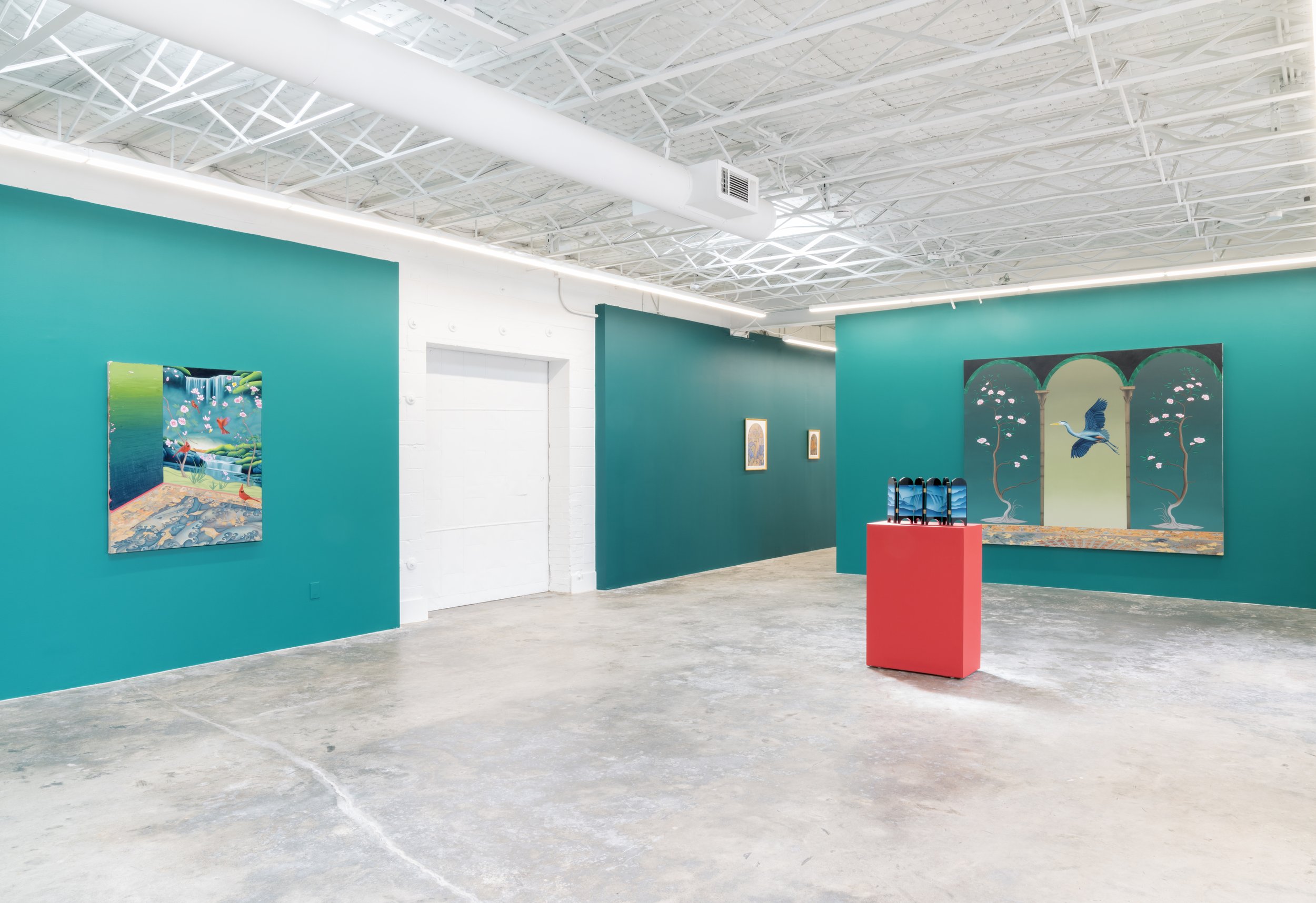
On exhibit at Wolfgang Gallery through May 18, Stephen Thorpe’s Who Looks Outside, Dreams; Who Looks Inside, Awakes is a paradoxical new body of work continuing Thorpe’s prior vision in a regionally distinct register that reflects the years the New York-based British artist spent teaching in Georgia.
The work is paradoxical because although Thorpe celebrates dreams and interior investigation as tools of discovery — and even alludes to Caspar David Friedrich, the premier German Romantic advocate of symbolic landscape painting — the paintings at Wolfgang seem the opposite of much of the Romantic sensibility, which valued such inwardness.
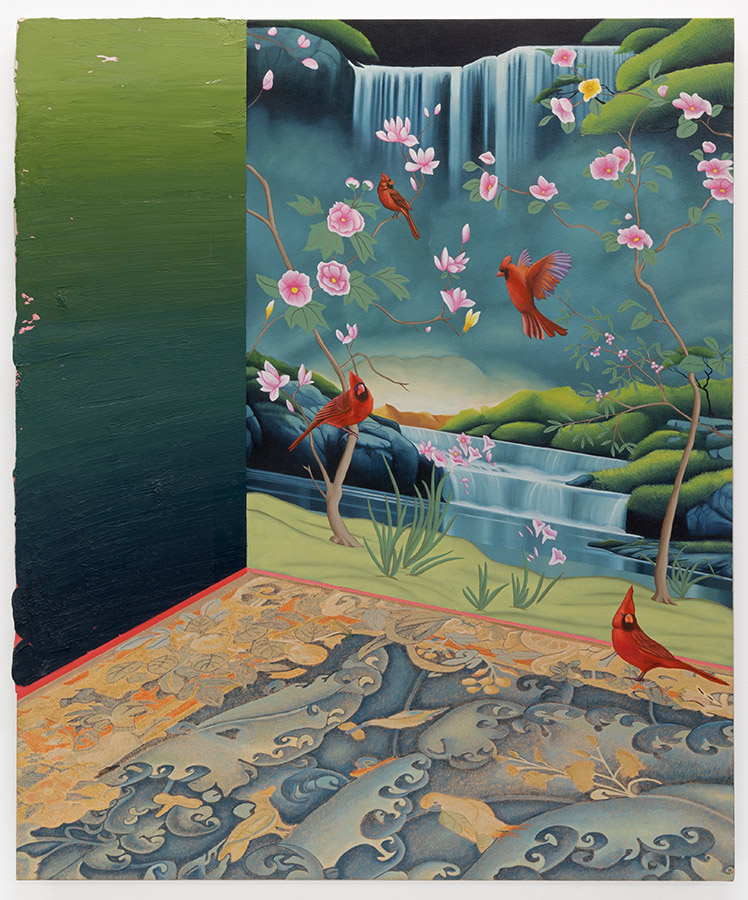
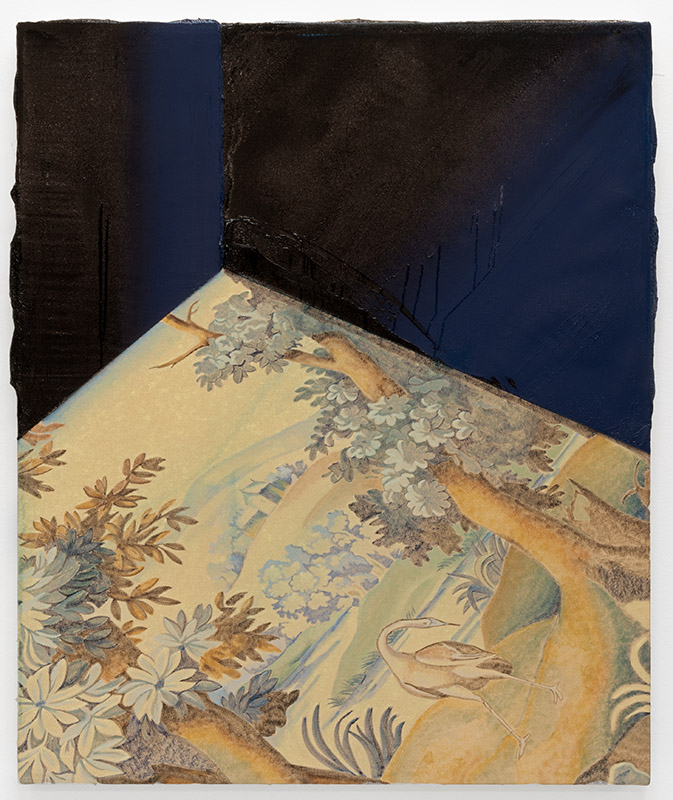
Thorpe’s most frequently used compositional device involves the two walls of a windowless room corner with a carpet covering the floor. The figures in the carpet more often seem derived from European tapestries, but Thorpe cites classic Chinese textiles and the European chinoiserie derived from them as perhaps his most important inspiration. The Chinese carpets, tapestries and ceramics that inspired European chinoiserie are symbol-laden, but they deploy their symbols decorously and decoratively. If they are dreamlike, the dreams are pleasing rather than disturbing, which distinguishes them from the unsettling qualities of the schools of painting descended from Romanticism. (Ironically, what seemed like chaotic exoticism from a clearly advanced Asian civilization appealed to Europeans as a way of loosening up the tightness of dominant styles of decorative design.)
Thorpe has assuredly read his archetype-minded sources: Carl Jung, French philosopher Gaston Bachelard and scholar of mythology Joseph Campbell. (Paintings not in this show have titles quoted directly from Campbell.) But his combination of the geometry of room corners and the designs of carpets draw their inspiration from the most domesticated renditions of mythic symbolism.
Although they are not without Romantic qualities of psychic depth, Thorpe’s paintings share in the reasonable and restrained aesthetic of his visual sources. Whether his imagined textiles quote Chinese or European designs, they are always extraordinarily polite.
Nevertheless, what he renders are the spaces of dreams, even if the dreams are orderly to a point best illustrated by two companion paintings in which a geometricized landscape is seen through the arch that forms one wall of a room featuring a carpet with an equally geometricized design of intertwined plants and animals. The landscape, more like a wall mural than anything in nature, depicts a sun focusing its rays on a wooded hill, where the rays fuse with a waterfall that then continues into the foreground as a river. A great blue heron flies across the space where light rays and falling water meet.
In Sacred Sentinel, the heron is flying to the left; in Soul Guardian, the heron is flying to the right. The two paintings are otherwise very nearly identical.
A few other works, all oil on twill weave fabric that the gallery identifies as denim, also feature dreamscapes of birds and waterfalls that are Thorpe’s homage to his experiences in the landscape of Northern Georgia. Again, this is a very orderly inward vision, easier to imagine as a mural on the right-hand wall than an actual outdoor scene replacing the wall. Even the precisely rendered birds, conceived as an homage to John James Audubon, seem to celebrate Audubon’s artistic skill more than his powers of acute observation.

“And yet, and yet,” if I may quote the legendary poem by Kobayashi Issa. In Ancient Arboreal Haven, a bright red cardinal has hopped out of the artificial paradise onto the Chinese carpet of the room, rather as in the case of the “imaginary gardens with real toads in them” in Marianne Moore’s famous poem titled Poetry. Here, and in the Dali-like twisted rocks sharing space with birds, hills, a waterfall and a strange tree in Veiled Ridges of Transformation, Thorpe allows his unconscious forces to act up at least a little bit.
Nevertheless, the overall impression of this show is enormously skillful control forming a body of work that Wolfgang Gallery has effectively turned into a single room installation by choosing a wall color that in some cases complements the paintings’ dominant palette so perfectly that they seem almost to merge with it.
There are almost certainly symbolic depths hidden in the carpets and the paradisal landscapes that would be revealed by a search for art historical precursors. But even lacking that, it can be said that if these paintings represent a Primordial Realm or Sacred Woods of Trial and Initiation, as the titles of two of them indicate, then that realm and those woods are distinctly well-ordered places.
This is not a bad thing. But given the myth-laden archetypes from which Thorpe started out, it still seems a paradoxical thing.
It is also arguable that the deepest message of works like Sacred Woods of Trial and Initiation lies not in the pastel pastoral rendered in the carpet but in the subtle effects of sunlight rendered in saturated color on the walls.
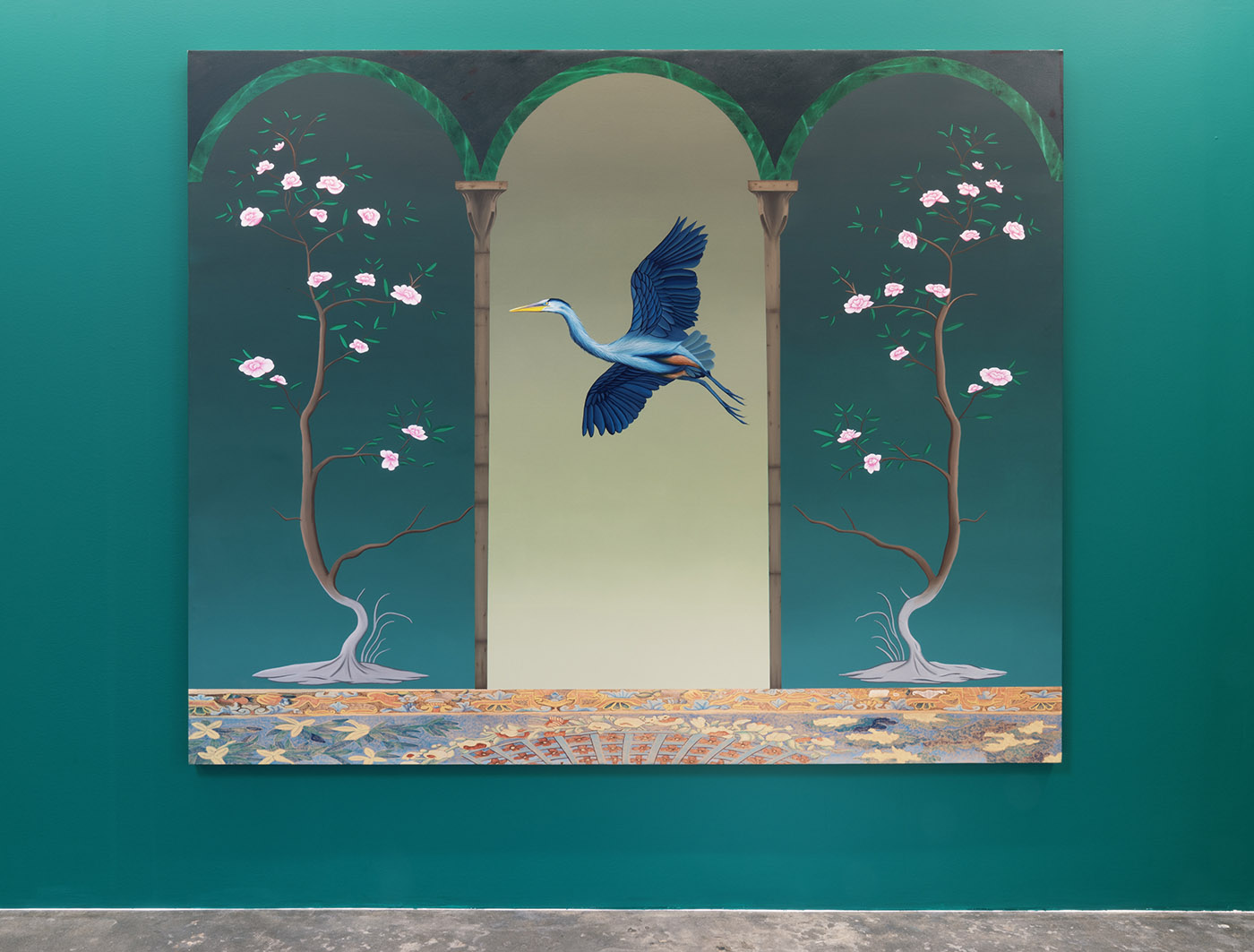
The most resonantly titled painting in the exhibition, No Tree, It is Said, Can Grow to Heaven Unless Its Roots Reach Down into Hell, is also the most formally circumscribed. Each symbolic element is portrayed within the frame of a Romanesque arch, and, while the centrally positioned bird seen frozen in flight in the central arch might be thought of as soaring in a semi-darkened sky beyond the facade, the matching flowering trees in the flanking arches are clearly not growing anywhere outside the exquisitely organized pattern in which they complement the botanical aspects of the carpet design.
The central bird recalls Campbell’s 1969 The Flight of the Wild Gander, in which he cites the wild gander as a symbol of spiritual liberation from oppressive restraints. So perhaps the point is that the trees’ roots decidedly do not reach down into hell, and thus they will never reach heaven either.
Perhaps the power of the whole show lies in the way it forces us to make our own intuitive sense out of its paradoxes. Looking within for the artist’s possible meanings instead of remaining outside analyzing the works’ decorative aspects, viewers may indeed awaken.
::
Dr. Jerry Cullum’s reviews and essays have appeared in Art Papers magazine, Raw Vision, Art in America, ARTnews, International Review of African American Art and many other popular and scholarly journals. In 2020, he was awarded the Rabkin Prize for his outstanding contribution to arts journalism.
STAY UP TO DATE ON ALL THINGS ArtsATL
Subscribe to our free weekly e-newsletter.

PLEASE SUPPORT ARTSATL
Your Gift Sustains the Coverage You Count On!
Related Posts