Review: Shakespeare Tavern’s ‘Love’s Labour’s Lost’ loses power and focus
An offbeat comedy with an uncommonly sober ending, Love’s Labour’s Lost has the capacity to both delight and move audiences with its clever wit and emotional agility. However, the production running through January 26 at the Shakespeare Tavern seems unaware of these virtues. Despite a couple of standout moments, this staging is unseasoned, boilerplate Shakespeare at its most monotonous.
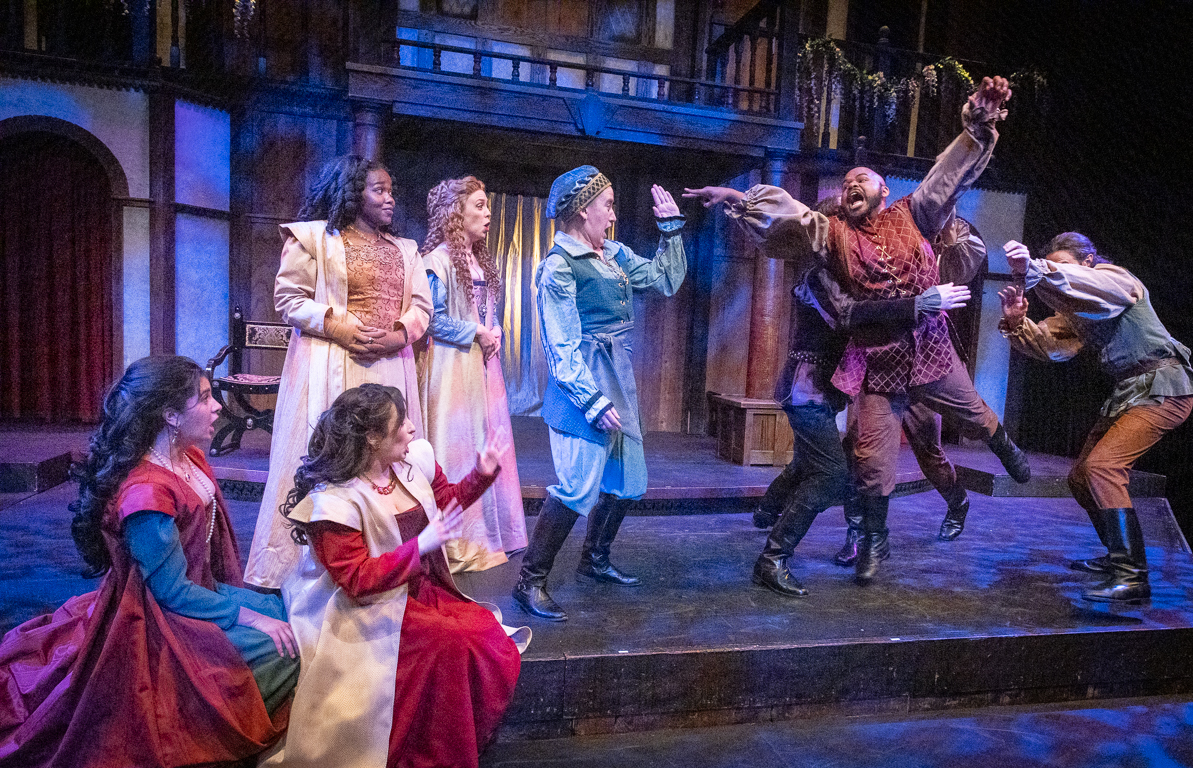
What is particularly disappointing is that Love’s Labour’s Lost is one of the Bard’s more idiosyncratic comedies. Speech-heavy and verbose, the play features more lengthy monologues than witty back-and-forth, necessitating dynamic staging to keep the momentum from flatlining. Director Jeff Watkins fails to provide on this front, leaving actors to stand in the same spot for minutes on end while they recite their lines. The actors themselves, many of whom are Tavern regulars and have proven themselves capable of better, feel like they are sleepwalking through their parts.
Some performances do feel more distinct than others. Amanda Lindsey McDonald brings a cheeky edge to the Princess of France, and she plays well off of Patty de la Garza’s brassy Rosaline. Anna Holland is perhaps the most consistent presence, infusing the character of Moth with a petulant charm that is amusing throughout.
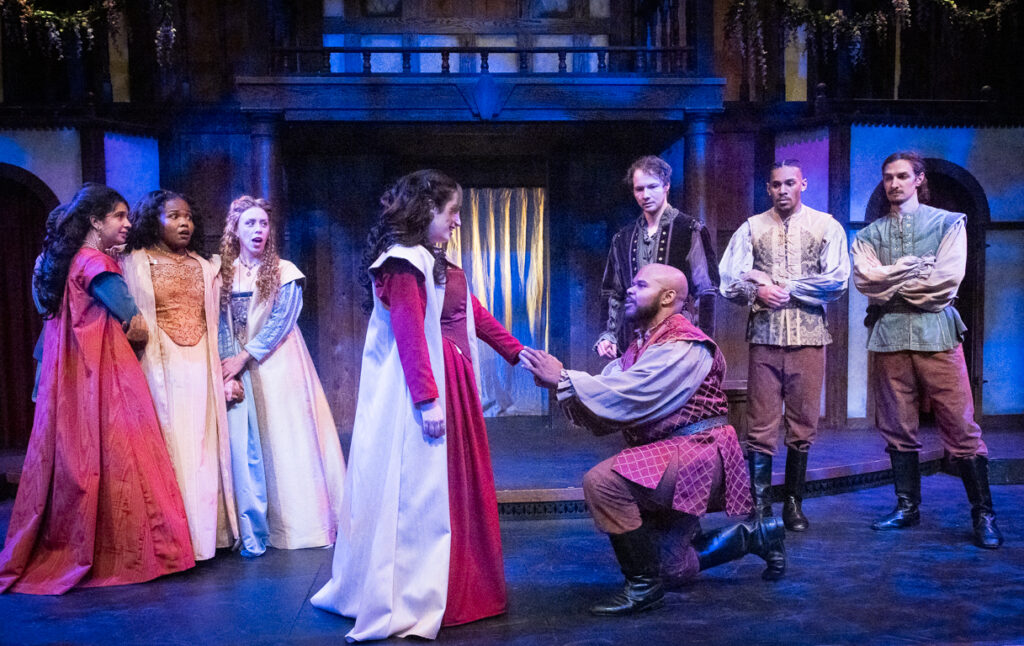
In fact, most of the cast members have moments that shine. Kenneth Wigley, excellent any time he plays a lover, is engaging in his romantic scenes with McDonald. O’Neil Delapenha’s Berowne gets off to a shaky start but has some comedic high notes in the second act. Nick Leonard has some of the best gags as Costard, and Mary Ruth Ralston’s Boyet provides moments of sarcastic levity.
But these bright spots only make it more frustrating when the play lapses back into hollow recitation. Even when the actors are animated, the performances feel superficial, with no sense of underlying motivation. The second act is better than the first, but much of the comedy in Act Two is built on relationships set up in Act One, all of which feel underdeveloped. This is to say nothing of characters like Don Armado or Holofernes, who are underutilized to the point of feeling superfluous.
The two best scenes of the play, both in the second act, serve as the dual centerpieces. The entire production seems geared around getting to these scenes, and while they are both admittedly highlights, the audience must slog through the rest. Still, these scenes give a glimpse at what the production could have been.
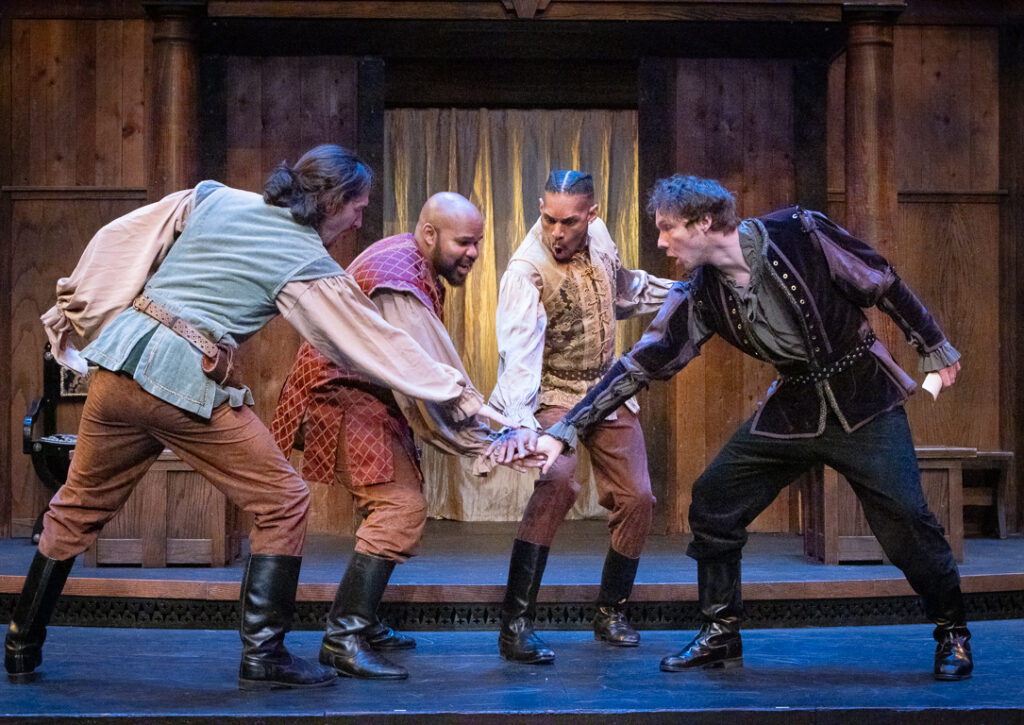
The first of these centerpieces is the love letters scene, where the male leads catch each other writing declarations of love to the women, in violation of the vow they have all made. Wigley, Delapenha, Tyshawn Gooden and Evan Judway all shine in this scene, which makes excellent use of the Shakespeare Tavern’s stage by having characters throw themselves to the ground and twirl around columns as they try to hide from each other. As the inherent physicality of the scene forces the actors to break from the stiff park-and-bark approach of the previous scenes, it’s as if they suddenly remember that they know how to be funny.
The best scene, however, is the last one — infamous among the Shakespearean canon — in which a messenger arrives unexpectedly, interrupting the mirth and revelry to deliver the news that the Princess’ father, the King of France, has died. A switch flips as all eyes turn to McDonald. Lighting designer Greg Hanthorn Jr. bathes the stage in melancholy blues, and, in the space of a breath, the entire cast locks in. The women rally around McDonald while the men stand to the side, unsure of what to say or how to react. Actors play off of each other in heartfelt, interesting and organic ways. Motivations become not only clear but immediate. In its last moments, the play comes to life. But by that point, it’s too little, too late.
::

Luke Evans is an Atlanta-based writer, critic and dramaturg. He covers theater for ArtsATL and Broadway World Atlanta and has worked with theaters such as the Alliance, Actor’s Express, Out Front Theatre and Woodstock Arts. He’s a graduate of Oglethorpe University, where he earned his bachelor’s degree, and the University of Houston, where he earned his master’s.
STAY UP TO DATE ON ALL THINGS ArtsATL
Subscribe to our free weekly e-newsletter.

PLEASE SUPPORT ARTSATL
Your Gift Sustains the Coverage You Count On!
Related Posts