
Review: Racism is a terror that hits close to home in Aurora’s “Feeding Beatrice”
Lurie and June Walker, a young African American couple, have moved into a fixer-upper in a mostly White suburb. They hope this house will be fresh start after losing a baby a year ago. One day, a precocious little White girl named Beatrice befriends June, and the two bond over glasses of milk, homemade jam and tango lessons. However, it soon becomes clear that this little girl is not who she appears to be. The creepy dark comedy, Feeding Beatrice, is onstage at Aurora Theatre through February 6.
Director David Kote and a four-person cast tackle Kirsten Greenidge’s complex, dense script with varying levels of success. Kote and cast really land the comedy of the play. However, the frenzy could stand to be a bit more frenetic. The script is dialogue heavy, and the energy of the play drops in the scene transitions. There is also an emotional depth that demands further exploration. The audience needs to see this couple really wrestle with the reality of this little White girl who uses terms such as “colored” and “Negro” in the 21st century in their home. They are saying the words but their faces and bodies aren’t conveying the internal conflict.
This is perhaps because the journey of bringing Feeding Beatrice to the stage encapsulates the challenge of creating theater during the Covid-19 pandemic. The show initially had a different cast, but due to actors getting sick, the team at Aurora had to recast all but one part. The new cast is mostly there, but not quite.
Christopher Hampton as Lurie is charming, funny and understands his character’s internal conflict of wanting to appease his wife versus staying true to himself. Meg Johns as Beatrice is a Mommy Dearest kind of terrifying, but there are also times where we need to see the character be less shrill and explore deeper emotions. Kymberli Green as June has the heaviest lift in terms of emotional complexity, and she’s still figuring it out. Where June collapses for me is that we never see her transition from pretending everything is fine to completely going mad. She just kind of goes crazy, obliterating the bathroom floor.
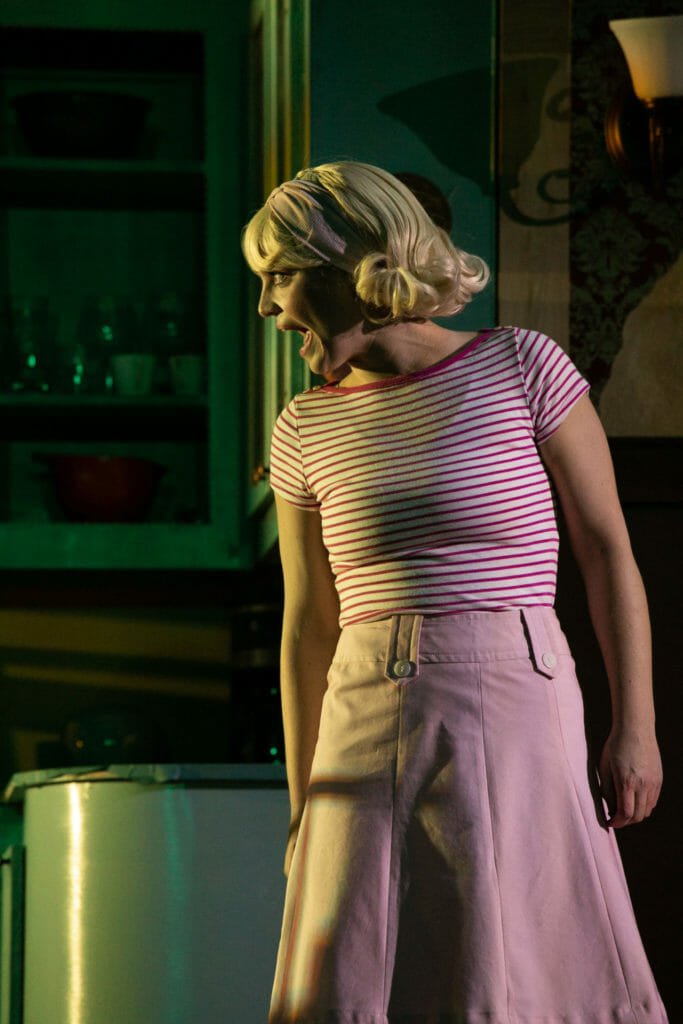
Feeding Beatrice premiered at the Repertory Theatre of St. Louis in 2019. In the play, it quickly becomes clear that the young Black couple in the haunted house is a metaphor. While attempting to renovate the large upstairs bathroom, Lurie swears he sees a White person’s hair and scalp under the tiles. June refuses to see it because the house is their new beginning and she is laser focused on a pending visit from the adoption agency. She suggests they cement over it and move on, which becomes June’s modus operandi throughout the play.
The house is a metaphor for America, and cementing over the ugly parts represents the ways in which some people resist addressing our nation’s unjust past. Beatrice is the symbol for White supremacy and White privilege.
Speaking of the house, the detailed set design by Isabel and Moriah Curley-Clay is absolutely stunning. From the sconce-lined hallway to the copper pots hanging on the kitchen walls to the peeling burgundy and gold jacquard wallpaper, this fixer-upper requires more than a simple renovation.
Kudos to lighting designer Toni Sterling for the crazy flickering lights during Beatrice’s tantrums and to sound designer Chris Lane for what perhaps is the most annoying creaking noise ever. It adds to the play’s tension and suspense.
In addition to the metaphor about the house, there’s also another layer for Lurie and June. They left their mostly Black neighborhood to move into a White one. But the question becomes, was it worth it? Or will they always end up being the help in some White person’s story?
At one point, Lurie’s brother LeRoy (Sean Dale) visits and presses Lurie about them being the only Black people in the neighborhood. Lurie replies, “It’s not Little Rock,” to which LeRoy responds, “It’s always Little Rock.”

This is the play’s central message. No matter how much African Americans have achieved over the last century, there is always another barrier to remove. When President Biden announced he would nominate a Black woman to the Supreme Court last week, people questioned whether he would be sacrificing qualification for race — as if a Black woman could not possibly be qualified? It’s no surprise that most of the books banned by school districts in the last five years address race, LGBTQIA+ identity and sexual assault — all things buried under the house.
Feeding Beatrice is certainly one of the most unique theatrical experiences I’ve had. The layers are peeled back in ways about as juicy as those jams Beatrice digs into with her bare hands. I just wish this production had the breathing room to really get under the foundation and answer the question, can the family survive in a haunted house?
::
Kelundra Smith, an ArtsATL Editor-at-Large, is a critic and arts journalist whose mission is to connect people to cultural experiences and each other. Her work appears in The New York Times, ESPN’s The Undefeated, American Theatre and elsewhere. She is a member of the American Theatre Critics Association and the Society of Professional Journalists.
STAY UP TO DATE ON ALL THINGS ArtsATL
Subscribe to our free weekly e-newsletter.

PLEASE SUPPORT ARTSATL
Your Gift Sustains the Coverage You Count On!
Related Posts