Review: Pianist Emanuel Ax breathes new life into Beethoven and Schoenberg
Beethoven was as radical in the 19th century as Schoenberg was in the 20th. Pianist Emanuel Ax probed the depths of both composers at Spivey Hall.
::
In an elegant, symmetrically balanced program, pianist Emanuel Ax returned to Spivey Hall Sunday afternoon with endearing music by two radical Viennese masters. The first one we know in abundance: Ludwig van Beethoven. The second we think we know, by reputation, although he’s heard too rarely in Atlanta: Arnold Schoenberg.
By setting these two paradigm-shifting composers side by side, Ax was making the pair artistic equals — boosting Schoenberg’s status in the process. He anchored the program with three Beethoven sonatas — at the concert’s start, middle and end — interspersed by sets of Schoenberg miniatures.
Along the way, the pianist was also exploring the chain that linked Austro-German music from the 18th to the 20th century. But rather than survey their voluminous keyboard works, he offered each composer in just two periods of their creative development, with mature masterpieces from the height of their powers sandwiching a youthful work that showed the influences of their teachers and role models.
For the audience, this was a lot of insightful, perhaps intellectual, programming to digest. But rather than a puzzle to unlock, Ax’s affable manner and warm musicality made it all feel cozy, compelling and inevitable.
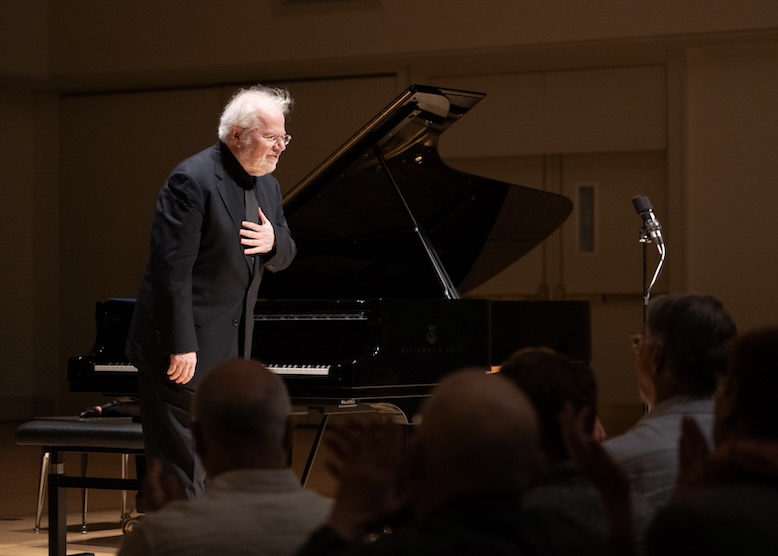
After walking across the stage in a baggy black suit, he opened with Beethoven’s popular Pathétique Sonata, highlighting its moody, manic, contemplative brilliance. In the brooding introduction, he seemed to be adjusting to Spivey’s big-personality Steinway, nicknamed “Robert,” but, as soon as they found their groove, Ax’s charms were apparent. At his best, he’s a substantive, often profound, interpreter and made this stormy music sound natural, effortless, almost conversational.
In the slow middle movement, typically a statement of melancholy and despair, he sped up the tempo a hair and emphasized the flowing lyricism, with sunny results. This led ideally into the finale, a fast rondo, spritely as it turned ’round and ’round. Delightful.
As the pianist told the audience, this is the 150th anniversary of Schoenberg (1874-1951), “so he’s no longer a modern composer!” In this music you hear Bach, you hear Brahms, you hear the same restless energy of Beethoven, forever pushing outward.
Schoenberg’s Three Piano Pieces, Op. 11, hold a key spot in music history because they were among the first works to completely abandon the traditional European harmony that had been in place for half a millennium. Later in his career, Schoenberg would invent a rigorous compositional technique called serialism, but the so-called “free atonal” works on Ax’s program were all played as late-late Romanticism — lush, intoxicating and maybe a little disorienting.
Since this composer still seems to require explanation and special pleading, Ax advised us to “listen for the emotional gestures and not worry about the harmony at all.”
Schoenberg’s Six Little Pieces for Piano, Op. 19, from 1911, take free atonality a step further. Each is a wisp of memory, a hint of emotion, the smear of a theme — all six pieces are just a minute or two in length. Blink and you’d miss them. The music here is expressionistic or pointillistic, at times darting or thorny, some with sharp edges, others a thick instant in time.
Each composer had a youthful work on the program, too. Beethoven’s Piano Sonata Op. 2, No.2 is loosely modeled after a sonata by his teacher, Franz Joseph Haydn, and Ax here played it with bouncy, puppy-dog energy. He took the final movement under tempo, however, making the music soggy or, perhaps worse, stodgy — one of the few misfires of the afternoon.
In a parallel, Schoenberg’s youthful Three Piano Pieces (1894), written when he was in his 20s, sounded a lot like the idolized music by Johannes Brahms. They’re heavier than mere salon pieces but lack the gravitas of, say, Brahms’ late-in-life piano intermezzos. Not surprisingly, Ax was utterly persuasive in this sound world.
At concert’s end, for the Appassionata Sonata, he reveled in Beethoven’s heroic middle period, full of controlled passion, at turns muscular or tender. The logic is very goal-oriented, and the music’s energy propels you forward toward a satisfying conclusion.
Yet Ax’s sense of proportionality and good taste gave the sonata a Classical-era formality — even as he set the piano on fire for the blazing final pages of the score. The near-capacity audience erupted even before the final chord ebbed away, a roar of approval for a beloved artist and a brilliant program.
::
Pierre Ruhe was the founding executive director and editor of ArtsATL. He’s been a critic and cultural reporter for the Washington Post, London’s Financial Times and the Atlanta Journal-Constitution and was director of artistic planning for the Alabama Symphony Orchestra. He is publications director of Early Music America.
STAY UP TO DATE ON ALL THINGS ArtsATL
Subscribe to our free weekly e-newsletter.

PLEASE SUPPORT ARTSATL
Your Gift Sustains the Coverage You Count On!
Related Posts