
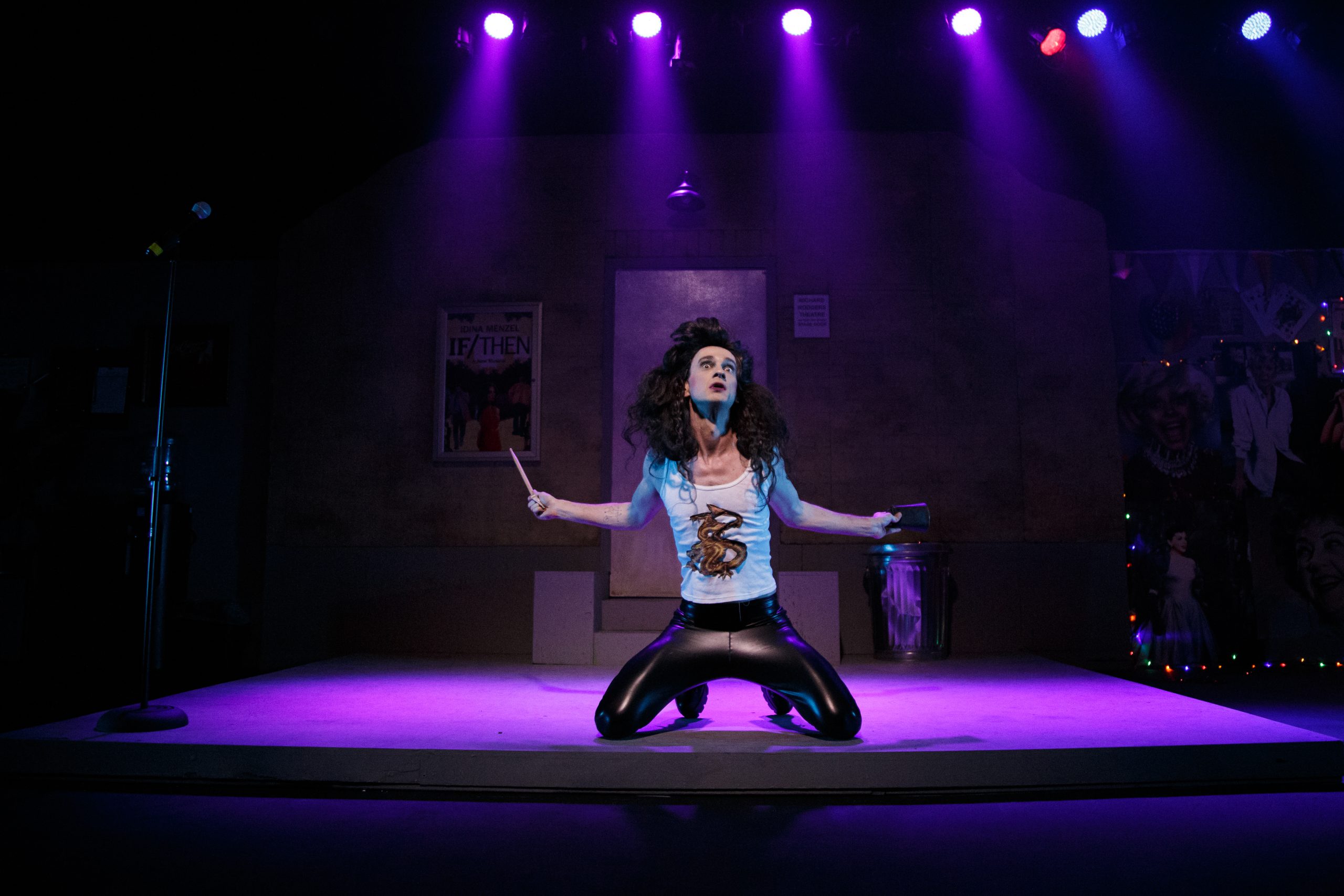
Review: Out Front’s ‘Which Way to the Stage’ is thoughtful comedy for theater buffs
When Idina Menzel uttered the immortal words “which way to the stage?” in 1996, she was asking about a literal stage. In Ana Nogueira’s play of the same name, the stage in question is the one described by Shakespeare — representing the search for oneself. This intersection between identity and performance forms the crux of Out Front Theatre’s latest offering, a flawed yet thoughtful comedy written by and for theater-lovers.
Running through March 28, Which Way to the Stage follows Jeff and Judy, best friends and musical theater fanatics who spend their evenings waiting outside the stage door of the Richard Rodgers Theatre in the hopes of meeting Broadway superstar Idina Menzel. Jeff is a set-in-his-ways drag queen whose sense of self is battle-forged from years of homophobia. Judy is an actor-turned-real-estate-agent-turned-actor-again with an uneasy relationship to her own femininity and a mountain of barely concealed self-doubt. The story follows their struggles to jump-start their careers while grappling with the internal and external stigmas of being an effeminate gay man and a plus-sized woman.

The script penned by Nogueira (whose Supergirl movie hits theaters this June) gets off to a somewhat shaky start with our leads coming off caricaturish. This is exacerbated by stars Matthew Busch and Caty Bergmark having polar opposite acting styles (his, exaggerated and performative; hers, grounded and understated). But as the story progresses, Nogueira begins to ask fascinating questions about gender, identity and performance.
Nogueira has packed the script with so many musical theater references that it borders on esoteric. If you lack the foreknowledge to get Rent jokes or follow a debate about whether Bernadette Peters or Patti LuPone was the better Mama Rose, a fair amount of the play will go right over your head. However, for those of us who do know what Jeff and Judy are on about, the characters’ fangirling often serves to deepen the play’s themes. For example, the way Judy describes Menzel’s stardom says a lot about her relationship to femininity and how she sees herself.
In fact, for a play about musical theater, there is an awful lot of talking. Characters spend long scenes dissecting their own thoughts on various musicals and performance styles. From the pitfalls of Broadway commercialism to the ethics of drag parody to the gentrification of performance spaces, this play has a lot on its mind.

This thoughtfulness is occasionally to the play’s detriment. Several scenes go on longer than necessary, and, with Director Justin Kalin giving the actors limited playing space, the pacing starts to stagnate more than once. Fortunately, there is enough humor to keep the story afloat, and Kalin does a good job of building chemistry between the actors.
Momentum is also maintained by the cast. Busch brings sharp layers to Jeff, starting as playful and unserious and slowly deepening as more of the character’s inner world is revealed. Bergmark, who has proven herself an incomparable talent in other productions, is just as appealing here. Her Judy is funny and self-possessed with a reluctant vulnerability that makes it easy to see what insecurities drive her actions (even when she is doing something as annoying as debating her right to use a gay slur).

They are joined by Nicolas Teixeira as Mark, another aspiring actor who has palpable chemistry with both leads. Teixeira has charisma to spare, though his performance is a bit one-note and his lack of diction leads to some lines getting lost. Alexandra Ficken rounds out the cast in multiple roles, each providing welcome comic relief.
Scenic designer Micah Martin constructs a nicely functional set with some fun touches in the decoration, such as posters of various Broadway divas. The costumes are mostly casual contemporary, leaving costume designer Berkeley Pillay with few opportunities to show out, but she makes the most of them. Lighting designer Lindsey Sharpless is able to use lighting shifts to create a sense of intimacy for certain scenes.
Which Way to the Stage is not for everyone. If you are looking for a quirky comedy, you may be turned off by the play’s long stretches of introspection. If you are only a casual theater fan, you may find yourself shut out by the play’s discussions of thespian culture. However, if you can meet the prerequisites of patience and a working knowledge of performance arts, Which Way to the Stage is an insightful and often challenging commentary on the industry — and the resilience and self-love it takes to hold your own.
Where & When
Which Way to the Stage is at Out Front through March 28. Tickets, $35.
999 Brady Ave. NW.
::

Luke Evans is an Atlanta-based writer, critic and dramaturg. He covers theater for ArtsATL and Broadway World Atlanta and has worked with theaters such as the Alliance, Actor’s Express, Out Front Theatre and Woodstock Arts. He’s a graduate of Oglethorpe University, where he earned his bachelor’s degree, and the University of Houston, where he earned his master’s.
STAY UP TO DATE ON ALL THINGS ArtsATL
Subscribe to our free weekly e-newsletter.

PLEASE SUPPORT ARTSATL
Your Gift Sustains the Coverage You Count On!
Related Posts

