Review: Synchronicity’s “In the Continuum” gives too-rough finish to fragile truths
Before the world knew her as a katana-wielding badass on The Walking Dead or a spear-wielding badass in the Marvel Black Panther franchise, Danai Gurira was a pen-wielding, Tony-nominated badass who wrote numerous plays centered on strong women characters. One of Gurira’s best-known pieces is also one of her earliest: the 2005 Obie-winning play In the Continuum, which she co-wrote with her fellow NYU Tisch School of the Arts grad student, actor/writer/director Nikkole Salter. Their celebrated, globe-touring show has now been revived by Synchronicity Theatre Company for a limited two-week run through June 18.
Running an hour and a half with no intermission, the play follows two women who, on paper at least, inhabit completely different lives. Abigail is a married, middle-class broadcaster in Harare, Zimbabwe, while Nia is a 19-year-old aspiring poet who grew up poor in an abusive household in South Central Los Angeles and is dating a rising basketball star. Abigail and Nia’s storylines begin to parallel poignantly when they each find out they’re pregnant and HIV positive in one fell swoop, having contracted the virus from the duplicitous men they thought they could trust.
Only two actors inhabit the stage, playing a total of 11 characters in a series of interconnected monologues. The play covers many themes, including the intersection of misogyny, racism and bigotry within public health; the continued stigma around HIV/AIDS; the gaping disparities in health care; and the lack of choices that so many women, particularly poor or disenfranchised women, face when they get sick.
The success of a show like this depends on the ability of the two actors to carry us through the many layers and ups and downs of this journey and to mine the humor and heartache embedded in the script, in equal measure at times. Unfortunately, both actors in Synchronicity’s staging start out already dialed up to 11 and maintain the same tempo and pitch throughout — making the experience of watching the show less a finely tuned emotional slow-burn and more of an exhausting sprint that goes on past what feels possible.
Asha Basha Duniani plays Nia less like a teenager who wears her confidence as a shield and more like someone filled with such relentless confidence that she’s mostly just grating for the first half of the show. Duniani’s intensity and commitment are in many ways admirable, but ultimately, the characters she’s tasked with portraying would have benefited from more nuance and dimension.
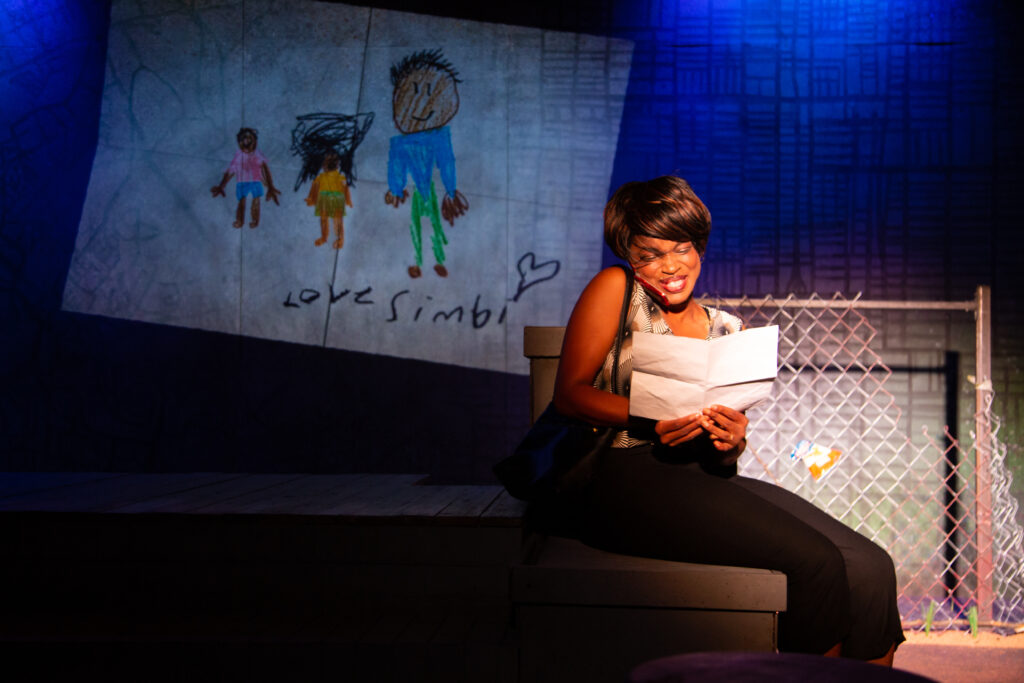
Dionna Davis as Abigail elevates many of her scenes, including some touching moments between Abigail and her unseen young son. She also delivers a very funny turn as one of Abigail’s well-meaning “friends” who has swooped into town from the United Kingdom. At the same time, she also portrays several characters who are so over-the-top, it distracts from what’s happening in the scene.
For instance, she plays a shrieking, physically awkward nurse who coldly delivers the HIV diagnosis to Abigail and feels straight out of a sketch show. This does not for a moment ring true even for the most beleaguered, cynical veteran of a profoundly underfunded, burnout-ridden health care system. The goofiness is a distraction from what is actually haunting and at times darkly funny about that particular vignette.
These misfires in bringing so many potentially fascinating characters to life are extra baffling because Valeka Jessica, making her directorial debut here, is such a talented actor, nominated last year for a Suzi Bass Award for her beautiful work in Intimate Apparel at Actor’s Express. If anyone can work effectively with fellow actors to make sure that they’re capturing the depths of emotional complexity, it stands to reason she could. And perhaps with more opportunities to explore her vision at the helm of future shows, she’ll show more of what she can do. We’ll be watching excitedly to see that come to fruition.
Unfortunately, the hit-you-over-the-head approach to the already difficult subject matter (which is still depressingly timely almost 20 years since the play debuted) means we miss softer pieces of dialogue and never quite dig down into the ways that each character is distinct, and what they contribute to the larger picture. Ultimately, it’s a disappointment because you can see the play that’s beneath it all, hiding under the high-pitched frequency — and you are left wondering how much more impact we might have felt as an audience under a gentler guiding force.
::
Alexis Hauk is a member of the American Theatre Critics Association. She has written and edited for numerous newspapers, alt-weeklies, trade publications and national magazines including Time, The Atlantic, Mental Floss, Uproxx and Washingtonian. An Atlanta native, Alexis has also lived in Boston, Washington D.C., New York City and Los Angeles. By day, she works in health communications. By night, she enjoys covering the arts and being Batman.
STAY UP TO DATE ON ALL THINGS ArtsATL
Subscribe to our free weekly e-newsletter.

PLEASE SUPPORT ARTSATL
Your Gift Sustains the Coverage You Count On!
Related Posts