Review: Zuckerman exhibit celebrates beauty now, when we need it most
With the beautifully titled The Gravity of Beauty, on view through December 10 in Mortin Gallery at the Bernard A. Zuckerman Museum of Art, curator Cynthia Nourse Thompson ponders nature, humanity and loss, and the potential of beauty to serve as respite in times of grief and suffering. Her entry point to this exhibition, as expressed in her statement, is a decades-old academic “conversation” about beauty in art. It’s worth mentioning here.
The preeminent philosopher and critic Arthur C. Danto, who died in 2013, noted in his 1994 essay “Beauty and Morality” that there was a scarcity of beauty in art, calling beauty a kind of catalyst that could transform “raw grief into tranquil sadness.”
He questioned the ability of beauty to be as relevant in a time of moral indignation which dominated the art scene then, and for good reason. A pandemic had recently ravaged the country, especially the art world. Political divisiveness and unrest were changing the face of geopolitics. At home, there was an unfinished reckoning with race in America. Sound familiar? How then could we prioritize beauty? There were simply things that beauty could not do.

Two years later, scholar Kathleen Marie Higgins responded with her essay “Whatever Happened to Beauty? A Response to Danto.” She agrees with much of what he wrote. For her, beauty as a relevant vehicle for contemplation, while perhaps not yet dead, was at best scarce. She believed in beauty’s promise to, in Danto’s phrase, “transfigure the commonplace” of everyday reality, but argued further that beauty’s reemergence could possibly transfigure contemporary art as well. It appears that Thompson would agree.
An entire argument can be made as to whether or not that was true then, and/or is still true, but let us, like Thompson did for this show, take as a starting point Higgins’ suggestion that “Beauty . . . in times of loss . . . urges renewed love of life.”
I would argue that Beauty (capital B intended) transcends human loss and as such reminds that any pain or loss we are suffering in the moment will, like Nature itself, eventually flow and change and become something else.
The 10 artists in this show, with works in video, sculpture, and painting, incorporate or manipulate beauty to address these concerns — or not — in various ways and to varying degrees.
The first two pieces I encountered in the exhibition were internationally recognized New York-based sculptor Rona Pondick’s resin-encased head, and a trippy, acid-colored video of bees buzzing flowers from collaborators Hironaka & Suib. They both made me wonder if this was a show about perception, which of course it is. There are as many definitions of beauty as there are eyes of its beholders. But let’s return to Danto’s statement that beauty can “transfigure the commonplace,” for that is what the best of these works at Zuckerman illustrates.

Among them are the New York-based painters Darren Waterston and Barbara Takenaga. Waterston’s large-scale paintings in oil on panel employ Japanese print-like landscape as metaphor, a classic utilization of beauty in art. Takenaga’s fantastically beautiful abstractions incorporate paint poured onto linen, the outcome of which is mitigated by manipulation and by chance, resulting in a consilience of macro- and micro-cosmic images. Their beauty can stun you into stillness. Red Meryl (2020), with its glimpse of a starry cosmos through a blood red “birth canal,” is one.
Other artists provide counterpoint, or at least other ways of considering beauty, its gravity or other qualities, in articulate but slightly less satisfying ways. Shelley Reed’s large-scale grisaille paintings (all blacks and grays), which reference traditional beauty in art history and are indeed beautiful themselves, feel slightly overbearing in context with the other works. Jennifer Steinkamp’s hypnotic video projection of drifting flowers reminded me of an equally beautiful projection by Atlanta artist Cynthia Farnell, making me wish there were more Atlanta artists in this show.
In addition to his lush paintings, Waterston is represented here by selections from a collaborative project of color etchings and aquatints combined with letterpress text created with admired poet Mark Doty. Incidentally, Doty gave a lovely, intimate Zoom reading and talk on October 13 as programming around the exhibition. The most compelling of these portrays — in a reversal of the show’s title — the beauty of gravity; for instance, a recumbent deer seemingly tethered to a tree “levitates” above unseen ground.

The event that inspired it was the opposite. Doty revealed that he had shared with Waterston his discovery of a dead doe in his own backyard, new life already feasting on and sprouting from its decomposing body. Death and renewal, in a dance of reincarnation.
Thompson’s conception of the exhibition began with the work of glass artist Amber Cowan and photographer William McDowell, two artists whose work questions how we can and do emotionally find beauty at a time when we are suffering.
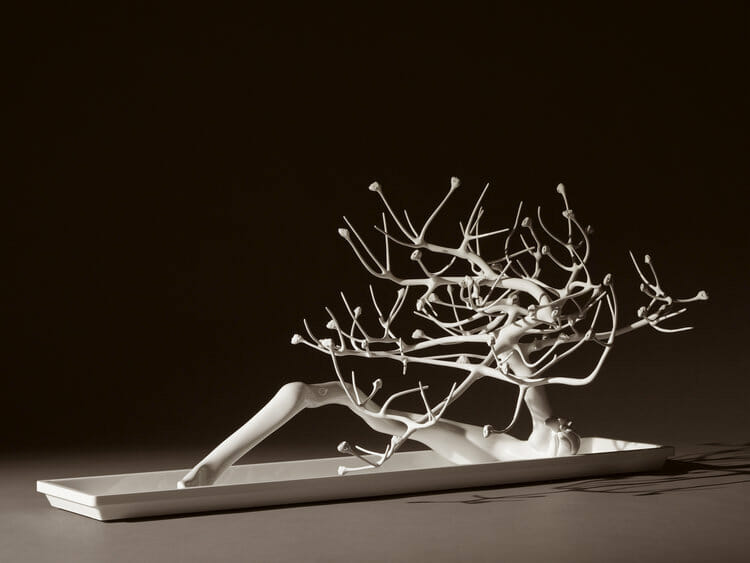
Cowan reworks and repurposes American pressed glass, incorporating flameworking and glassblowing techniques to create works of fragility and resilience. The work just seems to try so hard, but not in a way that is off-putting; instead, her pieces become everything, all at once — just as life comes at you, perhaps.
Her Young Love Resting in Gray Meadow (2019), an ashen gray “wreath” of fantastical glass, is fellow memento mori to McDowell’s deeply affecting book art.
The photographer scanned his father’s ashes and discovered that the tiny pieces of ash became the stars and galaxies he was studying in astronomy books. With metaphor of unspeakable beauty, McDowell’s transformation of the real to the imagined and the prosaic to the poetic shows us exactly what beauty can do. Be sure to read his own description in the QR code on the wall.
I would love to see an entire gallery of this work; there are volumes to be said about it and yet nothing at all of any value to add. The beauty of this work is unique and complete just as it is, like a life itself — or a death.
When I thought I had finished writing this review, I learned of the death of the inimitable Peter Schjeldahl, longtime art critic for the New Yorker magazine. In a 1996 piece for that magazine, “Beauty is Back,” written contemporaneously with the two writers Thompson referenced, Schjeldahl wrote that at some point in the future the argument over beauty will be over and “beauty will be what it has always been . . . an irrepressible, anarchic, healing human response without which life is a mistake.” And that, were I the writer Schjeldahl was, is exactly what I would write about McDowell’s images.
Art criticism may have been Thompson’s doorway to an examination of beauty’s role in assuaging grief and the fragility of life, but we don’t need the critics to know what beauty is and what beauty does.
In “Beauty and Morality,” Danto predicted that “beauty may be in for a rather long exile.” That was then. The Gravity of Beauty is here, now.
Hopefully, Schjeldahl was right (of course, Schjeldahl was right.) Beauty is back, if it ever left at all, and it’s here to stay when — in times like these — we need it most of all.
::
Donna Mintz is a visual artist who writes about art and literature. A current studio artist at Atlanta Contemporary, her work is in the permanent collections of the High Museum of Art and MOCA GA. She writes for the Sewanee Review, Sculpture magazine, BurnAway, and ArtsATL, where she is a regular contributor. She recently completed a book on the life of writer James Agee and holds an MFA from Sewanee’s School of Letters at the University of the South.
STAY UP TO DATE ON ALL THINGS ArtsATL
Subscribe to our free weekly e-newsletter.

PLEASE SUPPORT ARTSATL
Your Gift Sustains the Coverage You Count On!
Related Posts