Review: Despite missing elements, Alliance’s ‘Basura’ delivers hope in face of hardship
How to make something beautiful out of trash? This is both the textual and metatextual question at the heart of Basura, a heartwarming new musical about the creation of Paraguay’s Recycled Orchestra of Cateura. Running through July 12 at the Alliance Theatre, this world premiere delivers uplifting tunes and strong performances that allow the story to connect even through some mild imperfections.
Based on the documentary film Landfill Harmonic, itself an account of the formation of the Recycled Orchestra, Basura follows a group of teenagers living in the impoverished community of Cateura on the outskirts of Asunción, Paraguay. Cateura is most famously the site of a massive landfill where multiple countries have dumped their garbage for years, leaving the residents to sift through the piles in order to make a living.
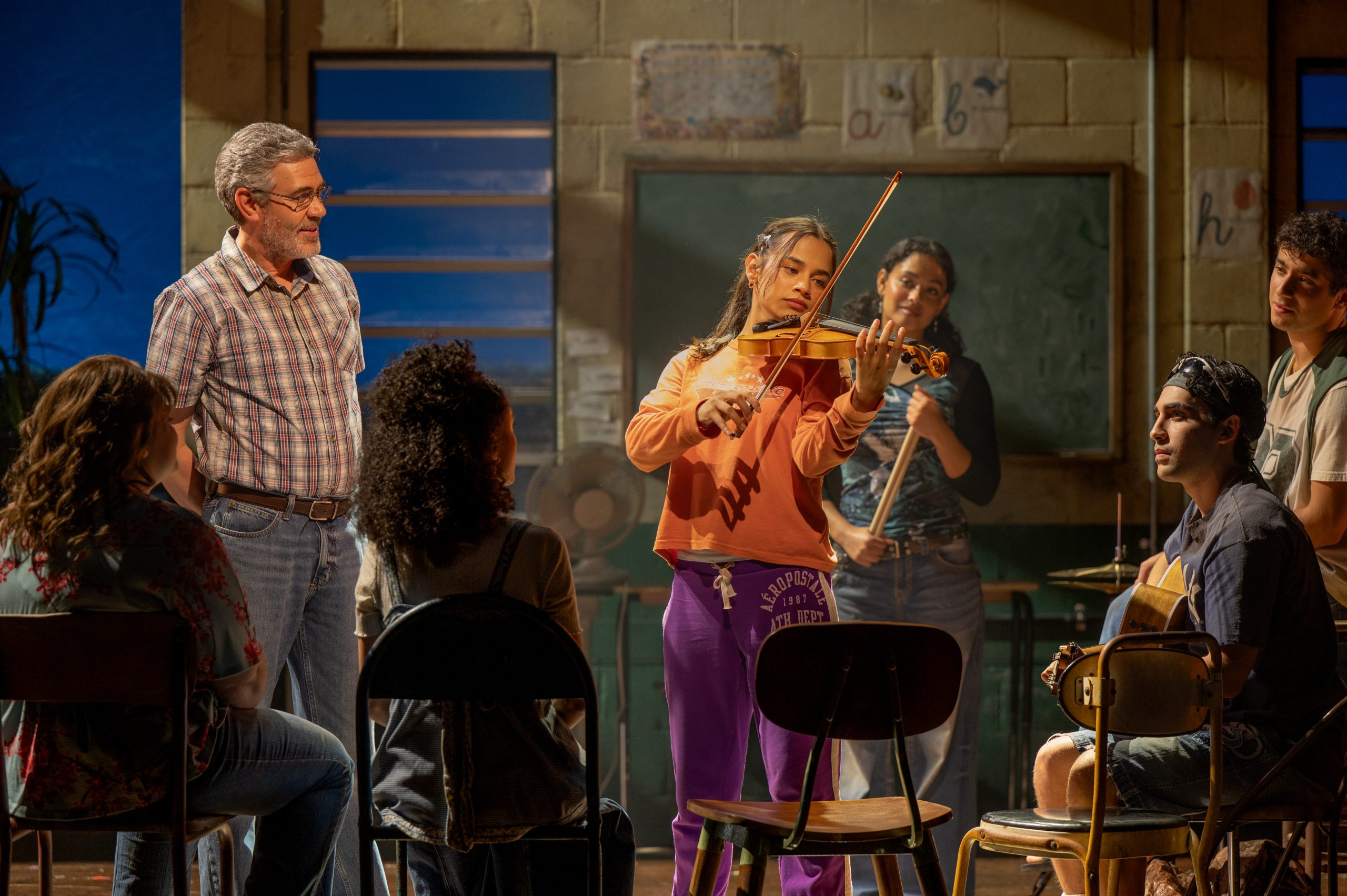
Protagonist Nambi’s only escape is listening to classical music, a passion she shared with her late father. When the optimistic Mario begins offering free music classes to the youths of Cateura, Nambi jumps at the chance to finally pursue something outside of scavenging garbage. When the group’s instruments are stolen, they adapt by making new instruments out of recycled materials from the landfill. Friendships form, and the orchestra members find themselves with an opportunity to lift themselves out of their current circumstances.
The bones of the story are familiar: A well-meaning educator galvanizing a group of disparate teens around a mutual love of the arts is a surprisingly well-trod template. What sets Basura apart is the environmental and class commentary inherent in its centering of the people and things that we treat as disposable. Karen Zacarías’ book digs into the idea that beauty and hope can be found in even the most unlikely of places, while also integrating themes of familial trauma and governmental neglect.
The script could go deeper into these subjects, but such explorations are somewhat limited by its sentimentality. Zacarías is interested less in issuing a call to action and more in showing how determination and community can enable the inhabitants of Cateura to find pockets of joy in an otherwise difficult life.
She is aided by the emotional score, composed by the mother/daughter team of Gloria and Emily Estefan, with orchestrations by Tony Award winner Alex Lacamoire. At times percussive and lively and at others somber and reflective, there is an earnestness that permeates the score and augments the aforementioned sentimentality. Ballads like the emphatic “I Wanna Run” and the more delicate “I Can Hear the Stars” are particular highlights.
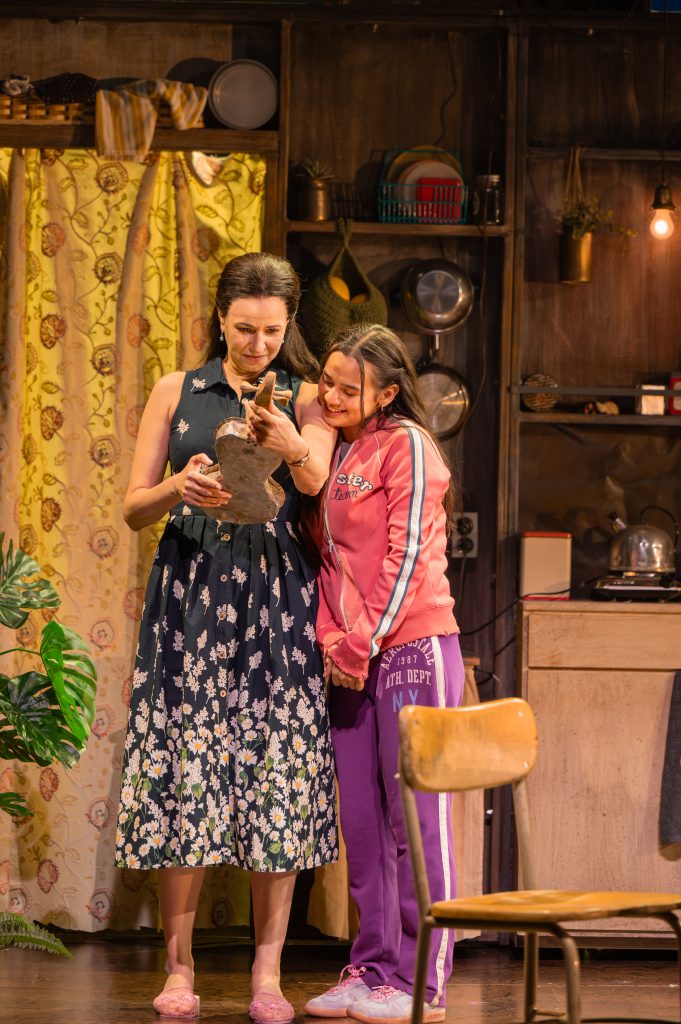
The cast is strong all around. Jaci Calderon gives a breakout performance as Nambi, radiating an openness and vulnerability that makes it very easy for the audience to connect to her. She is contrasted by the superb Mandy Gonzalez, who brings sharp edges and a powerhouse voice to Nambi’s cynical and disillusioned mother, Mónica.
Kevin Del Aguila is a perfectly affable presence as music teacher Mario, though he is perhaps the most underserved by the script, which never fully explores his personal life or his motivations for establishing this orchestra.
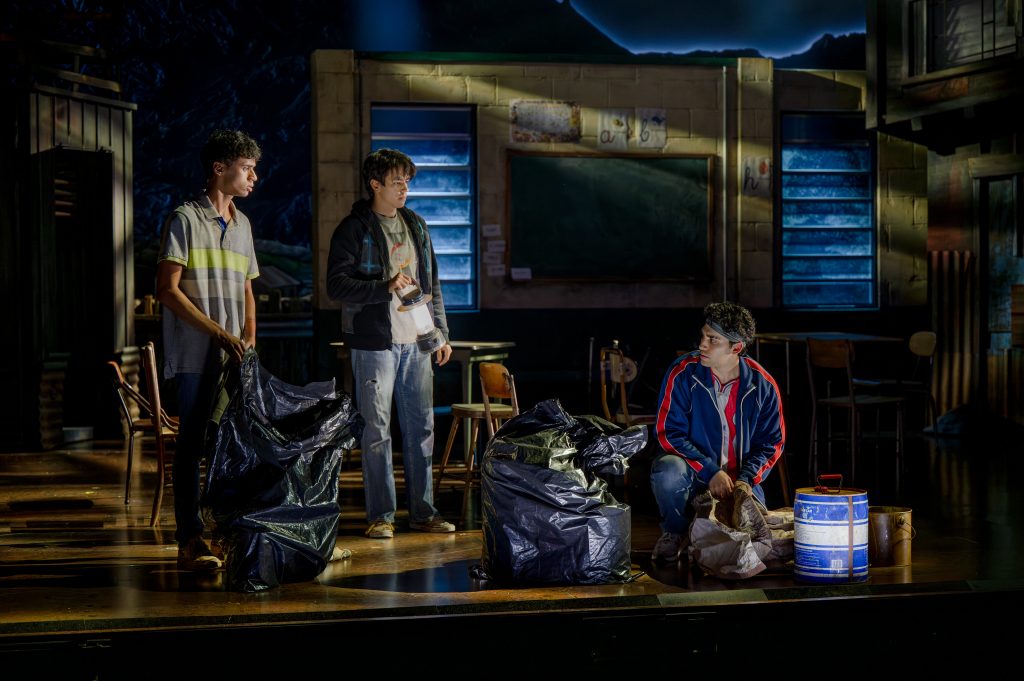
The rest of the students fill their roles well. Zack Calderon is a standout as Nunu, an unhoused boy who comes up with the idea to make their own instruments. The script never specifies if Nunu is neurodivergent, but the eccentric charm of Calderon’s performance would seem to suggest it. Meanwhile, Dario Alvarez, who plays the guarded and sarcastic José, carries one of the play’s most impactful moments.
It is the relationships between these students, second only to Nambi’s relationship with her mother, that anchor the play. This is, at its core, a story about how a community can come together and uplift one another through times of hardship, and seeing the tenderness that evolves between the members of the Recycled Orchestra is what gives Basura its emotional weight.
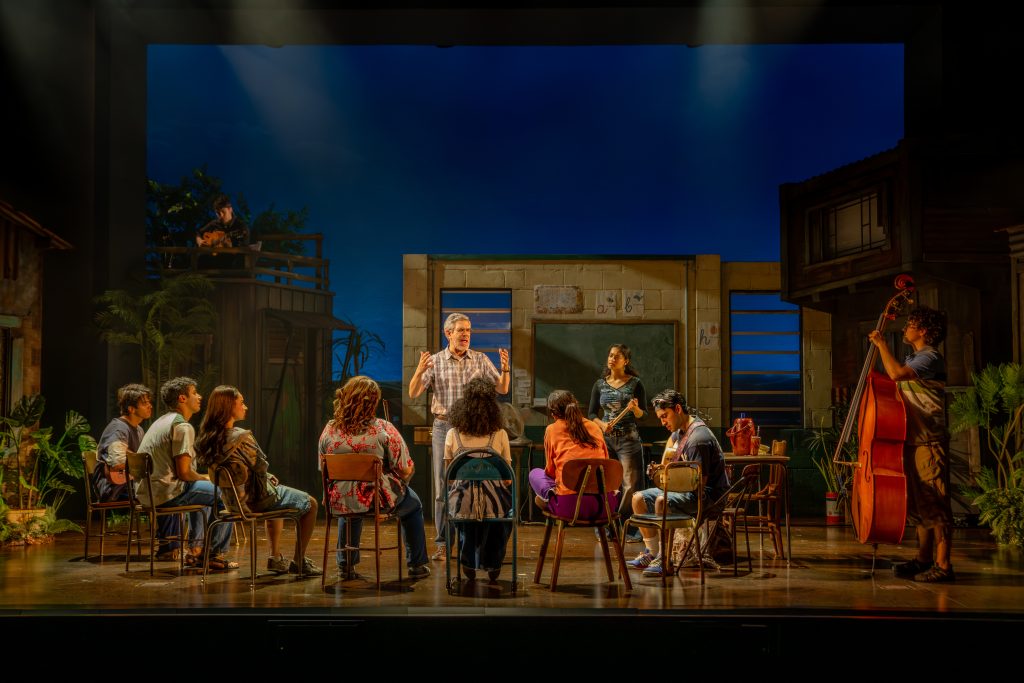
Director Michael Greif and the design team help to deepen this sense of community by giving the setting of Cateura a deeply lived-in feel. Costume designer Dede Ayite dresses the actors in a range of shabby and well-kept clothes, many of which look like they were likely pulled out of the landfill. David Korins creates multiple rotating sets to evoke the characters’ modest but cherished homes. As for Greif, he directs the cast with a sensitivity to detail, creating small background moments with various members of the orchestra so as to enhance the sense of familiarity between them.
There are moments where the careful balance between the play’s light and hopeful tone and its more grim backstory does falter. To state the most obvious example would unfortunately be too big a spoiler, but it is disappointing to see the conflict between Nambi and her mother, which is rich and emotionally complex, resolved so quickly in the name of a happy ending.
In these ways, Basura does not quite live up to its full potential. However, as a story about the importance of community and collective joy and, more importantly, about finding the beauty within the imperfect, Basura definitely hits the right notes.
Where and When
Basura is at the Alliance through July 12. Tickets start at around $60 and depend on seating.
1280 Peachtree St. NE.
::

Luke Evans is an Atlanta-based writer, critic and dramaturg. He covers theater for ArtsATL and Broadway World Atlanta and has worked with theaters such as the Alliance, Actor’s Express, Out Front Theatre and Woodstock Arts. He’s a graduate of Oglethorpe University, where he earned his bachelor’s degree, and the University of Houston, where he earned his master’s.
STAY UP TO DATE ON ALL THINGS ArtsATL
Subscribe to our free weekly e-newsletter.

PLEASE SUPPORT ARTSATL
Your Gift Sustains the Coverage You Count On!
Related Posts