
Review: Choreographers shine on stage and film in Dance Canvas showcase
TereLyn Jones’ dance film Prisoners of Time, one of eight works presented by Dance Canvas at Ferst Center for the Arts Friday, was the only dance film on the program, and it came into being because of time itself.
Jones was to have presented Prisoners of Time live on the Ferst stage as part of the March 2020 Dance Canvas showcase, but the Covid lockdown shuttered the event days before the premiere. In the ensuing two years, Jones decided she had time to reimagine it as a film. Her pivot inspired Angela Harris, the indefatigable executive artistic director of Dance Canvas, to develop a dance-on-film initiative. She too had the time. The first creations in this project were screened Thursday night, also at the Ferst.
Dance on film, historically a little developed field, has come of age in new and exciting ways. The Covid shutdown, when dancing outdoors or on film were the only options, dovetailed with today’s easy access to video equipment and the emergence of screendance training.

The first class of the Dance Canvas: on Film initiative comprised Chantené Doss, Dana Sokolowski and Veronica Silk. Their films were screened Thursday along with Glitch by software engineer and Spelman graduate Thulani Vereen. (The making of Glitch predated the Canvas film program and, like Prisoners of Time, helped inspire it.)
Glitch is a darkly haunting take on the story of Plato’s cave. A black-clad dancer (Vereen) is shot in low lighting, her hunched form on a concrete floor, her fingers taking tentative “steps” before pulling back. Cut to a dramatically different scene: Now in a long white dress, she stands in brilliant sunshine next to a river, as if discovering the “real” world for the first time. It is these kinds of cuts and images that dance on stage can never render.
Sokolowski’s deeply emotional, narrative film Who Sits Beside Us in The Bath, focuses on a woman’s grief over the loss of her mother and has similar, highly effective jumps in time and place. She hired a crew big enough to create impressive production values.
Doss, who filmed In Her Mind herself, was inspired by gymnast Simone Biles’ withdrawal from the Olympics and the ensuing backlash. Simpler production values don’t detract from soloist Deonta Featherston as she spreads colored paints on her arms, hands, face and across a white backdrop, as if giving expression to her emotions.
Of the four films, Silk’s Magic That I Am is the most like a single-setting music video – a group of dancers, mainly women in brightly colored silky dresses, move sensually and confidently as a voice-over by Chastity Hart takes on featurism and celebrates Black beauty.
Britt Whitmoyer Fishel, a Dance Canvas alumna, created the screendance program for Bryn Mawr College and is a professor at Drexel University. Now Dance Canvas’ screendance consultant, she reminded Thursday’s small but enthusiastic audience that dance film is permanent, while dance on stage is ephemeral.
On Friday, however, we experienced how powerful the ephemeral can be: that wonderful in-the-moment connection between dancers and audience; the joy of watching three-dimensional bodies move through three-dimensional space; the thrill of seeing a dancer emerge from the wings in unexpected ways.
Each work was prefaced by a brief video in which the choreographer described his, her or their concept and inspiration. Seven of the eight works were firmly in the contemporary dance realm, but Rapture’s Eve, created by husband-and-wife team Zach and Dorinda Walker, celebrated hip-hop.
While not the most innovative work of the evening, it was by far the most joyous — five dancers in jeans and white sneakers moved to the sounds of Miles Davis and ultimately raised their clasped hands to the sky.
Highlights of the evening were Enrique Villacreses’ Rinne Tensei, a compelling duet for Stephanie Perez and Rafael Ruíz-Del-Vizo, and Vereen’s The Permutations of Humanity. Her movement vocabulary was inspired by watching people in a MARTA station.
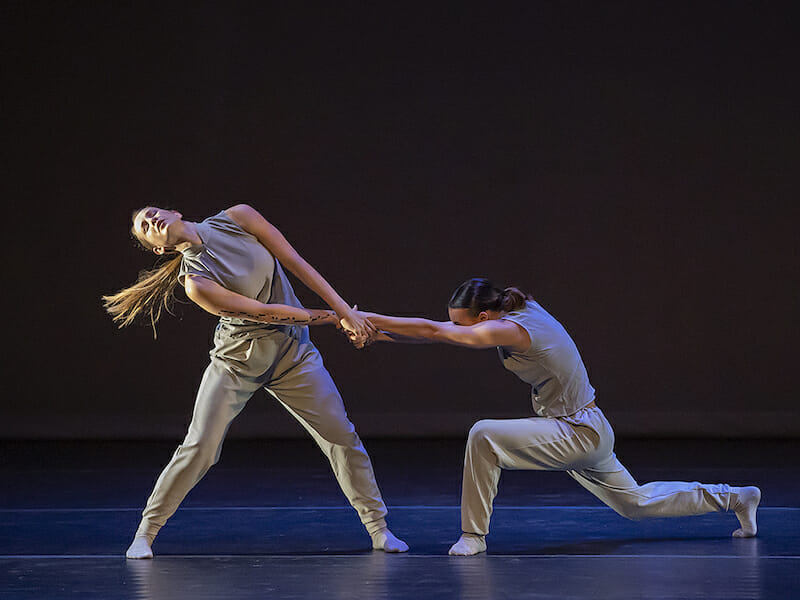
Rinne Tensei opened with an empty stage and the haunting voice of a soprano. Suddenly the two dancers fell into the space, one from each side of the stage. They crawled, rolled and slid along the floor. As the work progressed, they became like wild and wary creatures, eyes locked, muscles tensed, facing and sparring with one another.
They climbed on and over one another until finally he lifted her onto his shoulders. Facing the rear of the stage, he walked away into darkness while she slowly looked back at the audience. It was those small touches — a turn of the head, a finger pointing — that gave Villacreses’ minimal movement vocabulary mystery and depth.
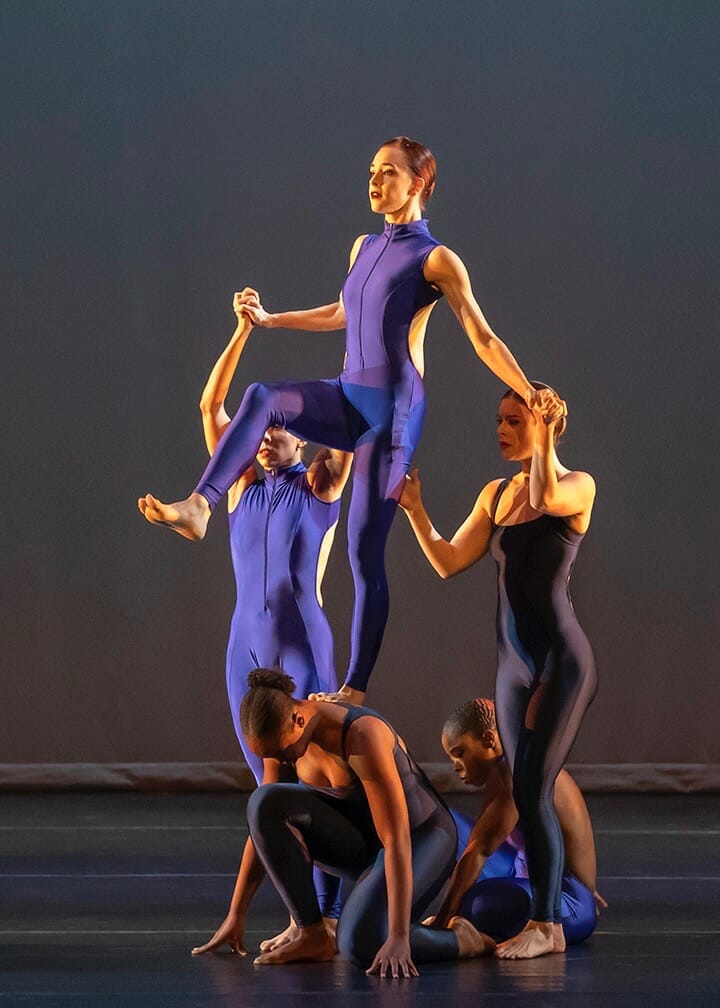
Permutations featured five strong female dancers in a beautifully structured work punctuated by individual penché arabesques and extensions, languid arm waves, and groupings that repeatedly came together and flew apart. The sound score included Philip Glass’ Akhnaten played at double the intended speed. Erin Burch and Cassie Broussard were standouts.
Atarius Armstrong’s Cabbage in the Concrete featured a series of beautiful leaps that emanated from low lunges and a long, languid front extension by one dancer that shifted the energy. A highlight was an innovative, linear tableau of intertwined bodies. The work evolved from a feeling of isolation in a crowd to three dancers, each cradling another in his or her arms. Notable for both technique and presence were Audrey Crabtree and Dominique Kinsey.

Patsy Collins’ concept for SWARM was the fight-or-flight response. The evocative opening — seven dancers in a tight group center stage, lit from above and swaying from side to side — progressed to sections of unison movement and body contact. Every once in a while, one dancer would leave the group, as if fleeing from a stressful situation.
Dara Nichole Capley’s f..-.r.-.o–n-.t-i..e.r.-. featured five dancers “faking” emotions with forced smiles (set to “Sunshine, Lollipops and Roses”) or holding a hand over the face, a gesture maybe of grief or a denial of reality.
Choreographer Monica Hogan Thysell recently moved to Atlanta from New York, and her company, Monica Hogan Danceworks, performed her latest work, bend to break. The movement vocabulary emphasized weight, the pull of gravity.
Some works looked more cohesive and better rehearsed than others, and the technical level of the dancers varied. But the overall quality demonstrated that Atlanta’s pool of talented emerging choreographers and dancers is becoming deeper, stronger and more diverse each year.
Harris has been a driving force in that growth, giving dance makers the resources to create, along with an annual performance platform and now a film program. Atlanta is lucky to have her.
::
Gillian Anne Renault has been an ArtsATL contributor since 2012 and was named Senior Editor for Art+Design and Dance in 2021. She has covered dance for the Los Angeles Daily News, Herald Examiner and Ballet News, and was dance critic on radio stations such as KCRW, the NPR affiliate in Santa Monica, California. In the 1980s, she received an NEA Fellowship to attend American Dance Festival’s Dance Criticism program.
STAY UP TO DATE ON ALL THINGS ArtsATL
Subscribe to our free weekly e-newsletter.

