Review: ASO rings in the season with the potent hymns of Handel’s ‘Messiah’
Way back in 1818, Boston’s Handel and Haydn Society — devoted to music of the old masters — gave the U.S. premiere of Handel’s Messiah. Although the three-hour oratorio was meant for the Easter season when it premiered in 1842 and remained a fixture of Britain’s Holy Week throughout the 18th century and beyond, Boston first heard it at Christmastime, where it’s remained firmly planted ever since.
Handel was a practical composer, and, as with most of his music, he revised Messiah each time it was performed in his lifetime, tailoring it to the available singers and instrumental forces. That there’s no “definitive” version, perhaps contributed to its plasticity. As Britain’s empire and wealth grew, so too did Messiah. Victorian-era productions swelled to elephantine proportions in gigantic spaces, with a thousand performers blasting away on the oratorio’s three-part commentary on the Nativity, Passion, Resurrection and Ascension. As a critic once observed, the work transformed from Handel’s ideal of a sublime “musical entertainment” to a “religious and patriotic totem.”
But Messiah, like A Christmas Carol or The Nutcracker, is high art of the season, an all-but-indestructible evergreen. These works are also, to use the vulgar term, a “cash cow” — a work so popular and festive that arts organizations, perpetually strapped for cash and looking to keep costs low, can come to perform them almost by rote.
If you think about it, once you (and your audience) are committed to Messiah at Christmas, performing the complete work with all that non-Christmassy stuff doesn’t really make sense. So you cut two-thirds of the score, tack on the built-in standing ovation “Hallelujah,” and it’s a win-win: marketing is a snap; the evening is shorter; less rehearsal time is needed; there’s no overtime costs for the orchestra; the audience, forgetting what the full score sounds like, is satisfied; rinse and repeat.
Perhaps the only meaningful tradition that keeps this model afloat is that it does good box office.

Thursday in Symphony Hall, the Atlanta Symphony Orchestra returned to its own performance traditions for Messiah. Since its abbreviated Handel lasts just an hour, the concert’s first half was J.S. Bach’s Christmas Oratorio — or, more precisely, just the first cantata of Bach’s three-part work.
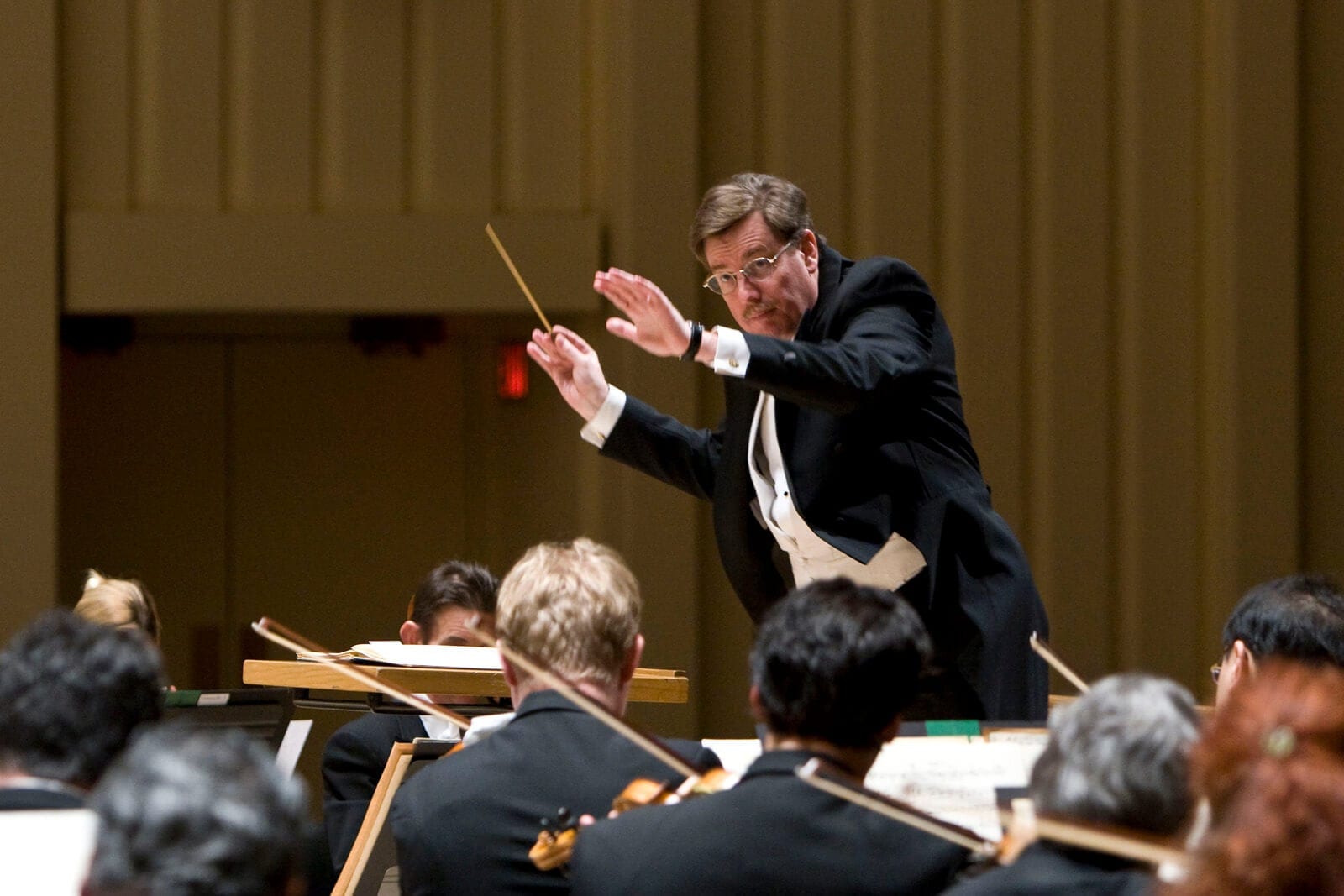
For many years, this show has been conducted by ASO Choral Director Norman Mackenzie, who slims down the ensemble to sort-of Baroque proportions. He gets most of the string players to use vibrato sparingly and use the bow more lightly, and gets the woodwinds to add zest and brilliance to their phrasing.
They were quick to warm up. The opening orchestral sinfonia was a bit chunky and hesitant until, in the nimble fugal section, the musicians loosened up and listened to each other as much as watched their conductor’s baton. Mackenzie has gravitas as a conductor, and he gave this little overture a sense of direction and purpose, carrying the weight of the ideas and images that were to come.
Last time I heard Mackenzie in this music, a few years ago, his reading of act 1 — called “Part the First” in the score — was rather fussy and distracted by mannerisms. This year, he’s streamlined his approach, with high spirits and minimal shaping, letting the music and the expression unfold organically. Each of the celebrated choruses and arias flowed, mostly, although, as he approached the end of each movement, he tended to slow way down and drag the harmony to its resolution with unnecessary grandeur. Then he’d leave a small but unwelcome silence before jumping with vigor and vim into the next section.
Yet there’s an odd tension in Mackenzie’s interpretation. On the one hand, he’s interested in treating Messiah properly, in Handel’s style of Baroque opera, which runs straight through without gaps and — this is key — where the music’s dance rhythms are at the fore. On the other hand, he likely has a lifetime of experience conducting Bach and Handel as church music, in all its sobriety and solemnity. The struggle was audible and led to conflicting musical priorities.
Perhaps unique in Handel’s vast opera and oratorio output, the vocal soloists in Messiah are assigned no names and have no roles to play. Finnish-American tenor Miles Mykkanen, with a blossoming international career, sang “Comfort ye” with operatic drama and charisma. On the line, “The voice of him that crieth in the wilderness,” he almost shrieked “wilderness” — a wonderfully raw and utterly theatrical delivery. Later in his lone aria — the tenor gets just one in this abbreviated version — Mykkanen’s rapid runs were beautifully controlled, his high notes clear and almost boyishly charming.
Lawson Anderson, a booming bass, was a big discovery at these ASO holiday concerts a few years ago, and he’s now more polished, more commanding. His word painting was thrilling when he sang “I will shake the heavens,” repeating that key word with the jarring force of an earthquake. He was at once beautifully lyrical and a little menacing for the aria “The people that walked in darkness have seen a great light.”
The soprano listed in the program, Maria Valdes, an Atlanta favorite, was ill. There was no program insert to announce her replacement, Adelaide Boedecker, with a clear and light soprano. She’s local, too, a staff singer at St. Luke’s Episcopal Church in Midtown, among other high-flying activities. Her pretty voice had a pastoral freshness and simplicity, perfectly reflecting text like “There were shepherds abiding in the field” followed by a radiant “And suddenly, there was with the angel.” You believed her wide-eyed wonder at this Nativity scene.
Alto Kelley O’Connor is perhaps the starry singer we hear most often in Symphony Hall: Her rich, caramel-colored voice has portrayed everyone from poet Federico Garcia Lorca (in Osvaldo Golijov’s 2003 opera Ainadamar) to the naughty brother in Hansel and Gretel and much in between. Thursday she was in splendid form and “O that tellest good tidings to Zion,” gorgeously delivered, was one of the evening’s hold-your-breath moments.
But, as always, when the ASO Chamber Chorus sings — some 45 voices strong — they somehow become the stars of the show. “And He shall purify” and “For unto us a Child is born” and “Glory to God in the highest” — these are the potent hymns that keep us coming back, century after century, to Messiah.
The program repeats tonight, December 15, at 8 p.m.
::
Pierre Ruhe was the founding executive director and editor of ArtsATL. He’s been a critic and cultural reporter for the Washington Post, London’s Financial Times and the Atlanta Journal-Constitution and was director of artistic planning for the Alabama Symphony Orchestra. He is publications director of Early Music America.
STAY UP TO DATE ON ALL THINGS ArtsATL
Subscribe to our free weekly e-newsletter.

PLEASE SUPPORT ARTSATL
Your Gift Sustains the Coverage You Count On!
Related Posts