Review: ASO, Nathalie Stutzmann open season with high voltage charisma
Nathalie Stutzmann had a rather spectacular spring and summer, garnering rave reviews for her Mozart at New York’s Metropolitan Opera — Don Giovanni and The Magic Flute — and, in Germany, for Wagner’s Tannhäuser at the Bayreuth Festival. Newspaper and word-of-mouth reviews for her opera conducting ranged from high praise to ecstatic. One friend, an experienced and often cynical musician, attended the Met’s Don Giovanni. Under her baton, he said, it was “one of the most profound experiences” he’d ever had at the opera.
She has that effect on many listeners. A star contralto-turned-conductor, her international career on the podium continues to accelerate.
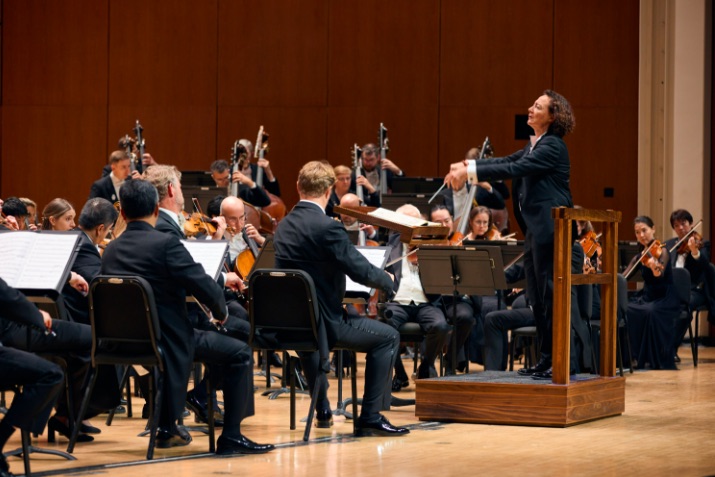
Closer to home Thursday evening, Stutzmann opened her second season as the Atlanta Symphony Orchestra’s music director with a Russian program: three Tchaikovsky favorites — the Queen of Spades: Overture, the waltzing polonaise from Eugene Onegin and the Symphony No. 4 — plus a recovered harp concerto from the darkest years of the Soviet Union.
ASO Executive Director Jennifer Barlament started us off with a welcome to the orchestra’s 79th season. A moment later, Stutzmann strode to center stage, arm held high to the roll of the snare drum, and we stood for “The Star-Spangled Banner.” She conducted the orchestra in elegant, sweeping gestures, light and airy, and turned to conduct the audience, too. With high-voltage charisma, when she smiles at the crowd and puts hand to heart in thanks, you feel like she’s communicating directly with you. When the moment is right and the music is powerful, it can give a little shiver.

She led the overture and polonaise as one connected work, with brassy heft and, for the ballroom dance, with a bit of swing and impressive force of personality.
Immediately we heard a slightly different sound from the orchestra than usual: She’d re-seated the viola and cello sections, putting the low-voiced cellos closer to center stage. And several large panels of Symphony Hall’s acoustical shell were removed, perhaps to allow harsh higher frequencies to float away and out of the sonic mix. On first hearing, it seemed an improvement. (Last season, with limited success, she also experimented with seating the string sections in different configurations. With the hall’s notoriously crappy acoustics — for the musicians on stage and ticket-buyers in the auditorium — it’s an unending challenge.)
Stutzmann and virtuoso French harpist Xavier de Maistre recorded the Harp Concerto by Aleksandr Vasilyevich Mosolov (with the West German Radio Symphony, on the Sony Classical label) and have been performing it all over.
In Atlanta, we hear a lot of music by Mosolov’s celebrated contemporary, Dmitri Shostakovich, who narrowly avoided Stalin’s wrath and the gulag but lived and composed on a creative knife edge — expressing himself honestly but aware that a wrong musical move could have him arrested — maybe killed.
Mosolov wasn’t so lucky. He started his career as a futurist and a brutalist, with a reputation for industrial-sounding dissonant music. (There’s a YouTube video of his “Iron Foundry,” from 1927, in a performance by the San Francisco Symphony and the heavy metal band Metallica.) He was a leader in the young republic’s avant-garde.
But in 1937 Mosolov was imprisoned then exiled into rural Russia. Along the way, his attitude and art changed, settling into a backward-looking, late-Romantic style favored by the authorities. The Harp Concerto, from 1939, reflects this safe, conservative voice. The complete work received its belated world premiere only in 2019.
But Mosolov was a true talent, and the four-movement concerto is brimming with ideas and clever interplay between soloist and orchestra. De Maistre’s harp was heavily amplified, making it as loud as a 9-foot Steinway. The score offers tender and attractive solos for woodwinds — first bassoon, then oboe, clarinet and more — and even the tinkly celeste gets its turn.
Yet the most compelling parts were for solo harp. De Maistre gave them an improvisatory feel, almost hallucinogenic. There are long moments of Tchaikovskian lyricism and what seems like Central Asian folk dance rhythms. Throughout, the composer never resorted to harp cliche: Even at its most dreamy, the instrument here is never superficially perfumed or naively angelic.
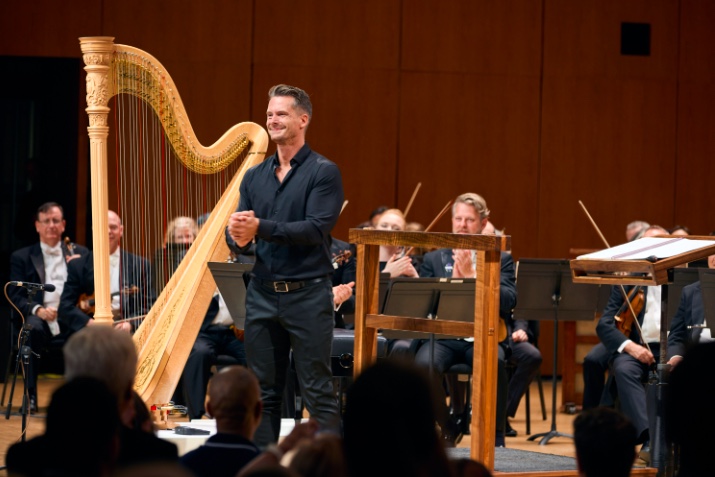
The finale is restless and scurrying. Stutzmann took it at a racing tempo. It was easy for de Maistre, playing a rapid-fire flurry of brittle notes at the top of his range, but difficult for the ensemble, who were barely hanging on. Mosolov’s Harp Concerto is an attractive, wonderful revival of forgotten work.
As an encore, de Maistre returned for “Carnival of Venice” variations, an old folk tune that, for centuries, has proved infinitely malleable. In Félix Godefroid’s 1880 version, the harpist deploys every manner of advanced harp technique, gossamer and soaring and finishing with a showy flourish. The audience ate it up.
But as can happen at a Stutzmann concert with the ASO, one part of the program is well prepared and strongly argued, and the other part not so much.
After intermission, for Tchaikovsky’s Symphony No. 4, the energy and discipline flagged in spots, with some flubbed solos and a couple of miscues. Instead of taut and intense, long sections felt under-rehearsed and a little rambling. Still, “Tchaik 4” is all but indestructible, and they muscled through till its blazing conclusion. The performance is certain to improve for Saturday’s show, which starts at 8 p.m.
::
Pierre Ruhe was the founding executive director and editor of ArtsATL. He’s been a critic and cultural reporter for the Washington Post, London’s Financial Times and The Atlanta Journal-Constitution and was director of artistic planning for the Alabama Symphony Orchestra. He is publications director of Early Music America.
STAY UP TO DATE ON ALL THINGS ArtsATL
Subscribe to our free weekly e-newsletter.

PLEASE SUPPORT ARTSATL
Your Gift Sustains the Coverage You Count On!
Related Posts