Review: Alliance’s “Dream Hou$e” is a rich take on pathos and price of gentrification
The phrase “if these walls could talk” takes on new, fascinating and poignant dimensions in the engrossing world premiere production of rising star playwright Eliana Pipes’ 2022 Alliance/Kendeda National Graduate Playwriting Competition-winning Dream Hou$e, now on the Alliance Theatre’s Hertz Stage.
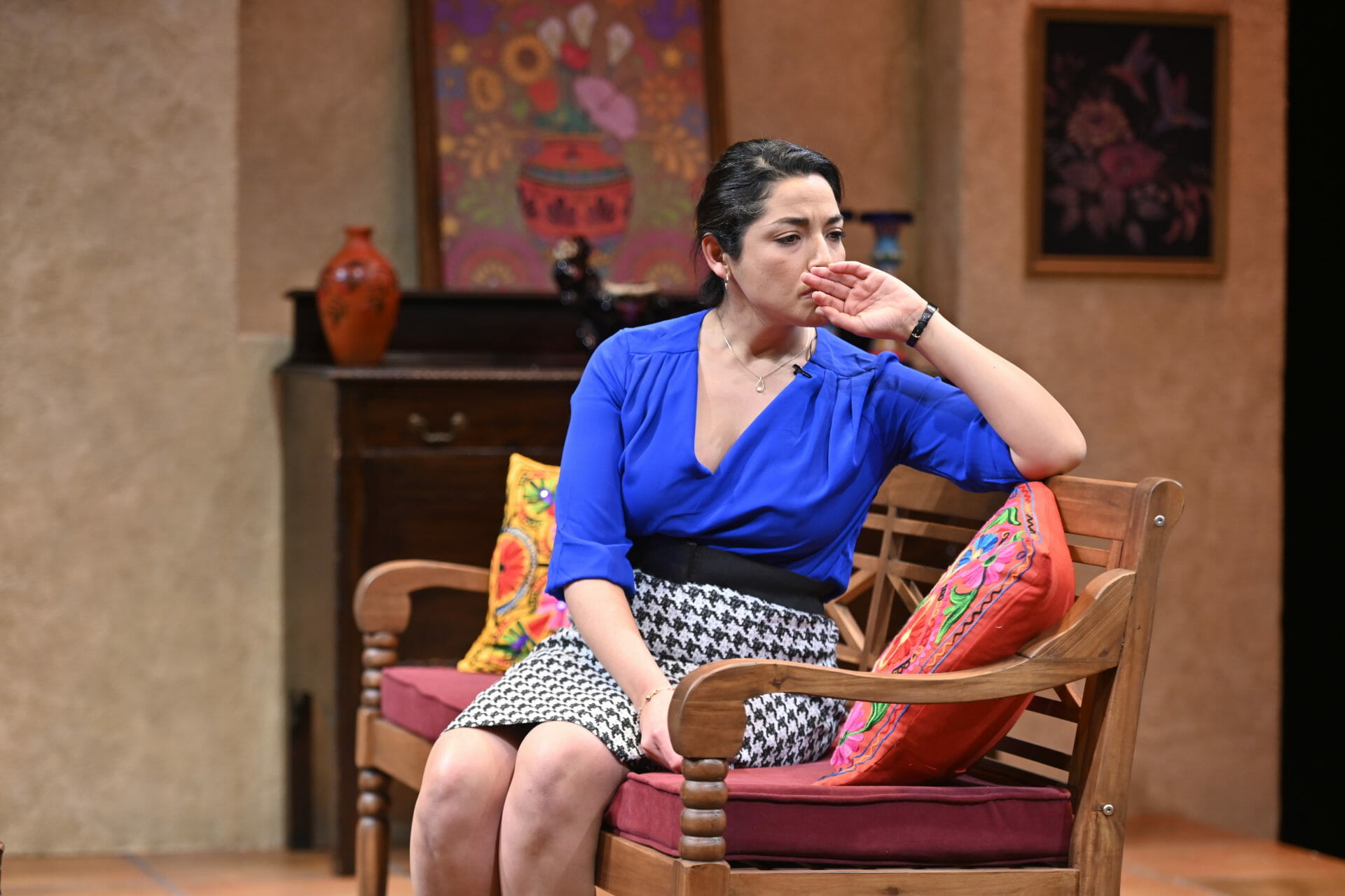
As the lights come up, we encounter Patricia (Jacqueline Correa) as she silently and anxiously packs up personal items in the living room — piling everything, from an empty ice cream carton to framed pictures of family members, into one single box. It’s an action anyone who has ever moved will recognize: the “dump everything and we’ll sort it later” phase. It’s also an early taste of the various ways in which this play asks what treasures we’re throwing out in the process of “growth.”
Patricia, along with her very pregnant sister Julia (played with warmth and vulnerability by Darilyn Castillo), has inherited the family home she’s packing up — situated in a newly hip neighborhood where prices are skyrocketing — following the prolonged illness and death of her beloved mother.
We later learn that, without much help from Julia, Patricia had put aside her accounting career to assume the caretaker role during their mother’s last months, and she’s crackling with bitterness about it. When Julia enters the scene, it’s at first stiff and awkward, and we soon learn it’s the first time the two have met in person since their mom died.
They’re now prepping the old house, built by hand by their great-great-grandfather, for sale. It’s not your typical transaction either. They’re selling through a cheesy HGTV-style show called Flip It and List It, which offers its contestants/home sellers the chance to “win big” through an elaborate “gut and tear” plan designed to give their house a complete makeover in the hopes of landing a massive payout.
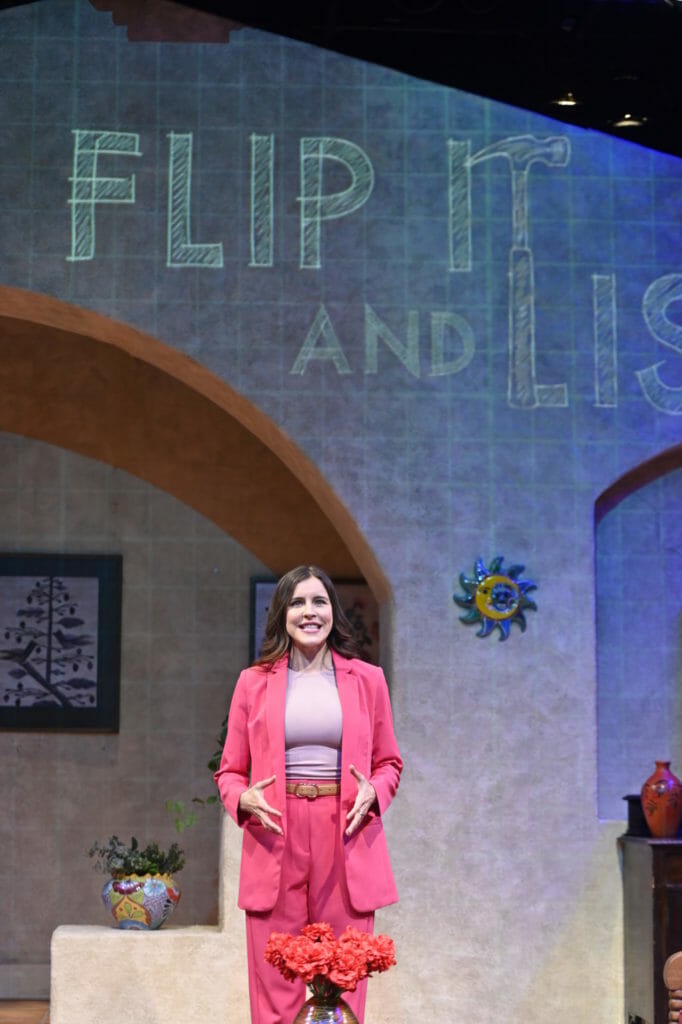
Of course, the risk is that if it doesn’t sell, those contestants and their big dreams are “on the hook for the renovation costs,” setting up some pretty major stakes right away.
“If we want to get a million, we need to look like a million,” Patricia says, straining to look happy amidst the turmoil of grief and uncertainty. Correa has a lot to do in this role, and she more than rises to the occasion, adding layer upon layer.
“We take run-down, rustic homes and turn them into sleek and sellable houses,” gushes the show’s host, Tessa, with the forced cheeriness of a realtor Nurse Ratched. As Tessa, Marianna McClellan has the showiest and funniest role in many ways, which she embodies with pitch-perfect sociopathic glee. She can turn on her earnest sympathy tone with the flick of a switch, goad the sisters into playing games that get increasingly invasive, and flippantly offer advice such as, “Treat the camera like the crew — tune them out, and you’ll never know they’re there.”
With the players and the game’s rules established, things soon begin to take a turn for the weird, in delightful and unpredictable ways that we won’t give away here. Suffice it to say, the twists and turns that Pipes has added to this 90-minute run (with no intermission) are worth going into unspoiled.
In the program, the show notes submit that the play asks: “What is the cultural cost of progress in America?” But Pipes’ writing probes deeper than that, following up with even tougher queries, such as: “What even constitutes progress if we’re losing so much in the process? And who is benefiting? And where are we progressing to?”
As Pipes herself has noted in interviews, audiences in each city where this show runs will draw a natural connection to the city they live in and the changes in the fabric of who lives there. In the play, there’s an extended dialogue about how the formerly named “Hilo Villa,” Spanish for “thread town,” due to the textiles industry that used to be centered there, has now been given the snappy moniker “Hi Town.” That’s mainly because the new well-to-do residents get neither the original pronunciation nor the historical roots.
Atlanta audiences may think about how multiple already-named areas of Atlanta’s westside have been lumped under the non-descriptor of “West Midtown” in recent years. Or they may think about how the average price of a home in metro Atlanta is now estimated to be around $355,000, up 22 percent from just a year earlier. When terms like “red hot” get thrown around to describe a largely unaffordable housing market, it belies the pervasive hardship sitting in the shadow of the real estate boom.
Many excellent plays have tackled the issue of gentrification — notably Clybourne Park, the 2010 spinoff of Lorraine Hansberry’s groundbreaking A Raisin in the Sun, which centers on a neighborhood in Chicago before and after the events in Raisin. But, as deftly directly by Laurie Woolery, there’s a freshness and an intimacy to Dream Hou$e that allows it to inhabit its own space.

The play, which Pipes wrote while earning an MFA from Boston University, originated from two autobiographical themes. First was her experience as a young teenager when her family sold their house in Culver City, a now beyond-fancy area of Los Angeles that’s home to studios, swanky restaurants and Amazon. But also, from her experience as an artist of color (she is Black, White and Puerto Rican), being “asked to sell my cultural pain for money” in predominantly white spaces.
My only significant critical note about this show is that the ending feels unfinished — much like the renovations process. In fact, in a Q&A after the performance I attended, Pipes shared that she had rewritten the last section several times, making tweaks even up until that very morning.
Shows don’t have to be perfect, though, and seldom are. In fact, some of the most brilliant entries to the theatrical canon have flaws and creaks in their floorboards. It’s the ones that frame things in a new light through intelligent, empathetic storytelling that stick to your bones, and this is one such play, unfinished ending and all.
::
Dream Hou$e continues through February 13, after which it will continue its three-city premiere by moving on to Baltimore Center Stage and Long Wharf Theatre in New Haven, Connecticut. Alliance audience members are asked to provide proof of vaccination or a negative COVID-19 test and wear a mask throughout the show.
::
Alexis Hauk has written and edited for numerous newspapers, alt-weeklies, trade publications and national magazines including Time, the Atlantic, Mental Floss, Uproxx and Washingtonian magazine. Having grown up in Decatur, Alexis returned to Atlanta in 2018 after a decade living in Boston, Washington, D.C., New York City and Los Angeles. By day, she works in health communications. By night, she enjoys covering the arts and being Batman.
STAY UP TO DATE ON ALL THINGS ArtsATL
Subscribe to our free weekly e-newsletter.

PLEASE SUPPORT ARTSATL
Your Gift Sustains the Coverage You Count On!
Related Posts