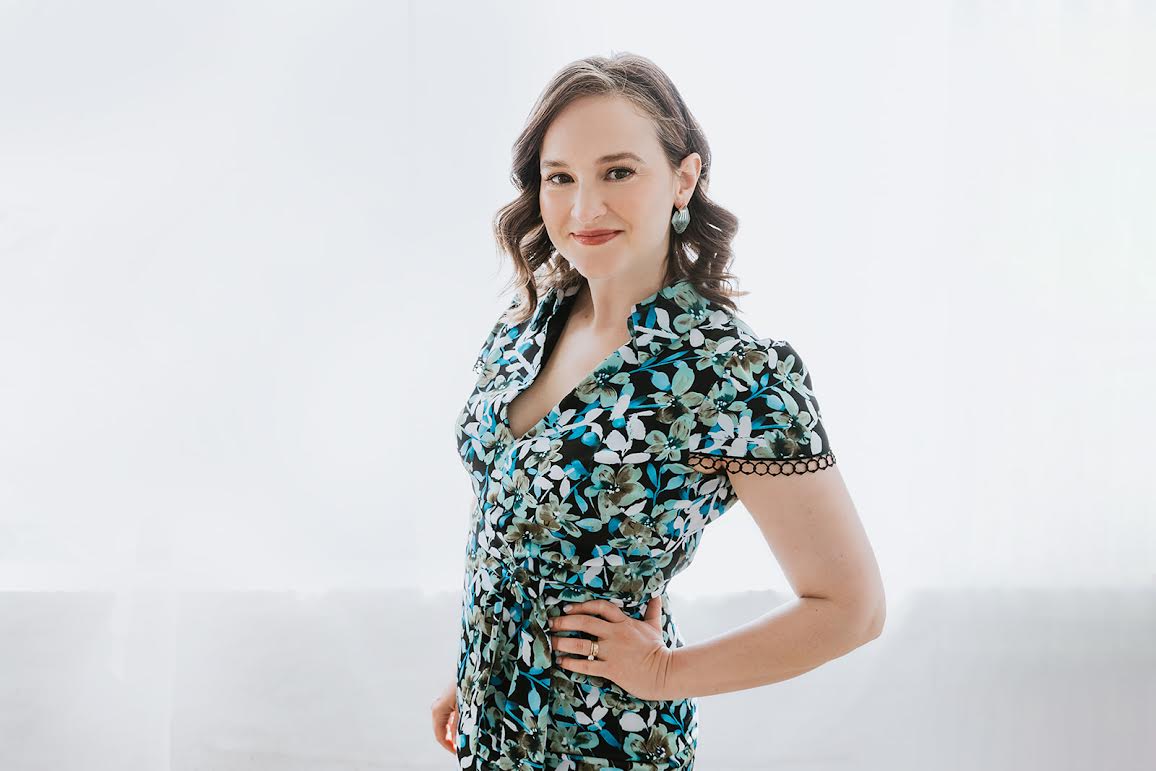
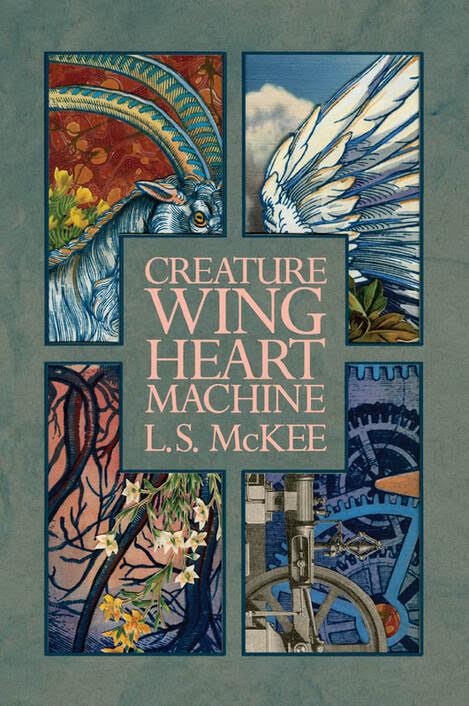
Poet L.S. McKee explores tensions of love in an era of AI and technology
There’s a friction in L.S. McKee’s debut poetry collection, Creature Wing Heart Machine (Zone 3 Press), between the visceral and the mechanical, the somatic and the cerebral, the body and the algorithm. She weaves whole worlds inside these tensions, worlds where the “whirring machine” of the flesh “sings a silent, canary-throated song,” where a different kind of machine is “learned on all the lonesome data.”
Our guide through her techno-carnal landscape is Alva, a kind of alter-ego persona who “is and is not me,” writes McKee, who “could only add up to anything but me.”
Alva leads us through her heartbreaks and her online dates, her doctor’s appointments and emotional devastations. We begin with poems about the molecular particularity of a breakup and expand out across vast natural landscapes, across space and time. The daily minutia of Alva’s life feels small and ubiquitous as an atom, the ache of her longing, deep enough to swallow the whole universe.
In Creature, Wing, Heart, Machine — through Alva’s narrative poems and more lyric poems that pause and punctuate her journey — McKee wields figurative language with a fierce tenderness, another wrought tension, as demonstrated in these loose couplets from “Alva and the Complex Pool”:
As I said, I was only waiting, which, let’s face it,
is a kind of fire, but smaller. One rule of nuclear physics:
in collapse, there is light. Energy, like a rejected lover,
has to go somewhere.
In these lines, and throughout the collection, we see that physics is love is touch is tech. We see clock hands hiccuping, the green skins of avocados gripping against gravity. We see “bots gone rogue from the algorithmic cage of lovelessness.”
McKee, a former Atlanta resident, holds an MFA from the University of Maryland and was a Wallace Stegner Fellow in Poetry at Stanford University. She recently received a 2022 Mass Cultural Council Artist Fellowship Grant in poetry and a St. Botolph Club Foundation Emerging Artist Award in literature. She has also received scholarships from the Bread Loaf and Sewanee Writers’ conferences and has held residencies at the Hambidge Center for Creative Arts and Sciences, the Virginia Center for Creative Arts and Vermont Studio Center.
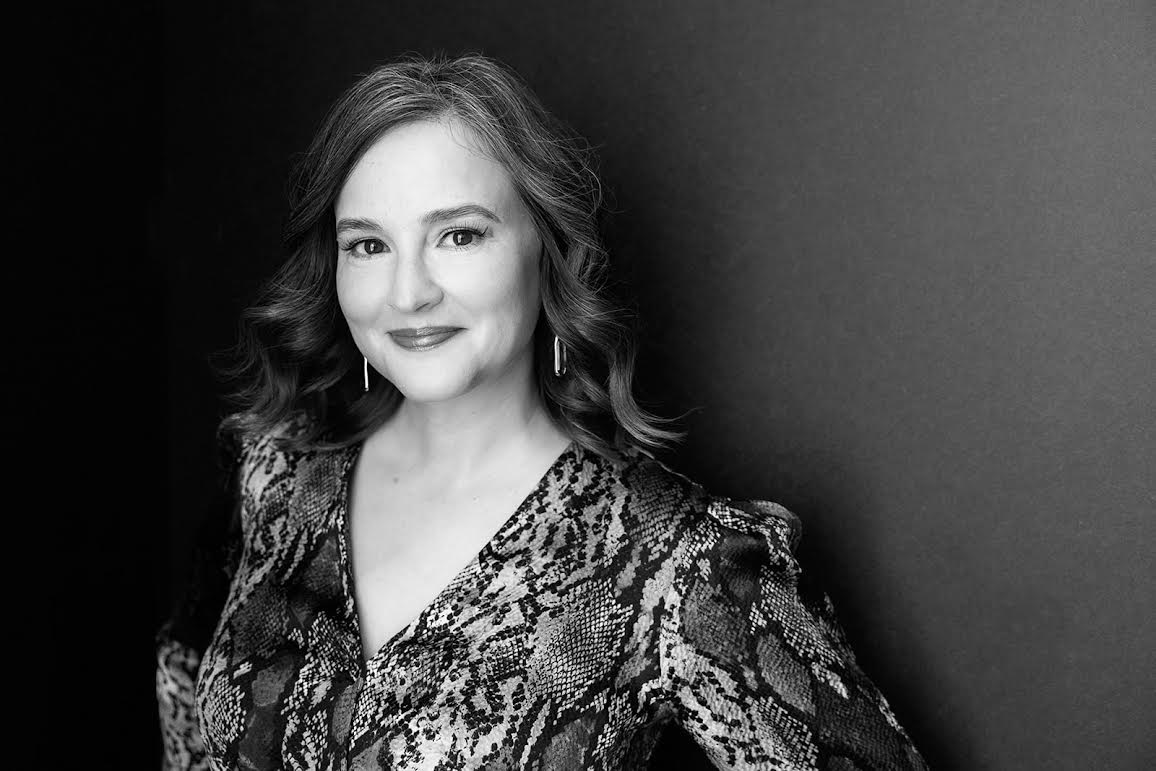
She is a former MIT professor and current coordinator of Writing Across the Curriculum at the University of Georgia. McKee spoke to ArtsATL about crafting this collection, the beautiful binary of desire versus surrender and the big questions poetry can help us answer.
ArtsATL: I’d love to begin by hearing about how you first came to poetry.
L.S. McKee: I think for a lot of readers, poetry is this kind of cryptic text. We’re usually presented with it only in the classroom, and I think that was my relationship to poetry. The texts that I had to engage with in classrooms, I never really enjoyed them that much. I always enjoyed fiction.
Then I went to UT Chattanooga. Rick Jackson and Earl Braggs. I took their workshops. They were both poets, and there was something about these workshops. I learned how to read a poem in a way I had never been taught — thinking about how poems create their own meaning and learning to read for the internal logic and structure of a poem versus always trying to decode it according to stuff that’s external to the poem.
A poem can hold us in an ambiguous space in a way that can be comforting and clarifying, even if we don’t walk away with an answer. I learned that in my undergraduate years, and I fell in love with poetry.
ArtsATL: As you were learning how to engage with a poem as a college student, in a way that feels more accessible to you, whose poems were you turning to?
McKee: As a younger poet, a lot of that had more to do with who was being taught at the time, so a lot of James Wright — someone who’s really important to Rick Jackson. And certainly Elizabeth Bishop, who is a presence, I think, in everybody’s reading history because she is able to write these really sharply wrought and focused poems that are incredibly expansive. They’re accessible but also really surprising.
Anne Carson’s work is also really important to me. When I feel lost, or feeling kind of a lack of inspiration, I always go back to her work, particularly Autobiography of Red.
Yusef Komunyakaa — he’s a brilliant writer. On the level of image, no one can kind of do what he does. And from a more regional standpoint, I really adore the work of Maurice Manning.
ArtsATL: I’d love to talk about the poems in Creature, Wing, Heart, Machine. We’re introduced to Alva on its first pages. How did she first appear to you?
McKee: She and I have had a long relationship.
Going back to Anne Carson, I really love epic poetry — contemporary epic poetry, but also the classics — because it’s poetry with a narrative pull. I love fiction, and I write fiction sometimes, but, as a reader of poetry sometimes I miss that. I miss having the sense that there’s some sort of narrative pull and also the figure of a character.
So intellectually, I was always interested in doing that. For a while I thought, “Maybe I’ll try to write a long narrative poem, an epic poem.” And that’s how Alva started, probably in 2011.
I thought it’d be a historic piece. I’m from northeast Tennessee, and I was exploring setting a character in WWII Appalachia. Just working through some research, I started to shape that character a little bit, but she was totally different. She was living in 1940s Appalachia. At the same time, I was trying to write about things that were going on in my life, and, slowly, the two projects started to converge.
Somewhere around 2015, I dropped the premise of the overtly fictionalized, historical character, and Alva became more of this persona character grounded in our contemporary world.

I didn’t set out to create this character in the way that I did. I failed through a few versions of what she might be. The book, Alva, was probably, from beginning to end, like a 10-year project.
ArtsATL: At what point did these poems begin to feel like they were coalescing as a collection for you?
McKee: When I wrote what is now the first poem in the collection, “Alva Getting Dumped in the Desert,” which I think I wrote in about 2014 or 2015, that was the commitment to this being a project about Alva’s journey from this moment of devastating heartbreak, a project about navigating longing, and desire and dating, about a world increasingly mediated by technology. All these things. That was sort of the point where I started to say, “OK, this is her book.”
I continued to write [her] poems, but they’re also punctuated by these more animal metaphor poems. That kind of shape — where I wanted Alva’s poems to be alternating with these more lyric, metaphorical poems where the natural world, or metaphors of animals, were trying to reflect states of interiority that might be more universal — I found that dynamic for the book at a residency at the Virginia Center for Creative Arts in the summer of 2018.
ArtsATL: Speaking to your love of epic, narrative poetry, do you want readers to experience Creature, Wing, Heart, Machine as a chronology, as a linear story?
McKee: I want that in part. But I want that kind of counter-pull, too, where you’ve got narrative poetry, and you’ve got lyric poetry.
For me, a working definition of lyric poetry is that it plays with time differently — is often suspended. There are poems that are not explicitly Alva poems, and, for me, those poems are kind of meant to still time a little bit — be spaces of reflection and interiority.
But the book as a whole? Yes. I would want readers to feel that there’s a chronological pull from beginning to end, with these kinds of interstitial moments that are working against the forward push of time.
ArtsATL: What were some of the big questions you were asking yourself as you were writing these poems?
McKee: Alva’s inciting incident reflects some of my own autobiographical inciting incidents — a long-term relationship fell apart, and this was a relationship I’d moved for. So I found myself in my early 30s restarting everything from scratch. I had been in California, and I suddenly found myself back at my parents’ house. I had to start a new job, and I had left my community.
It was a complete leveling of my whole life. Everything had to be rebuilt. It was a kind of an annihilation of the self, an annihilation of the ego, right? So I think for me, one of the questions was just like, “How do we understand ourselves?”
That’s such a huge, abstract question but starting to look closer at how we actually do understand ourselves and in some of the tools that we use today — even in something as simple as social media and online dating. We’re projecting ourselves in order to be attractive or build community with people in the digital realm, and in that process we’re trying to project something, an idea of ourselves, that we hope is authentic, but maybe is not always. But I think the process of doing that also becomes one of self-making. It becomes a reflective experience as well.
A lot of it was also just about that binary of, “How do we navigate desire, that longing that can sometimes feel so overwhelming, and also surrender?” I think in some ways maybe that tension is what I see reflected in the Alva poems versus the more lyric nature poems.
I also started writing these poems as all this new technology was coming in various ways. That’s where the Machine part from the title comes in. From an environmental perspective, our relationship to nature is very much mediated by technology. We understand things like particles because technology allows us to see them. And it’s just so interesting to think about that question. Technology causes harm, but it’s also just the language of seeing now.
There were other questions of the body, mortality. We long to live, but we’re going to die. So how can we find peace with not getting what we think we want? How do we find peace in thinking about death?
ArtsATL: As a reader, it wasn’t just that tension between desire and surrender that was apparent in so many of these poems. There were other frictions as well. What about these tensions, this kind of opposition, most interests you?
McKee: I think I was more aware of them in poems like “Magnetic Resonance.”
We’re having all these conversations about AI right now, but technology is our own creation. We’re making it. When technology is working — and when it’s not working and it’s harmful — it’s often a reflection of the things in our own humanity that are wonderful or harmful. The way that AI can replicate prejudices? That’s coming from human bias. That’s not machine bias.
The last year or two of this book, I was writing it when I was teaching at MIT, learning more about things like machine learning. You see these things, and they’re built by humans. So when I write that an algorithm gets lonely, for me, I just see it as a pattern of human loneliness that it’s learning.
Sometimes in our everyday conversations, we have these hard boundaries between humans and technology, but we are making the technology. And I think that’s probably where some of that porousness between the boundaries is coming into the poems — how technology helps us to see things that we never could before and how that introduces more mystery into our understanding of the world.
ArtsATL: Now that this book is out in the world, what is your highest hope for the collection?
McKee: I want readers who are feeling lonely to feel held and seen by these poems. I’m interested in the complexities of poetry and poetic language, but I want this book to feel welcoming to readers who don’t necessarily read poetry.
And I hope readers find comfort — whether you’re navigating heartbreak, longing, desire. Whether you’re navigating something frightening physically, thinking through mortality or where we are in this contemporary world. Technology can be frightening, so I hope there’s some solace and comfort that these poems can provide.
That’s why I ultimately committed to Alva. I feel like there’s something about a fictional character and a persona poem; it acts as a bridge. It’s not just me imagining Alva. The reader gets to imagine Alva, too.
::
Beth Ward is an Atlanta-based writer and editor. Her work has appeared in numerous publications, including The Rumpus, Hyperallergic, Atlas Obscura, BUST magazine, The Bitter Southerner, Atlanta magazine and Burnaway. Learn more about her work at www.bethwardwriting.com.
STAY UP TO DATE ON ALL THINGS ArtsATL
Subscribe to our free weekly e-newsletter.

PLEASE SUPPORT ARTSATL
Your Gift Sustains the Coverage You Count On!
Related Posts