Luxury Addict: André Leon Talley’s ‘Style is Forever’ at SCAD FASH
Currently on view at SCAD FASH through March 1, 2026, André Leon Talley: Style is Forever brings together a spectacular selection of garments, photographs, documents, memorabilia and ephemera to celebrate the life and career of one of the most important fashion editors and kingmakers of the second half of the 20th century.
SCAD FASH Curator of Exhibits Ralph Gomez organized the exhibit around selected garments from the fashion maven’s private collection, showcasing the evolution of Talley’s personal style, which, he said, “evolved over decades [to become] . . . fundamentally the awareness that a man can dress with splendor, in full-blown over-the-topness, and be admired for it.”
From Savile Row bespoke suits to custom-made designer caftans, what unites this spectacular evolution is Talley’s appreciation for what he called “the clean lines of true elegance,” an appreciation first inspired not by the rarefied ateliers of Parisian haute couture but by his humble beginnings in the rural American South.
The self-described “luxury addict” was born in Washington, D.C., in 1948 and raised by his maternal grandmother, Bennie Francis Davis, a cleaning lady, in Durham, North Carolina. It was from his grandmother that he first gained a lifelong appreciation for elegance, refinement and luxury, describing the aisles of the church he would attend with her on Sundays as his first runways.

An early reader of Vogue and other fashion magazines, Talley rose from his humble beginnings in Durham to study formally — not fashion but French literature — at North Carolina Central University, later earning a scholarship for a graduate degree from Brown. After completing his master’s degree, he left academia for an unpaid apprenticeship with former Vogue Editor Diana Vreeland at the Met’s Costume Institute, followed by a writing stint at Andy Warhol’s Interview magazine, an assignment as Paris bureau chief of Women’s Wear Daily and fashion editor at Ebony, climbing the fashion journalism ranks to become the first African American creative director at Vogue in 1988. He worked with the magazine in various capacities until his departure in 2013.

The SCAD exhibit charts Talley’s stunning rise in the fashion industry through a selection of more than 70 outfits from his private collection, displayed on mannequins designed by SCAD graduate Stephen L. Hayes Jr. The first gallery is titled From Durham to Dreams and features an impressive selection of Talley’s early works that highlight his playful approach to the Southern Ivy and classic menswear traditions. Here we see Talley’s love for the Savile Row bespoke tailoring of Richard Anderson and Huntsman & Sons.
While the name Savile Row for some may evoke a kind of stiffness or stuffiness, Talley brought his own renegade style to the classics, mastering the high/low style aesthetic before anyone was even calling it that. Immaculately turned out in a Huntsman House check suit or Ralph Lauren pinstripe, both on display, Talley would often mix things up, donning a double rider leather vest for a fresh take on the three-piece suit, introducing a subtle sparkle in a suede horse bit loafer or throwing on a military-inspired Versace coat to inject a street-wear vibe.
Always impeccable, the garments on view in this first gallery offer a veritable who’s who of 20th-century fashion, from the retro-style Thierry Mugler mod shades to the Baby Phat bedazzled denim coat, charting Talley’s move through what he called the “forward, frenetic” world of fashion, in which he was not just reporting on the style icons of the day but actively becoming one himself.
As a writer and editor, Talley was instrumental in the rise of some of the most important designers of the later 20th century, many of whose designs are featured here. He was indispensable in helping to arrange John Galliano’s landmark Autumn/Winter 1994 Japonisme show at the Hotel de Luzy in Paris, which Talley has said set “the template for fashion from then on.” Featured in the SCAD exhibit is the military-inspired Galliano for Dior coat, paired with navy wool pants and Gucci loafers. Talley maintained a close relationship with the problematic designer for decades, regarding him as a true poet. In appreciation for his continued support and friendship, Galliano would give Talley his Commander of the Order of the British Empire medal.
Another designer Talley championed and who features prominently in the later gallery of the exhibit is Dapper Dan, aka Dan Day, the Harlem, New York, designer who introduced haute couture to the world of hip-hop. Talley was an early supporter, and his promotion was crucial in bringing the designer to the attention of a wider audience. His description of Dapper Dan could just as fittingly be said of himself: “the ultimate success saga, an iconic fashion hero to multiple generations, fusing fashion with high sartorial elegance.” Among several Dapper Dan designs on view is the reversible Gucci gold and crimson Chinese brocade caftan that Talley wore to the Harlem premiere of the documentary about his career, The Gospel According to André (2017).
It is, indeed, the caftan that dominates the later Talley personal style, showcased in the gallery Becoming A.L.T.: A Pen, A Point of View. By the latter decades of his career, caftans — long, loose robes or tunics — had become Talley’s uniform of the day. They were, he said, “a wellness retreat in terms of my daily, individual style,” adopted, he confesses in his memoir The Chiffon Trenches, in part to cloak what he discretely refers to as his “adipose crisis.”
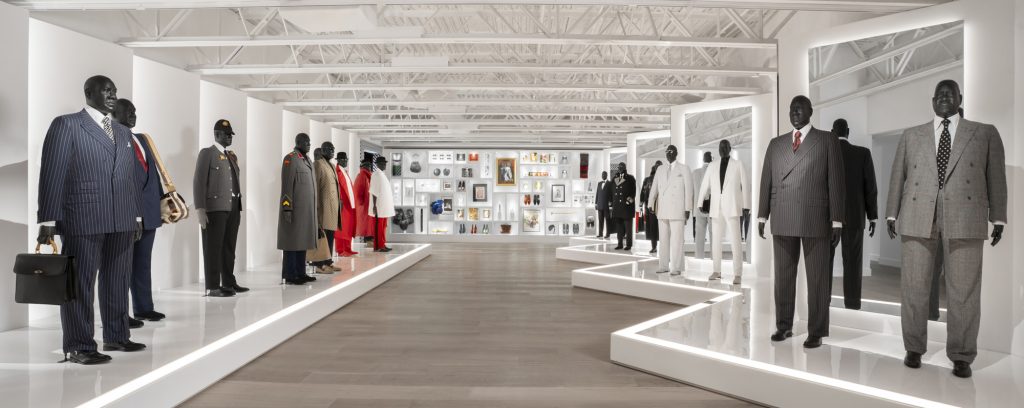
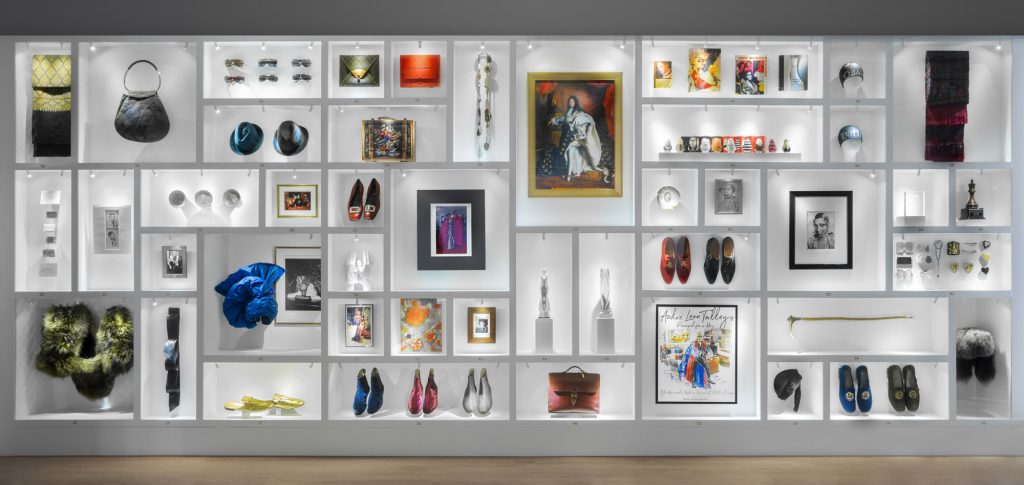
In addition to the luxurious, regal tunics, capes and roomy balmacaans of Dapper Dan, Prada, Manolo Blahnik and Vivienne Westwood, the exhibit features several garments by a designer perhaps less familiar to a more general audience: the American-born Ralph Rucci, a designer whose clothes Washington Post fashion critic Robin Givhan once said, “ooze luxury.” Upon meeting Talley, Rucci — “in one fell swoop,” Talley says — cut 17 couture caftans for the fashion editor, at least a half a dozen of which are on display here in all their billowy splendor and refinement.
“Luxury is larger than life,” Talley says in his memoir A.L.T.
SCAD FASH’s exhibit André Leon Talley: Style is Forever captures that larger-than-lifeness, showcasing an extraordinary career in fashion and self-fashioning.
::

Robert Stalker is an Atlanta-based freelance writer who writes about modern and contemporary art.
STAY UP TO DATE ON ALL THINGS ArtsATL
Subscribe to our free weekly e-newsletter.

PLEASE SUPPORT ARTSATL
Your Gift Sustains the Coverage You Count On!
Related Posts